
The Sydney summer fishery is pelagic season. Yellowtail kingfish hold under the buoys at Clarke and Shark Islands. Mahi mahi switch on around the Fish Attracting Devices off the Heads. Marlin and yellowfin run on Browns Mountain. Bonito hits the wash on every Tasman-facing ledge. Mulloway move through the harbour on the new-moon evenings. Squid jig under the bridge lights at night. Dusky flathead hold on the inner-harbour sand flats. This guide is the eight species that carry the warm-months calendar, the platforms they hold on, and the verbatim NSW DPIRD bag and size numbers for each.
From October through April the Sydney inshore catch record flips. The cold-water species that defined the winter taper off as the East Australian Current strengthens and inshore water climbs from an August trough around 17 degrees Celsius back through 19 degrees in October and a February peak near 23 degrees. The species that fill the gap are the warm-water pelagics — yellowtail kingfish in the harbour mooring fields, mahi mahi on the offshore FADs, marlin and yellowfin on the wider shelf and Browns Mountain. The day a Sydney angler stops chasing winter tailor and starts chasing summer kings is roughly the day inshore water climbs back through 19 degrees, on average the last week of October.
The harbour pattern carries most of the inshore calendar — yellowtail kingfish under the buoys and on the rocks inside the Heads, summer mulloway on the Clontarf Drop-Off around the new moon, squid jigging on the kelp at Camp Cove, Wy-ar-Gine and the Spit Bridge lights. The wash pattern carries the open coast — bonito on the Tasman-facing ledges at Hornby Light and the Fairfax platforms below North Head. The offshore pattern carries the deep water — mahi on the FADs, marlin and yellowfin on Browns Mountain. Dusky flathead sits across the inner harbour on the sand flats at Rose Bay, Balmoral and Clontarf. Each species below reads off its own forecast inputs and carries its own NSW DPIRD bag-and-size rule.
The Sydney summer does not behave as a single block. October is a shoulder month with autumn pelagics returning. November through March is the warm-water core. April is the shoulder back into the cold-water pool. The species that peak in each month are not the same.
Juvenile kingfish showing in the mooring fields. Bonito arriving on the wash. Southern calamari switching on over the kelp. Inshore water climbing back through 19 degrees by month end.
Yellowtail kingfish filling the mooring buoys. Mahi mahi on the FADs from mid-month. First black marlin on Browns. Bonito at peak on the dawn wash at Hornby and the Fairfax.
Kingfish at peak surface activity on Halco Roosta poppers at dawn. Dusky flathead on the sand flats. Mahi consistent on the FADs. Mulloway on the new moon at Clontarf.
Yellowfin tuna arriving on Browns from mid-month. Marlin at peak — black, striped and the occasional blue. Kingfish consistent at the Heads. Squid strong under the Spit Bridge lights.
Yellowfin at peak on Browns. Marlin still running. Kingfish in the harbour. Watson's leaping bonito on the wash. Inshore water at its annual peak near 23 degrees.
Mahi still on the FADs. Yellowfin on Browns. Mulloway on the new moon at Clontarf. Flathead on the sand flats. Squid consistent on the kelp.
Big mulloway on the run-in off Clontarf and around Roseville. Late kingfish still showing inside the Heads. Watson's leaping bonito in Pittwater. First whaler sharks at Crater Bay. Water dropping back through 21 degrees.
The pattern most weeks is one species at peak in the harbour and a different species at peak offshore. A Sydney angler with one morning a week to fish picks the platform based on swell and wind — harbour mooring fields and the inside of the Heads in any decent forecast, offshore FADs and Browns Mountain on stable light-easterly days. The companion tides and swell guide covers the forecast read.
Yellowtail kingfish (Seriola lalandi) is the species that defines the Sydney summer for most harbour anglers. The fish hold structure — moorings, buoys, reef pinnacles and the rocky points inside the Heads. From November through April the resident harbour population is supplemented by larger run-fish on the East Australian Current. Three-kilogram fish are routine through the mooring fields. Metre-plus fish — locally called hoodlums — push above 12 kilograms and are caught off the rocks at the Heads each summer. Craig McGill of Fishabout describes the rocky south point of Camp Cove as offering Sydney Harbour's best shore-based access to quality kingfish.
The inner harbour is the prime kingfish water. The buoy fields between Rose Bay and Garden Island — Clarke Island, Shark Island and the navy buoy belt — produce consistent fish through November to April. Bradleys Head holds resident fish year-round. Sow and Pigs reef in the middle channel sits in front of Hornby Light and produces metre-plus fish on the high-tide turn. Bottle and Glass Point at the foot of Vaucluse holds fish on the southerly. Spring Cove and Cannae Point at the back of North Head produce kingfish on metals and live bait — note the Manly Little Penguin Critical Habitat covers this water with anchoring restrictions in Area A sunset to sunrise during the May-to-February breeding window, plus a four-knot speed limit year-round. The land-based standouts are Camp Cove's south point, Hornby Light, the Fairfax ledges below North Head and Gap Bluff.
The McGill default is a live yakka or live squid downrigged near structure on a 10 to 15 kilogram rod paired with a 6000 to 8000 spinning reel loaded with 40 to 50 pound braid. The leader is 50 to 80 pound fluorocarbon to a 7/0 to 9/0 octopus hook. A small sabiki drops off the side first to collect yakka from any pylon. The bait is pinned through the nose and dropped to working depth on a downrigger. At dawn when fish bust up on baitfish the rod swaps to a surface popper — the Halco Roosta 80, the Cultiva Tango Dancer and the Rapala Skitter Pop are the local defaults. The first run is met with locked-up drag because the fish runs immediately for structure.
The 65-centimetre minimum and 5-bag both held over the 2024-25 review. Fish under 65 centimetres are released. On charter boats the right-side pectoral fin must be removed at the base before the fish is taken off the vessel — the rule applies to kingfish along with snapper, yellowfin tuna, southern bluefin tuna and the three marlin species and is a charter-monitoring measure rather than a general recreational requirement. The species sits inside the Sydney Harbour dioxin advice east of the Bridge — 150 grams per person per month. West of the Bridge is catch and release.
Mahi mahi (Coryphaena hippurus), also called dorado, is the surface pelagic that arrives off Sydney in November and runs through April. The fish hold structure on the open ocean — drifting weed mats and log debris in the offshore current, and most importantly the Fish Attracting Devices that NSW DPI deploys each spring. The Sydney-area FAD network sits offshore of the Heads and along the Maroubra-Bondi line. The fish run small to medium through December and grow heavier through January and February. Five-kilogram bulls are routine. Ten-kilogram fish are caught each summer.
The marquee Sydney summer mahi water is the FAD network. The Sydney Harbour FAD sits roughly four nautical miles east of the Heads. The Sydney East FAD sits off the Maroubra-Bondi line at a similar distance. NSW DPI publishes the current FAD coordinates each season and the positions drift over time — confirm the current deployment on the NSW DPI Fish Aggregating Devices page before departure. The wider field beyond the FADs holds occasional fish on drifting weed mats along the inshore edge of the East Australian Current.
The default approach is to troll a spread of small skirted lures around the FAD until the first hook-up locates the school, then drop a sabiki on a short rod for live bait. The troll spread is two or three small skirts at five to seven knots — six to eight inches in pink, blue-and-white or lumo patterns. The hook-up rig is a 24 to 37 kilogram trolling outfit with 50 to 80 pound braid and a 60 to 100 pound fluorocarbon leader. Once a fish is hooked the boat slows — mahi school behind the hooked fish and the rest take live or pilchard bait while one rod stays loaded.
The 60-centimetre minimum and the 10-fish-with-one-over-110-centimetre rule are unchanged in the 2024-25 review. The Sydney FADs are deployed under NSW DPI's recreational fishing licence program — no permit is required to fish them, but the standard boating-safety and EPIRB rules apply on the offshore run.
Bonito (Sarda australis) and Watson's leaping bonito (Cybiosarda elegans) are the warm-water schooling pelagics that hit the Sydney wash from November through April. Bonito is the larger of the pair — a fish of one to three kilograms running in dense schools along the Tasman-facing ledges. Watson's is smaller and faster at 500 grams to a kilogram, taken most often on a small trolled skirt inside the Heads. Both fish a strong dawn bite on small metals worked fast across the wash. Both are dark-fleshed and most often used as fresh bait rather than eaten directly.
The marquee bonito water is the Tasman-facing wash. The Fairfax ledges below North Head, Hornby Light, Gap Bluff and the Maroubra ledges produce schooling bonito at dawn through the warm months. Inside the harbour the Sow and Pigs reef and the entrance corners at Bottle and Glass produce occasional fish on the run-in. Watson's leaping bonito is more often taken on the troll — small skirts pulled inshore around the Sow and Pigs, Bottle and Glass and the wider Long Reef and Pittwater water at four to six knots. Long Reef sits inside an aquatic reserve — line fishing for finfish is permitted but invertebrate collection is not.
The shore bonito rig is a 30 to 40 gram metal slug on a 9 to 10 foot rock rod rated 12 to 15 kilograms paired with a 6000 to 8000 spinning reel and 30 to 40 pound braid. The leader is 30 to 40 pound mono running roughly two metres. The lure is a Surecatch Knight or equivalent in chrome — Spanyid Raider and Halco Twisty also fish well. The retrieve is fast and straight. The bite often comes in the first 30 seconds as the lure clears the wash. Watson's leaping bonito on the troll takes a four to six inch skirted lure on a 10 to 15 kilogram trolling outfit at five knots — the rig is the same as the inshore tuna troll, scaled down.
The 10-fish bag is the operative number for Australian bonito under the 2024-25 review. Watson's leaping bonito sits outside the listed species table and defaults to the general 20-per-day cap that applies to any saltwater species not specifically listed. Small fish under 30 centimetres are often released as they make poor bait. The schooling bite can fill a tub fast — keeping only what is needed is the standard practice on the Sydney wash.
Black marlin (Istiompax indica), blue marlin (Makaira nigricans) and striped marlin (Kajikia audax) are the three billfish species recorded off Sydney each summer. The marquee water is Browns Mountain (officially Woolnough Knoll) — a seamount whose twin peaks rise roughly 180 metres above a 440–600 metre seafloor, sitting around 22 nautical miles east of Sydney and 19 nautical miles off Botany Bay heads. Browns sits in Commonwealth waters outside the three nautical mile state limit, but recreational fishing for the Eastern Tuna and Billfish Fishery species is managed by NSW DPI rather than AFMA. The black marlin season runs from late November through March. Striped marlin concentrates from January through April. Blue marlin is the occasional bonus.
Browns Mountain is the standout. The Twelve Mile and the wider Continental Shelf line are the alternative marks. The Twelve Mile sits roughly 12 nautical miles east of the Heads and produces black marlin and yellowfin on the shoulder of the shelf. The wider current line — sometimes 30 to 40 nautical miles offshore — produces blue marlin on the warmer-water days when the East Australian Current pushes wide. The water temperature edge is the operating signal — a fishable Browns day reads a clean blue-water edge against a colder green-water inshore current.
The standard Sydney marlin approach is a switched-bait sequence — trolling skirted lures to raise a fish, then dropping a live or rigged dead bait into the spread. The trolling outfit is a 24 to 37 kilogram stand-up rod paired with a 50 to 80 pound class lever-drag reel and 80 to 130 pound mono mainline. The bait switch is a live yellowtail kingfish or a swimming rigged stripey on a 10/0 hook. The boat runs a four-lure spread at seven to nine knots until a fish raises behind the lures, then the lures are pulled and the bait dropped. The bite on the live bait is a sustained run — feeding line for ten to fifteen seconds before locking the drag is the standard practice.
Tag-and-release is the Sydney game-fishing cultural norm. The NSW DPI Game Fish Tagging Program tag is the only billfish tag recognised in GFAA tournaments, and most game crews release marlin under the program. Release is encouraged rather than a legal mandate — a fish kept inside the bag limit is legal under the 2024-25 rule set. On charter trips the right-side pectoral fin must be removed at the base before the fish leaves the boat, a charter-monitoring measure that also applies to yellowfin and southern bluefin tuna, kingfish and snapper.
Yellowfin tuna (Thunnus albacares) is the heavyweight summer offshore species in Sydney. The fish runs from mid-January through April on Browns Mountain and along the Continental Shelf line east of Sydney. A typical Sydney fish is 30 to 50 kilograms. Ninety-kilogram-plus fish are caught each summer on the wider shelf. The flesh is the standout table fish of the Sydney offshore catalogue. The bite window is dawn and dusk, with the standout days falling on stable light-easterly weather when the East Australian Current pushes a clean blue-water edge close to the shelf.
Browns Mountain is the standout. The Continental Shelf line — running roughly 20 to 25 nautical miles offshore at the longitude of Sydney — produces yellowfin from mid-summer onward. The Twelve Mile produces shoulder-season fish from late spring. Albacore is taken inshore of the yellowfin water and is often the first warm-water tuna species recorded each summer. Southern bluefin runs cooler — the bluefin fishery off Sydney peaks from May through August.
The standard yellowfin approach is a cube trail dropped down-current of the boat to bring the school up, then a single live or dead pilchard floated back into the trail on a circle hook. The cubing outfit is a 15 to 24 kilogram rod paired with a 50 pound class reel loaded with 50 to 65 pound braid and a 60 to 80 pound fluorocarbon leader. The hook is an 8/0 to 10/0 circle. A handful of cubed pilchards is dropped every 30 seconds to maintain the trail. The first run is sustained — yellowfin fights routinely run 30 to 60 minutes from hook-up to gaff on a 24 kilogram outfit. Trolled skirts work as an alternative — the same four-lure spread as the marlin troll at seven to nine knots will raise yellowfin on the deeper line.
The combined tuna bag is the operative number. The 90-centimetre split is a tuna-wide rule — a 90-centimetre yellowfin weighs roughly 20 to 25 kilograms. On charter trips the right-side pectoral fin must be removed at the base from any retained yellowfin or southern bluefin before the fish leaves the boat, a charter-monitoring requirement that does not apply to private vessels. The standard charter practice is to clip on the boarding ladder and tag-and-release any fish above immediate eating needs.
Mulloway (Argyrosomus japonicus), the species also called jewfish in Sydney, runs a different summer pattern from the winter one. The winter fishery is quality — fewer fish, larger size, holding deep on the Clontarf Drop-Off. The summer fishery is volume — fish move through the estuaries and into the harbour on warm humid evenings around the new moon. McGill's standing description of the window is the first two hours of a run-in after a moon-phase change in warm humid summer conditions. That window accounts for a disproportionate share of the summer mulloway catch in Sydney inshore waters.
The marquee harbour summer mulloway water is the Clontarf Drop-Off on the run-in tide. The bottom falls from 15 to 70 feet over a 50-metre run, concentrating fish on the tide change. The Spit Bridge holds fish on a live squid at night — the pylons and the strong tidal flush make it a known mulloway corridor through summer. The Roseville Bridge pylons hold fish on a similar pylon-and-flush pattern. The Bradleys Head wall produces fish on the run-in. Outside the harbour, the deep gutters at Maroubra and the channel water inside Botany Bay produce summer mulloway through the warm months.
The mulloway rig is a 10-pound braid main line on a 4000 to 6000 reel with a 25-pound fluorocarbon leader running two metres to a 5/0 to 7/0 octopus hook. The bait is a live squid floated under a balloon on the run-in, or a fresh-killed squid head fished hard on the bottom in the deeper holes. The shore angler casts from the Clontarf foreshore onto the edge of the drop. The boat angler anchors up-current and lets the bait drift back. The bite is a long heavy pull. Striking is done by letting the rod load before lifting — a hard strike pulls the hook on the soft mouth.
The 70-centimetre minimum and 1-per-day rule was tightened from the previous 45-centimetre, 2-fish rule and reflects population status. The species is slow-growing — a 70-centimetre fish is roughly five years old. Fish under 70 centimetres must be released. The Sydney Harbour dioxin advice applies to mulloway taken east of the Bridge — 150 grams per person per month.
Southern calamari (Sepioteuthis australis) and giant cuttlefish (Sepia apama) are the inshore cephalopods that switch on in Sydney from late October through early autumn. The fish hold on kelp beds at four to ten metres of water, on the edges of harbour beaches and around the bridge lights at night. The technique is a Yamashita jig cast over the kelp and worked back in short upward sweeps. The bite is a tightening of the line. The flesh is the standout table item of the inshore catalogue and the rigged squid is the operative live bait for kingfish, mulloway and john dory.
The harbour squid water sits on the kelp beds at Wy-ar-Gine Point — locally called Jonnies Corner, the outermost south-east point of the headland — at Camp Cove on both ends of the beach, and on the kelp around the Spit Bridge lights at night. The bridge-light pattern is strongest in mid-summer when the warm humid evenings pull baitfish under the lights. The kelp pattern is steadier through the season — a clean kelp bed in three to six metres of water with a sand edge is the textbook geometry. Pittwater and Botany Bay also produce summer squid but the harbour-internal water is the operationally important one.
The squid rig is a 7 to 8 foot light spinning rod rated 2 to 5 kilograms paired with a 2500 spinning reel loaded with 10 pound braid. The leader is 15 pound fluorocarbon running roughly a metre. The jig is a Yamashita Egi 3.0 or 3.5 in pink, orange or natural-prawn pattern. The retrieve is a cast over the kelp, a 10-second sink, then short upward sweeps of the rod tip followed by a five-second pause. The bite often comes on the pause. The hookset is a smooth lift.
North (Sydney) Harbour Aquatic Reserve and Long Reef Aquatic Reserve are finfish-only. NSW DPI verbatim: "Long Reef and North (Sydney) Harbour aquatic reserves for finfish (bony fish and cartilaginous fish) only. Fishing by any method for any invertebrates, such as cuttlefish and squid, is not permitted."
That removes Grotto Point, Forty Baskets, Reef Beach and the entire North Harbour basin from Manly Point west to Dobroyd Head from the squid map. Long Reef headland is also out. Wy-ar-Gine's outermost south-east point sits outside the reserve and is the textbook legal squid mark inside the harbour. Camp Cove and the Spit Bridge lights are also outside the reserve. Grotto Point — historically famous as a squid mark and referenced in older McGill content — is inside the reserve and is no longer fishable for squid.
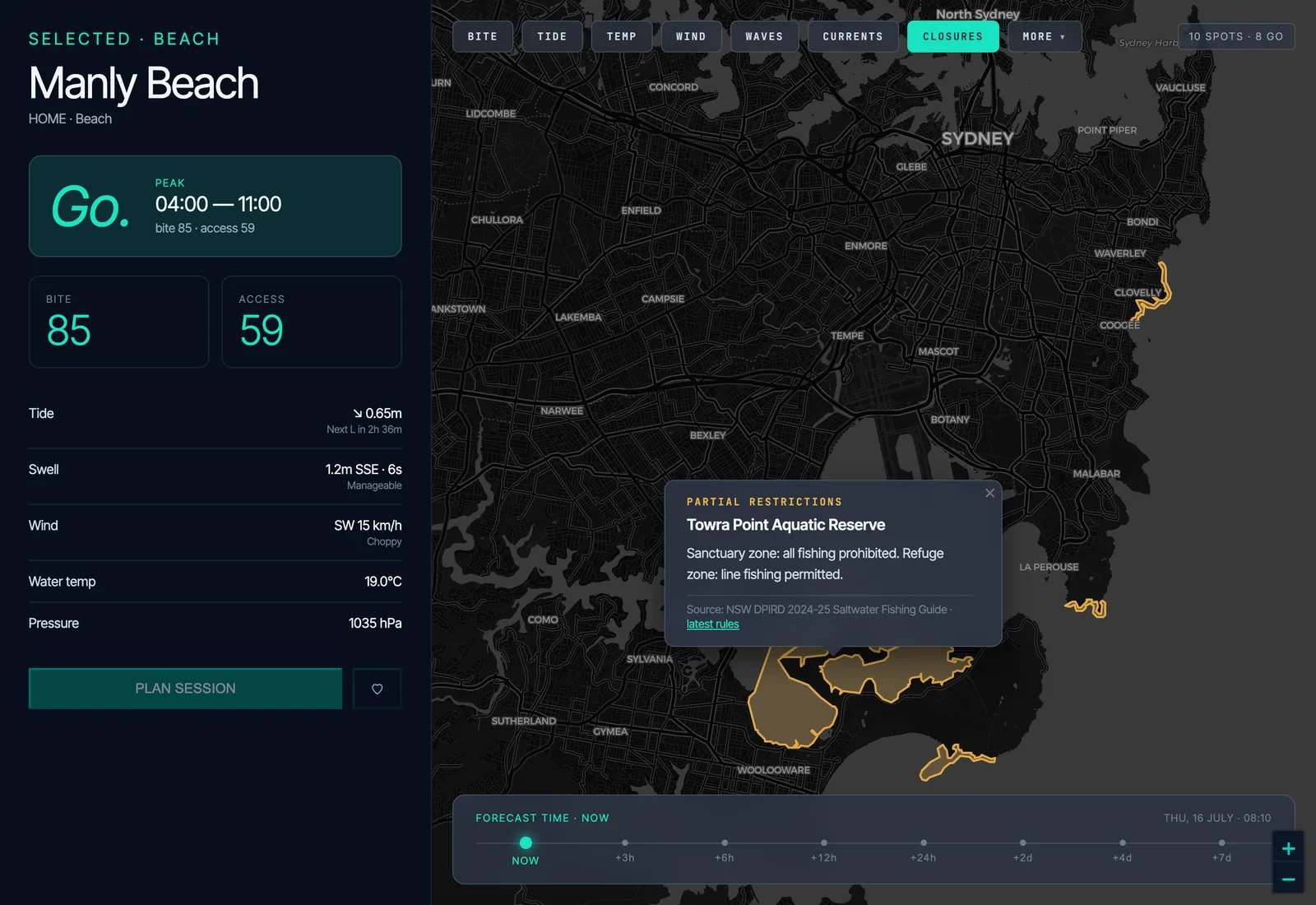
The full reserve boundaries are mapped in the aquatic reserves guide.
Dusky flathead (Platycephalus fuscus) is the species that fishes the inner-harbour sand flats through the warm months. The fish is an ambush predator — it buries in the sand with only the eyes exposed and inhales any small baitfish or shrimp that passes within a metre. The Sydney harbour flathead average is one to two kilograms. Three-kilogram-plus fish are caught each summer on the wider sand flats. The standout shore catch is a fish over the 70-centimetre slot — those big breeding females are taken on live bait at night around the Roseville and Bradleys Head edge water and are released under the slot rule.
The Rose Bay sand flats — fished from the wading edge at Lyne Park or drifted in shallow water from a boat — are the textbook Sydney harbour flathead water. Balmoral's sand strip and the Edwards Beach corner produce drift flathead. Clontarf's sand strip outside the Drop-Off holds fish through summer. The Cobblers Beach sand drift at 15 feet is the McGill flathead water on the north shore — McGill notes old military trucks dumped offshore provide structure that concentrates fish. The Forty Baskets sand strip and the sand edges inside Pittwater and Botany Bay fish the same pattern.
The flathead rig is a 7 foot light spinning rod rated 2 to 4 kilograms paired with a 2500 spinning reel loaded with 8 to 10 pound braid. The leader is 12 to 15 pound fluorocarbon. The lure is a 3 to 4 inch soft plastic — a paddle-tail or a curl-tail — on a 1/8 to 1/4 ounce jighead. The retrieve is a hop-and-pause along the sand bottom. The bite often comes on the drop. The live-bait alternative is a small live yellowtail or a live nipper drifted on a running ball sinker. The nipper rule is the operationally important one — the Sydney Harbour shoreline is an Intertidal Protected Area where pumping nippers is prohibited. The exception is the narrow strip from Manly Point south to Forty Baskets Beach. Outside that strip nippers must be bought from a tackle shop.
The 36-70 centimetre slot is the operative rule. Fish under 36 centimetres and fish over 70 centimetres must be released. The large fish above the slot are almost exclusively breeding females and the slot rule protects the spawners. The species sits inside the Sydney Harbour dioxin advice east of the Bridge — 150 grams per person per month combined across all Sydney Harbour seafood.
Most of the Sydney summer catch is taken on one of three rigs. A harbour-and-offshore angler who carries the gear for all three is set up for every species in this guide.
The live-bait outfit is the workhorse of the Sydney summer harbour. The rod is a 6 to 7 foot medium-heavy boat rod rated 10 to 15 kilograms. The reel is a 6000 to 8000 spinning or a 50 size overhead. The line is 40 to 50 pound braid with a 50 to 80 pound fluorocarbon leader running two metres to a 7/0 to 9/0 octopus hook. A live yakka or live squid is pinned through the nose. The downrigger drops the bait to working depth — 30 to 50 feet over Sow and Pigs, 15 to 50 feet on the Clontarf Drop-Off, just under the surface around the Clarke Island moorings. The same outfit fishes for mulloway at night on the Drop-Off — only the depth and the bait change.
The cube trail is the operative method for both yellowfin and mahi. The cubing outfit is a 15 to 24 kilogram rod paired with a 50 pound class reel loaded with 50 to 65 pound braid. The leader is 60 to 80 pound fluorocarbon to an 8/0 to 10/0 circle hook. A cubed pilchard is dropped every 30 seconds down-current of the boat. The first hook-up is the prompt — the rest of the school takes live or dead bait floated into the trail. For mahi the technique is a small troll spread of skirts around the FAD until the first hook-up locates the school, then a sabiki drops off the side for live bait. The sabiki also loads the live tank at the wharves before the run offshore.
The popper rig fishes for kingfish busting up on baitfish at dawn and for Watson's leaping bonito on the inshore troll. The popper outfit is a 9 to 10 foot rock or boat rod rated 10 to 15 kilograms paired with a 6000 to 8000 spinning reel and 30 to 40 pound braid. The lure is a Halco Roosta 80, a Cultiva Tango Dancer or a Rapala Skitter Pop in chrome or blue-and-silver. The retrieve is a hard sweep with a long pause — a kingfish often takes on the pause. The Watson's troll is a four to six inch skirt pulled at four to six knots on a lighter 10 kilogram outfit — the same skirt the mahi troll uses, scaled down. The Sow and Pigs reef and the wider Long Reef troll line are the standout Watson's marks.
The cross-reference below maps each summer species to the platforms it holds on. Each row references one species. Full spot detail for every platform is in the Sydney harbour fishing guide. Aquatic-reserve and consumption-advice overlays are in the aquatic reserves guide.
| Species | Primary Sydney platforms | Notes |
|---|---|---|
| Yellowtail kingfish | Clarke Island, Shark Island, Sow and Pigs, Bradleys Head, Bottle and Glass, Camp Cove south point, Hornby Light, Spring Cove, Cannae Point | Live yakka or squid downrigged; Halco Roosta at dawn |
| Mahi mahi | Sydney Harbour FAD, Sydney East FAD, Sydney North and South FADs | Small skirts then sabiki + live bait. Confirm current FAD coords |
| Bonito | Fairfax (North Head), Hornby Light, Gap Bluff, Long Reef, Maroubra | 30-40 g metals at dawn on the wash |
| Watson's leaping bonito | Sow and Pigs, Bottle and Glass, Long Reef troll line, Pittwater inshore | Small skirts trolled inshore at 5 knots |
| Marlin | Browns Mountain, the Twelve Mile, Continental Shelf line | Troll then switched bait. Pec clip + tag-and-release norm |
| Yellowfin tuna | Browns Mountain, Continental Shelf line, the Twelve Mile | Cube trail + live bait. Pec clip required |
| Mulloway | Clontarf Drop-Off, Spit Bridge, Roseville Bridge, Bradleys Head, Maroubra gutters | New moon + run-in at night on warm humid evenings |
| Southern calamari / cuttlefish | Wy-ar-Gine Jonnies Corner, Camp Cove, Spit Bridge lights | Yamashita over kelp. Not at Grotto Point, Forty Baskets, Cabbage Tree Bay, Long Reef |
| Dusky flathead | Rose Bay flats, Balmoral, Clontarf sand strip, Cobblers Beach, Forty Baskets sand | 3-4 inch SP on light jighead. Buy nippers — IPA prohibits pumping |
The platform names above are not all open to keeping every species — some sit inside aquatic reserves with collection restrictions or fishing prohibitions, and some sit inside the Sydney Harbour dioxin advisory area east of the Bridge. The aquatic reserves guide covers every reserve boundary with the verbatim rule text.
Three overlays are operationally important through the warm months. The squid and cuttlefish prohibition inside North (Sydney) Harbour Aquatic Reserve and Long Reef Aquatic Reserve is the rule cited verbatim in the squid section above. The Sydney Harbour Intertidal Protected Area prohibits the collection of every invertebrate — including saltwater nippers — across the entire harbour shoreline, with the single exception of the narrow strip from Manly Point south to Forty Baskets Beach. The dioxin consumption advice covers all seafood taken east of the Sydney Harbour Bridge — 150 grams per person per month combined. Cabbage Tree Bay at Shelly Beach is a no-take aquatic reserve where no fishing of any kind is permitted. The boundaries and verbatim rule text are in the aquatic reserves guide. The lifejacket law for declared LGAs is in the rock-fishing safety guide. The summer rule for the rock platforms is the same as the winter one — wear the jacket regardless of how the platform looks at the carpark.
Specific tactical insights from working Sydney anglers and guides, sourced from the Doc Lures podcast.
The questions readers and members ask most often about this guide.
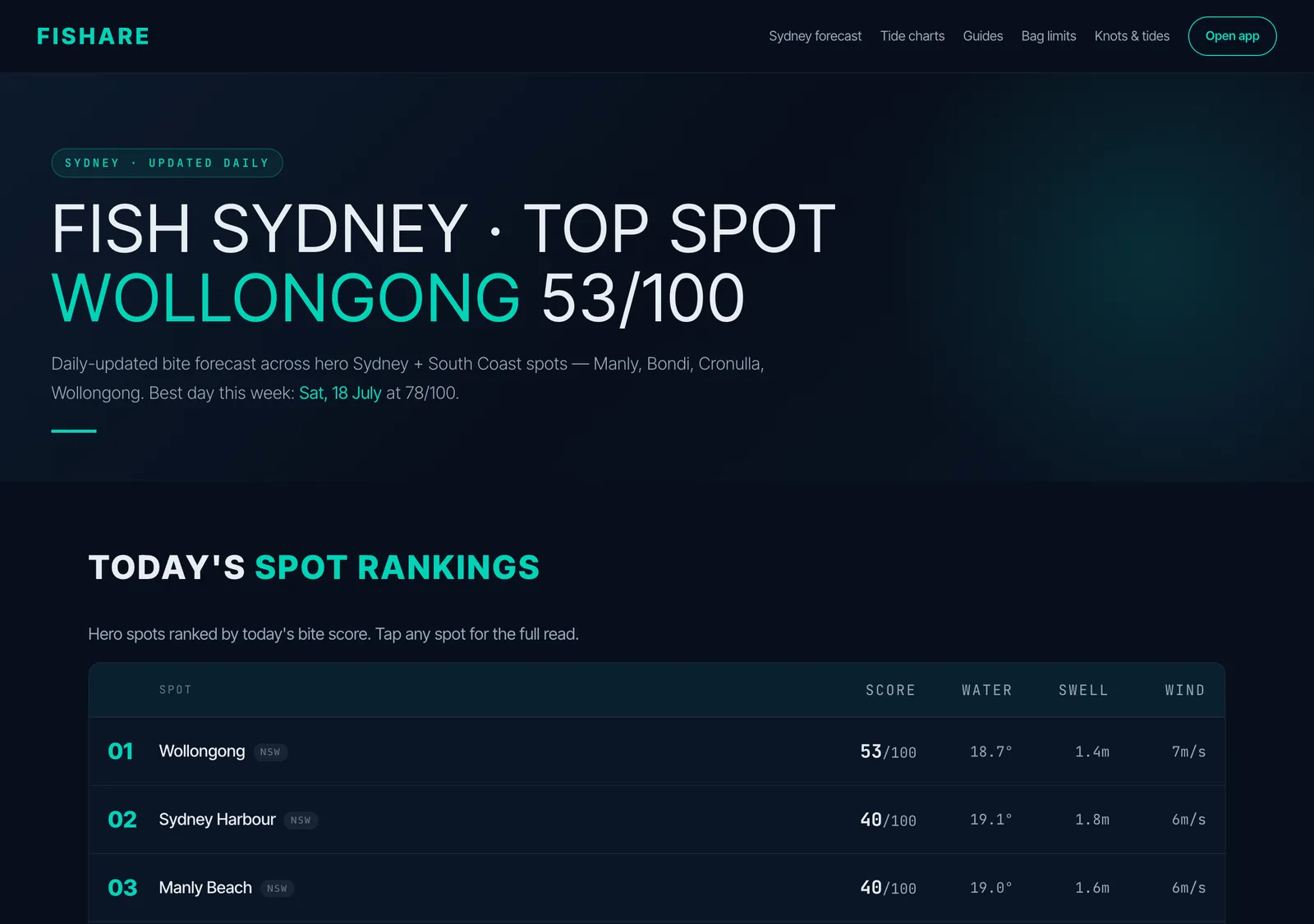
The Sydney forecast page scores every hour of the next 14 days for the platforms you fish — bite probability paired with access probability, all sitting under the BOM and MHL overlay. Save the kingfish moorings, the squid kelp and the Clontarf Drop-Off and the matrix fills in.
Every bag, size and possession number above is from the NSW DPIRD 2024-25 Recreational Saltwater Fishing Guide PDF, verified against the document in May 2026. Aquatic-reserve and intertidal-protected-area rules are sourced from the NSW DPI marine-protected-areas pages. FAD coordinates and deployment status are sourced from the NSW DPI Fish Aggregating Devices page. Local platform behaviour is consistent with long-standing Sydney harbour and offshore practice and is cross-referenced to the flagship harbour guide.
Last verified: 2026-05-20. Bag and size limits change. The current NSW DPI saltwater bag and size limits page is the operative reference for any session — confirm before keeping a fish. FAD coordinates drift between deployments — confirm on the NSW DPI FAD page before departure. The lifejacket law applies on every declared Sydney rock platform regardless of which species is in scope.