Every NSW DPI aquatic reserve in the Sydney metro and adjacent coast, with the verbatim 2024-25 rule for each one, a plain-English summary of what you can and can't do, and a nearby legal alternative when the answer is "nothing." Eleven reserves from Palm Beach down to Shellharbour.
12-minute read · Verified May 2026 · NSW DPIRD 2024-25 rule set
Why these reserves exist
NSW has declared aquatic reserves under the Fisheries Management Act 1994 since the early 1980s. Each reserve targets a habitat type — kelp reef, intertidal platform, seagrass, mangrove estuary — that the state considers under-represented in the broader fishery. The rules are not standardised. Some prohibit every form of take. Some allow line fishing but ban invertebrate collection. Two of the largest Sydney reserves are zoned, meaning different rules apply to different parts of the same reserve.
For an angler this matters because four reserves sit inside what most people would call "Sydney's normal fishing water." A boat drifting from Manly Cove toward Dobroyd Head is inside North Harbour Aquatic Reserve the whole way. A rock-fisher walking from Bronte to Coogee is inside Bronte-Coogee Aquatic Reserve from end to end. The rules differ across that one walk. The single best habit is to know the boundary and rule of any reserve you regularly fish near, and to mirror NSW DPI's language rather than the half-remembered version on a forum thread from 2014.
This guide pulls the rule text directly from the NSW DPIRD 2024-25 Recreational Saltwater Fishing Guide (pages 76 to 77) and the relevant DPI reserve pages. Every reserve has its location, area where published, declaration year where published, the verbatim NSW DPI rule, the practical translation, and a nearby legal spot to fish instead.
Live closures overlay on the Fishare map
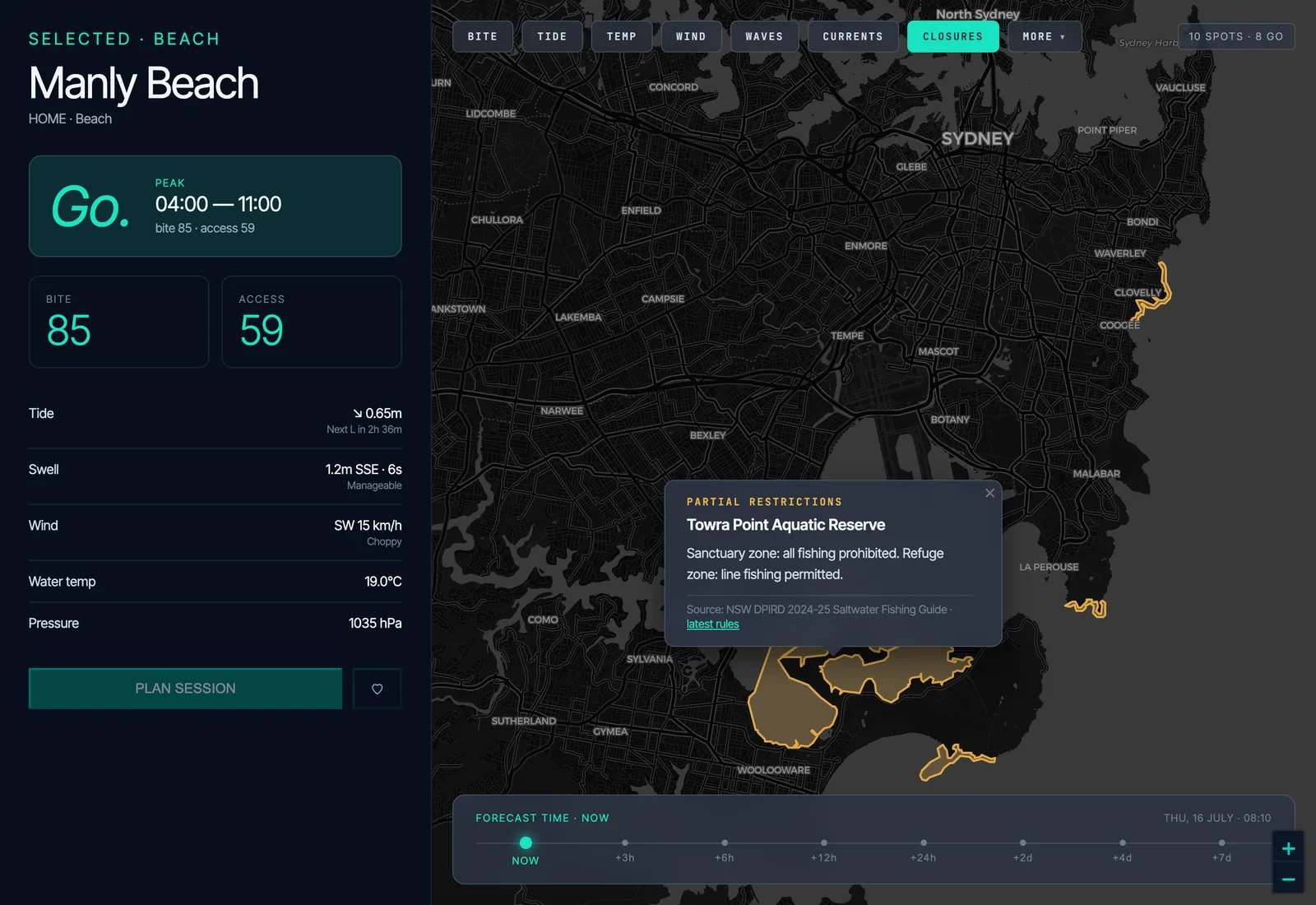
Open the Fishare map to see every reserve drawn as a polygon, colour-coded for rule type. The same data file that powers this guide drives the overlay, so the boundaries you read here match the ones on screen.
Every reserve drawn as a polygon on the Fishare map, with each rule on tap.
Three are fully no-take. Two permit line fishing for finfish only. Five permit line and spear for finfish with limited invertebrate exemptions. One is internally zoned with different rules in different sub-areas. Click any reserve to jump to its full rule set.
No-take — all fishing prohibitedFinfish only or partial restrictionMixed zoning — depends on sub-zone
Bouddi Marine Extension, sometimes listed alongside Sydney's reserves, sits on the Central Coast inside Bouddi National Park and is administered separately. It is not part of the metro DPI aquatic reserve network covered here.
1. Cabbage Tree Bay (Shelly Beach, Manly)
No-take · All fishing prohibited
Cabbage Tree Bay is one of three fully no-take aquatic reserves in this guide. Walking the rocks with a rod is enough to draw an inspection. The bay is one of the best snorkelling sites in Sydney — bring a mask instead.
Cabbage Tree Bay Aquatic Reserve
Shelly Beach, Manly · Approx. 20 ha · Declared 2002
NSW DPI rule (verbatim)
All fishing and collecting is prohibited.
In plain English. No line fishing. No spearfishing. No collecting marine plants, marine animals or empty shells, alive or dead. The rule covers the water from the south end of Manly Beach around the headland to the north end of Shelly Beach Headland.
Why it matters. Cabbage Tree Bay is the showcase result of a Sydney no-take reserve. iNaturalist's species list for the bay runs past 150 fish species, including resident Eastern Blue Gropers, giant cuttlefish in winter, wobbegongs in the kelp and a long-resident green turtle. The species count is roughly what the rest of the eastern Sydney coast looked like before fishing pressure removed the bigger and slower fish.
Legal alternative nearby. Walk five minutes north onto Manly Beach proper for beach fishing under general NSW rules. Or fish the rock platforms of Queenscliff Headland to the north of Manly Beach, outside the reserve. Both fall under the Northern Beaches Council lifejacket law for any rock platform.
Rule type
No-take
Source
NSW DPIRD Saltwater Fishing Guide 2024-25, pp. 76-77
Sydney's smallest fully protected aquatic reserve. Easy to overshoot if you are launching from the public ramp at Burraneer Bay — the boundary runs across a stretch of mid-estuary that looks like ordinary fishable water from a kayak.
Shiprock Aquatic Reserve
Port Hacking, near Lilli Pilli · Small estuarine reserve
NSW DPI rule (verbatim)
All fishing and collecting is prohibited.
In plain English. Same rule as Cabbage Tree Bay. No line, no spear, no nets, no collection of any marine plant or animal. The reserve protects a small but biologically important section of Port Hacking — a rocky outcrop with hard-substrate communities that the surrounding sand-dominated estuary lacks.
Why it matters. Shiprock is the only formally protected hard-substrate site inside Port Hacking. Resident species include eastern blue groper, blue-throated wrasse and small reef fish that depend on the boulders for cover. The reserve is well known to local divers as a winter cuttlefish aggregation site.
Legal alternative nearby. The rest of Port Hacking outside the Shiprock boundary fishes well under general NSW rules — Gunnamatta Bay and the entrance flats around Bundeena. Bream, dusky flathead and luderick are the standard targets. Land-based access at the boat ramp near Lilli Pilli puts you within a short paddle of fishable water outside the boundary.
Rule type
No-take
Source
NSW DPIRD Saltwater Fishing Guide 2024-25, pp. 76-77
Outside the strict Sydney metro, but listed alongside the Sydney reserves in the DPI guide because it draws regular weekend traffic from the south.
Bushrangers Bay Aquatic Reserve
Bass Point, Shellharbour
NSW DPI rule (verbatim)
All fishing and collecting is prohibited.
In plain English. Same baseline as Cabbage Tree Bay and Shiprock. The bay is widely used for snorkelling and scuba training and the no-take rule is one reason the inshore fish assemblage there remains visibly intact.
Legal alternative nearby. The outer rock platforms of Bass Point outside the bay boundary fish under general NSW rules. The Wollongong side has open beach and rock fishing the length of the coast to the north. Bass Point falls under Shellharbour Council, which is in the Rock Fishing Safety Act zone south of Sydney — lifejacket is mandatory on rock platforms.
Rule type
No-take
Source
NSW DPIRD Saltwater Fishing Guide 2024-25, pp. 76-77
Finfish only · No invertebrate take · No spearfishing
The largest reserve sitting inside Sydney's regular fishing water. The entire basin from Manly Cove west to Dobroyd Head is covered. Approximately 260 hectares. Many older fishing guides predate the reserve and still describe Grotto Point and Manly Wharf as squid spots — under the current rule they are not.
North (Sydney) Harbour Aquatic Reserve
Inside Sydney Heads, north shore · Approx. 260 ha
NSW DPI rule (verbatim)
Long Reef and North (Sydney) Harbour aquatic reserves for finfish (bony fish and cartilaginous fish) only. Fishing by any method for any invertebrates, such as cuttlefish and squid, is not permitted.
In plain English. You can fish for finfish with a hand-held line. You cannot use a squid jig, a cuttlefish jig or a net to take squid, cuttlefish, octopus or any other invertebrate. You cannot collect cunjevoi, crabs, pipis, oysters or any other intertidal animal. Spearfishing is not permitted inside the reserve. Bait must come from outside.
Why it matters. The reserve covers a sheltered, kelp-edged basin that historically supported a very high density of southern calamari and giant cuttlefish. The finfish-only rule preserves a working bait base for the entire system — kingfish, mulloway and snapper in the inner harbour depend on the squid and cuttlefish biomass that the reserve protects.
Legal alternative nearby. Manly Cove, the Spit Bridge edges, Bradleys Head and Chowder Bay all fish inside the reserve under the finfish-only rule. For squid jigging, the closest legal water is outside the harbour — the wider Eastern Suburbs ocean rocks for southern calamari, or inside Pittwater. The flagship harbour guide covers the finfish-legal spots inside the reserve in detail.
Rule type
Finfish only
Source
NSW DPIRD Saltwater Fishing Guide 2024-25, pp. 76-77
Finfish only, line and spear permitted · No invertebrate take
Long Reef is sometimes misreported as a no-take sanctuary. It is not. Line fishing and spearfishing for finfish are permitted. Collection of invertebrates is the part that is prohibited. The rule is paired with North Harbour in the DPI text, but Long Reef carries a separate provision allowing spear take of finfish.
Long Reef Aquatic Reserve
Long Reef Point, Collaroy · Northern Beaches
NSW DPI rule (verbatim)
Long Reef Aquatic Reserve for finfish (bony fish and cartilaginous fish) only. Fishing by any method for any invertebrates, such as cuttlefish and squid, is not permitted in these reserves. Spearfishing permitted (finfish only).
In plain English. You can fish for finfish from the rock platform or from a boat. You can spearfish for finfish in the reserve. You cannot take squid, cuttlefish, octopus, rock lobster or any invertebrate by any method. You cannot collect bait from the reserve — no pumping nippers, no cunje, no oysters, no crabs.
Why it matters. Long Reef is one of the most intensively studied inshore reefs in NSW because of its protected status. Baited remote underwater video work by NSW DPI and university researchers has consistently documented higher fish biomass and a greater proportion of large individuals inside the reserve than on adjacent unprotected reef. The site is also the standout land-based wobbegong, drummer and bream platform of the Northern Beaches.
Legal alternative nearby. The Long Reef rocks themselves are legal for line and spear take of finfish — the rule does not exclude fishing, only invertebrate take. For squid and lobster, the closest legal water is the southern end of Dee Why Beach or the rocks around Collaroy Basin further south, outside the reserve boundary.
Rule type
Finfish only with spear
Source
NSW DPIRD Saltwater Fishing Guide 2024-25, pp. 76-77
Line fishing permitted · Spear partially permitted · No bait collection
The most rule-dense reserve in the metro. Line is allowed but bait cannot be collected. Spear is allowed in some bays and prohibited in others. A short list of invertebrates is exempt from the general collection ban. Read carefully before you fish anywhere from Bronte to Coogee.
Bronte-Coogee Aquatic Reserve
Bronte to Coogee headlands · Includes Clovelly Bay, Gordons Bay, Wedding Cake Island
NSW DPI rule (verbatim)
Line fishing permitted as long as bait is not collected. Spearfishing permitted EXCEPT in Clovelly Bay and Gordons Bay and between Shark Point and the southern headland of Gordons Bay.
In plain English. Line fishing for finfish is allowed along the full length of the reserve. Bait cannot be collected from inside the reserve — no pumping nippers, no cunje knife, no beach worms, no pipis. Spearfishing is allowed in the open coast sections but is specifically prohibited in Clovelly Bay, Gordons Bay and the stretch between Shark Point and the southern headland of Gordons Bay. A short list of invertebrates remains legal to take if size and bag limits are observed: eastern and southern rock lobster, blacklip abalone, sea lettuce and bait weed. Every other invertebrate is no-take.
Eastern Blue Groper note. Line fishing for Eastern Blue Groper is prohibited state-wide regardless of the reserve. The state-wide closure runs through at least 1 March 2028. Incidental groper hooked inside or outside the reserve must be released.
Why it matters. Bronte-Coogee covers some of the best-studied subtidal kelp reef in Sydney. The no-spear zones inside Clovelly Bay and Gordons Bay coincide with the most heavily-snorkelled stretches of coast in the eastern suburbs — the rule keeps swimmers and spearfishers apart and protects the resident populations of large wrasse and groper that draw the snorkellers in the first place.
Legal alternative nearby. For line fishing inside the reserve, the Bronte and Coogee headland platforms are productive for bream, drummer and tailor under the reserve rules. For squid, the closest legal water is south of Maroubra or the south end of Bondi outside the reserve. For bait collection, you must source bait from outside the reserve.
Rule type
Mixed restrictions — line OK, spear partial, no bait
Source
NSW DPIRD Saltwater Fishing Guide 2024-25, pp. 76-77
Line and spear permitted · No bait collection · Limited invertebrate take
The northernmost Sydney reserve. Covers the rocky shoreline around the Barrenjoey Head lighthouse at the entrance to Pittwater. A short walk-in from Palm Beach.
Barrenjoey Head Aquatic Reserve
Palm Beach / Barrenjoey · Pittwater entrance
NSW DPI rule (verbatim)
Line and spearfishing permitted. Bait cannot be collected. Rocklobster, abalone, sea lettuce, bait weed permitted.
In plain English. Line fishing and spearfishing for finfish are both legal. Bait must be brought from outside the reserve — no nippers, no cunje, no pipis, no worms. The exemption list is short: eastern and southern rock lobster, blacklip abalone, sea lettuce and bait weed may be taken if size, bag and method limits are observed. Every other invertebrate is no-take.
Why it matters. Barrenjoey Head is the meeting point of the open Tasman and Pittwater estuary. Resident species include kingfish off the lighthouse rocks, drummer in winter swells, wrasse and blue groper in the kelp. The reserve rule preserves the intertidal community along the headland walk while leaving the recreational line and spear fishery intact.
Legal alternative nearby. Inside Pittwater the rules revert to general NSW saltwater rules and you can collect nippers and other bait. Palm Beach itself is open ocean fishing under general rules. The headland platforms fall under Northern Beaches Council and are therefore covered by the Rock Fishing Safety Act — lifejacket is mandatory.
Rule type
Line + spear, limited invertebrate take
Source
NSW DPIRD Saltwater Fishing Guide 2024-25, pp. 76-77
Line and spear permitted · No bait collection · Limited invertebrate take
Smaller reserve covering the headland between Narrabeen Beach and Turimetta Beach. Walk-in access from either side.
Narrabeen Head Aquatic Reserve
Narrabeen Headland · Northern Beaches
NSW DPI rule (verbatim)
Line and spearfishing permitted. Bait cannot be collected. Rocklobster, abalone, sea lettuce, bait weed permitted.
In plain English. Same rule template as Barrenjoey, Cape Banks and Boat Harbour. Line and spear for finfish are permitted. Bait collection is prohibited. The short exemption list covers rock lobster, blacklip abalone, sea lettuce and bait weed.
Why it matters. Narrabeen Headland is a high-relief sandstone platform with deep gutters that hold drummer, blackfish, bream and trevally through autumn and winter, and tailor and salmon on dawn metals year-round. The reserve protects the intertidal community along the rocks — the cunjevoi line in particular is intact compared with the unreserved headlands further north.
Legal alternative nearby. Narrabeen Lake and the Narrabeen Lagoon entrance fish under general NSW rules and are open to bait collection. Turimetta Beach south of the headland is general open beach. Northern Beaches Council means the Rock Fishing Safety Act applies on the headland platforms — lifejacket mandatory.
Rule type
Line + spear, limited invertebrate take
Source
NSW DPIRD Saltwater Fishing Guide 2024-25, pp. 76-77
Line and spear permitted · No bait collection · Limited invertebrate take
The northern headland of Botany Bay. The reserve sits inside the wider Botany Bay area, which is also a Recreational Fishing Haven — meaning commercial fishing has been removed since 2002. Older sources sometimes describe Cape Banks as fully no-take; the current 2024-25 NSW DPI text places it in the line-and-spear category. Read on-site signage before fishing.
Cape Banks Aquatic Reserve
La Perouse · Botany Bay north head
NSW DPI rule (verbatim)
Line and spearfishing permitted. Bait cannot be collected. Rocklobster, abalone, sea lettuce, bait weed permitted.
In plain English. Line and spear for finfish are permitted. Bait collection from inside the reserve is prohibited. Rock lobster, abalone, sea lettuce and bait weed are the only invertebrate-class items that may be taken, subject to standard size and bag limits. Botany Bay-wide PFAS contamination advice from NSW EPA also applies for any catch retained from the broader bay system.
Why it matters. Cape Banks protects the high-energy rock platform at the northern entrance to Botany Bay. The site is well known to land-based anglers for groper, drummer and bream in winter and for kingfish on metals in summer. Browns Rock, the popular platform on the south side of the headland, sits just outside the reserve boundary — confirm your position before casting.
Legal alternative nearby. Bare Island and the Congwong Beach to Frenchmans Bay strip fish under general NSW rules. The Kurnell side of Botany Bay opposite Cape Banks is the alternative for boat-based bream, whiting, flathead and squid. Randwick City Council means the Rock Fishing Safety Act applies — lifejacket mandatory on any rock platform.
Rule type
Line + spear, limited invertebrate take
Source
NSW DPIRD Saltwater Fishing Guide 2024-25, pp. 76-77
Line and spear permitted · No bait collection · Limited invertebrate take
The Kurnell peninsula side of Botany Bay. The reserve covers a stretch of the wave-cut platform north of Cronulla. Access by foot from Kurnell or by boat.
Boat Harbour Aquatic Reserve
Kurnell peninsula · Cronulla area
NSW DPI rule (verbatim)
Line and spearfishing permitted. Bait cannot be collected. Rocklobster, abalone, sea lettuce, bait weed permitted.
In plain English. Same rule template as the other Sydney "line and spear" reserves. Line and spear for finfish permitted. Bait collection prohibited. Short invertebrate exemption list: rock lobster, abalone, sea lettuce, bait weed.
Why it matters. The Kurnell wave-cut platform is one of the most species-rich intertidal habitats on the Sydney coast — the protection of the cunjevoi line, mollusc population and beachworm density keeps the area productive for line fishers who source bait from outside the reserve. The platform is also a recognised long-term snorkelling and scientific survey site.
Legal alternative nearby. Cronulla Point and the Wanda end of the Bate Bay beach run fish under general NSW rules. Inside Botany Bay, the Kurnell shore from the boat ramp area south is general-rules water. Sutherland Shire means the Rock Fishing Safety Act applies on the rock platforms — lifejacket mandatory.
Rule type
Line + spear, limited invertebrate take
Source
NSW DPIRD Saltwater Fishing Guide 2024-25, pp. 76-77
The only reserve in the Sydney metro with internal zoning. Two sub-zones with different rules. The sanctuary zone prohibits all take. The refuge zone permits line fishing only. Confirm which zone you are in before casting.
Towra Point Aquatic Reserve
Botany Bay south shore · Wetland-fringed reserve
NSW DPI rule (verbatim)
Sanctuary zone: all fishing prohibited. Refuge zone: line fishing permitted.
In plain English. The reserve is divided into a sanctuary zone where no fishing is permitted at all and a refuge zone where line fishing (hook and line, including from a boat) is allowed but all other take methods are not. Spearfishing is prohibited reserve-wide. Net fishing is prohibited reserve-wide. The land-based Towra Point Nature Reserve is closed to public access.
Why it matters. Towra Point is the largest remaining seagrass and saltmarsh complex inside Botany Bay. The reserve protects nursery habitat for prawns, juvenile bream, juvenile dusky flathead and the bait base for the wider Botany Bay fishery. The sanctuary zone safeguards the most sensitive eelgrass beds; the refuge zone allows line fishing in the adjacent water.
Legal alternative nearby. Outside the reserve boundary, the rest of the Kurnell-side Botany Bay foreshore fishes under general NSW rules. The Cooks River entrance and the wider bay are open water under general rules. Botany Bay-wide PFAS advice from NSW EPA applies for any retained catch — limit consumption per the EPA fact sheet.
Rule type
Mixed zoning — sanctuary and refuge
Source
NSW DPIRD Saltwater Fishing Guide 2024-25, pp. 76-77; NSW DPI Towra Point page
NSW Fisheries Officers patrol the metro reserves regularly. Compliance work is on-water (DPI boats), shore-based and increasingly intelligence-led — drone footage, citizen reports and routine inspections of vehicles at popular access points. Penalties scale by offence and by reserve type.
Penalty infringement notices
Fishing inside a no-take aquatic reserve — Penalty Infringement Notice (PIN) starting at $500, with court-imposed maximums into the thousands of dollars for repeat or commercial-scale offences. Equipment can be seized.
Taking a prohibited species (e.g. Eastern Blue Groper) inside or outside a reserve — PIN of $500, court-imposed maximum up to $22,000 for the blue groper offence specifically.
Taking invertebrates in a finfish-only reserve — PIN issued under the Fisheries Management Act, scaled to the species and quantity taken.
Spearfishing in a no-spear zone (e.g. Clovelly Bay inside Bronte-Coogee) — PIN plus potential equipment forfeiture.
Fishing without a recreational fishing fee paid — $100 PIN. Required for all saltwater and freshwater recreational fishing in NSW unless an exemption applies (under 18, certain Indigenous fishing rights, etc.).
Inside Northern Beaches, Randwick and Sutherland Shire LGAs the Rock Fishing Safety Act 2016 adds a separate $100 PIN per person for fishing on a declared rock platform without an Australian-Standards-approved lifejacket. The lifejacket penalty stacks on top of any reserve offence. Helpers and accompanying children on the platform are also covered.
How officers identify a reserve breach
The most common reserve breach is using a squid jig inside North (Sydney) Harbour Aquatic Reserve. The most common second is collecting bait — particularly nippers and cunjevoi — inside a reserve where collection is prohibited. The third is fishing inside Cabbage Tree Bay despite the prominent signage. Officers look for any of these patterns, ask to inspect gear and catch, and issue PINs on the spot where evidence is clear.
If you are not sure where a reserve boundary sits, the safest move is to stop fishing, check the signage at the nearest access point, and confirm with the live closures overlay on the Fishare map. Ignorance of a boundary is not a defence under the Fisheries Management Act.
Why these reserves work
The conservation logic behind NSW aquatic reserves is not abstract. The science around Sydney's two flagship sites is good enough to point at.
Cabbage Tree Bay — the species count
iNaturalist's species list for Cabbage Tree Bay sits past 150 fish species, including resident Eastern Blue Gropers, giant cuttlefish in winter, wobbegongs, a resident green turtle and a long list of smaller reef species. Snorkellers report consistent sightings of large blue gropers and wobbegongs that most of the adjacent unprotected coast no longer holds in similar numbers. The bay was declared no-take in 2002. Twenty-plus years of protection have produced the visible difference snorkellers see today.
Long Reef — the biomass data
Long Reef Aquatic Reserve has been the subject of multiple peer-reviewed and NSW DPI in-house studies because of its size, accessibility and long protection history. Baited remote underwater video surveys consistently document higher total finfish biomass and a greater proportion of large individuals inside the reserve than on adjacent unprotected reef. The signal is strongest for the large kelp-reef species — wobbegong, blue groper, large wrasse — that respond most strongly to reduced fishing pressure. The reserve also functions as a known spawning aggregation site for several species.
Bronte-Coogee — the urban-reef test case
Bronte-Coogee is the most heavily-used recreational marine area inside a Sydney aquatic reserve. The reserve has held its baseline assemblage of large wrasse and blue groper through two decades of high snorkeller, swimmer and shore-fisher pressure. Randwick Council's regular fish counts on Wedding Cake Island and Gordons Bay support the conclusion that even partial protection — line allowed, spear partially restricted, invertebrates protected — is enough to maintain an inshore reef assemblage that the surrounding coast has lost.
The case for respecting the boundaries
The reserves are small relative to the total Sydney coast. Cabbage Tree Bay is roughly 20 hectares against many thousands of hectares of open coast and harbour. The fish in the reserves do not stay in the reserves — large groper and kingfish move between protected and unprotected water, and the reserves function as recruitment sources for the surrounding fishery. Fishing the boundary lines hard and respecting the inside of the reserves is the practical compromise most NSW reserves are designed around.
Olli-Mikael Vaittinen has fished his whole life. Fifteen years of fly fishing, guiding seasons on Norway's Lakselva — his favourite Atlantic salmon river — and a blue marlin landed in Vava'u, Tonga. Founder of Fishare — the app that puts the data behind the decisions every angler makes on the water.
The Fishare map draws every aquatic reserve, intertidal protected area and dioxin boundary as a live polygon. Pin your home water, see the boundaries before you cast, get a bite-window alert the next time the 3-hour peak opens at your saved spot.
Sydney Harbour Fishing — The Complete Guide — the flagship companion piece. Spot-by-spot rundown of every fishable corner of Port Jackson, with the same NSW DPI rule set applied at each spot.
All Fishare guides — species pages, regional reports and weekend forecasts.
Sydney 7-day forecast — region score, per-spot detail, the next 3-hour bite window at your saved water.
Sources cited
Every regulatory claim in this guide traces to one of the sources below. NSW DPI rules are reviewed annually and the next version of the Recreational Saltwater Fishing Guide will be the 2025-26 edition. Always check current on-site signage before fishing.
Last verified: 2026-05-19. Reserve text mirrored from the NSW DPIRD 2024-25 guide pages 76-77 and the linked DPI reserve pages. Always check current on-site signage before fishing.