
The Rock Fishing Safety Act 2016 in plain English. Which Sydney platforms come under which LGA. The AS 4758 Level 50S lifejacket the law mandates for adults, the Level 100 it mandates for under-12s. The $100 on-the-spot fine and the $5,500 court maximum. The April 2026 Chan coronial inquest that brought Kiama into the declared list. The conditions that have killed Sydney rock fishers for thirty years.
On 19 August 2024, Nelson Chan and his 17-year-old son Joshua drove south from Sydney to fish Storm Bay, a rock platform on the coast just north of Kiama. They were last seen on the rocks in the afternoon. By the next morning their car was still in the carpark. A rod, a tackle bag and a phone were found on the cliff edge above the platform. Witnesses on the headland told police the pair had been in dark clothing with no obvious lifejackets. The bodies were never recovered.
In April 2026 the NSW Coroners Court delivered its findings. The coroner accepted that the most likely cause of death was drowning after being washed off the platform. Illawarra Mercury, "Missing father and son died in waters off Kiama: coroner" reported the central legal observation from the inquest: Storm Bay sits inside Kiama Municipal Council, and at the time of the deaths Kiama was not a declared local government area under the Rock Fishing Safety Act 2016. The compulsory lifejacket law that applies up the coast at Sutherland Shire's Royal National Park boundary, and down the coast at Wollongong, did not apply at Storm Bay.
In March 2026, in the weeks before the finding was handed down, Kiama Council voted to opt in. The declaration begins a standard twelve-month moratorium before infringement notices can be issued. Kiama will be the tenth declared LGA in NSW. The Storm Bay coastline is the reason.
The rest of this guide is the same law, the same gear and the same set of platforms — explained the way they should have been earlier. The law that applies to you depends on which council boundary you are standing on. The lifejacket that satisfies it is a sub-hundred-dollar piece of foam. The conditions that kill rock fishers have not changed for three decades.
The Rock Fishing Safety Act 2016 (NSW) is short legislation. Section 5 is the operative provision. While a person is rock fishing in a declared area, that person must wear an approved lifejacket. A parent or guardian fishing with a child must ensure the child is also wearing one. The on-the-spot fine is $100 per person. The maximum court-imposed penalty is fifty penalty units, which at the NSW penalty-unit value of $110 comes to $5,500. NSW Government, "Rock fishing lifejacket law and declared areas" publishes the same figures and links the relevant maps for each declared council.
The Act incorporates Australian Standard AS 4758 by reference. Two thresholds apply:
Level 50S is the standard rock-fishing foam jacket designed to keep a conscious adult afloat in protected water. Level 100 is the higher-buoyancy jacket designed to keep an unconscious person face-up. Children require the higher level because they are smaller and less able to right themselves once submerged. The under-12 threshold is the part of the law most often misread on retailer signage — many adult-style 50S jackets are sold in children's sizes, but a 50S jacket on a child does not meet the legal standard. AS 4758.1:2022 — Lifejackets: General requirements is the underlying standard.
Both are legal where the certification states AS 4758 compliance at the required level. Inflatable PFDs must be serviced annually by an approved technician — a service sticker or logbook entry is required, and an officer can ask to see it. Inflatable jackets that rely solely on oral inflation are not approved under the Act. Most working rock fishers use a foam Level 50S because it does not need annual servicing and cannot fail through a slow leak.
The Act covers anyone "rock fishing" in a declared area, including people present on a platform with rods or lines. A spotter or companion who is not actively casting can be issued a PIN if they are on the platform as part of the fishing party. Children under 12 with a fishing adult must wear the Level 100 jacket whether or not they are holding a rod. The Act does not cover swimmers or sightseers.
The Act does not automatically cover every NSW council. Each council must opt in by resolution, after which the NSW Government formally declares the area and a twelve-month moratorium follows before infringement notices can be issued. The list is published by the NSW Government and by the Office of Local Government. As of May 2026 it contains ten councils, of which three cover Sydney metro rock-fishing water.
This is the part most rock fishers get wrong. Three Sydney metro councils with substantial rock-fishing platforms have not opted in. A lifejacket is legally optional on their platforms, although the recommendation is identical regardless of legal status.
The Waverley and Woollahra exclusion is the most counterintuitive part of the map. The Bondi rocks at Ben Buckler and Mackenzies Point sit inside Waverley. The Hornby Lighthouse platforms at South Head and the ledges around Camp Cove sit inside Woollahra. Both councils have substantial ocean-exposed rock-fishing pressure and neither is in the declared list. NSW DPIRD Recreational Saltwater Fishing Guide 2024-25, p. 29 is the canonical source for the lifejacket-law map.
Every named rock-fishing platform in the Sydney metro maps to one council. The table below is the working reference — platform, suburb, LGA, whether the lifejacket law legally applies, and a one-line risk note. Where a platform is closed by NPWS, the column reflects that even though the law would apply if the platform were accessible.
| Platform | Suburb | LGA | Law applies | Note |
|---|---|---|---|---|
| North Head — Fairfax-accessible platforms | Manly | Northern Beaches | Yes | Open via the Fairfax Lookout track. Lifejacket mandatory. |
| Old Mans Hat | Manly | Northern Beaches | Closed | Hole-in-the-Wall track closed by NPWS after the August 2016 rockfall. Do not access. |
| Bluefish Point | Manly | Northern Beaches | Closed | NPWS-closed. Anchors removed. More than fifty recorded deaths since 1890. |
| Curl Curl headlands (North & South) | Curl Curl | Northern Beaches | Yes | South-east swell exposure. Drummer and tailor platform; multiple fatalities on record. |
| Long Reef Point | Collaroy | Northern Beaches | Yes | Sits inside Long Reef Aquatic Reserve — finfish only, no invertebrate take. |
| Avalon headland | Avalon | Northern Beaches | Yes | Open. Lifejacket mandatory. |
| Bilgola headland | Bilgola | Northern Beaches | Yes | Open. Lifejacket mandatory. |
| Palm Beach / Barrenjoey rocks | Palm Beach | Northern Beaches | Yes | Best land-based kingfish platform north of Sydney. Lifejacket mandatory. |
| Hornby Lighthouse / South Head | Watsons Bay | Woollahra | No | Not in the declared list. Wear one regardless — fully Tasman-exposed platform. |
| The Gap / Gap Bluff | Watsons Bay | Woollahra | No | Back of the platform is unfenced cliff. Respect the memorial signage. |
| Camp Cove ledges | Watsons Bay | Woollahra | No | Sheltered. Not in the law. Lower swell exposure than South Head. |
| Bottle and Glass Point | Vaucluse | Woollahra | No | Harbour-facing rocks. Not in the law. |
| Ben Buckler | North Bondi | Waverley | No | Sydney's most famous beach is outside the law. Wear one anyway — open Tasman exposure. |
| Mackenzies Point | Tamarama | Waverley | No | Bondi-to-Bronte cliff walk platform. Not in the law. |
| Maroubra rocks (Mistral Point, Magic Point) | Maroubra | Randwick | Yes | Inside the declared LGA. Lifejacket mandatory. Heavy south-east swell exposure. |
| Little Bay / Julieanne's | Little Bay | Randwick | Yes | Single most cited Sydney rock-fishing fatality platform — five of the last ten years of Randwick deaths. |
| Cape Banks | La Perouse | Randwick | Yes | Inside Cape Banks Aquatic Reserve. Among the most dangerous in NSW per Randwick Council. |
| Cape Solander | Kurnell | Sutherland Shire | Yes | Access via Kamay Botany Bay NP. Whale-watching headland. Multiple fatalities. |
The pattern that matters: every Northern Beaches, Randwick and Sutherland Shire platform comes under the law. Every Waverley and Woollahra platform does not. The legal answer flips at the council boundary, but the swell and the chance of being washed off do not. NSW Government, declared-areas list and the LGA boundary maps published by each council are the canonical sources.
The cheapest legally compliant adult rock-fishing lifejacket sold in mainstream Australian retailers is the Motion Rock Fish Kayak PFD at $99.99 at BCF. Anything below that price point usually drops to a non-compliant level rating or a recreational-only PFD. Three models worth knowing about, sub-$100 or in the next bracket up:
Level 50S foam jacket, AS 4758.1:2022 certified. Polyester outer, deep armholes for casting movement, soft foam panels. The cheapest model on the BCF shelf that meets the legal minimum for adult rock fishing. Marketed for kayaking but rated identically for rock platforms. Sold as BCF product 696913 — Motion Rock Fish Kayak Level 50S PFD.
Level 50S foam jacket. Standard side-zip design with adjustable side straps. Sold in adult sizes; the junior version at $59.99 is also Level 50S but does not meet the under-12 Level 100 requirement under the Act. Buy this for adults and use a separate Level 100 jacket for any child under 12 in the fishing party. BCF product M224007 — Marlin Australia Adult Dominator PFD 50S.
Above the sub-$100 bracket, but the only jacket on the Australian market designed specifically for rock fishing. High-vis panels, multiple deep pockets sized for tackle, cut to fit over the long-sleeve layers most rock fishers wear in winter. Sold by Hobie Fishing Australia and Totally Immersed. Hobie Rock Series 3 product page.
Inflatable Level 50S and Level 150 PFDs are legal where the certification is current. They are lighter and less restrictive than foam, but require an annual professional service that costs around $30 to $50. Most working rock fishers settle on foam for simplicity. If you choose inflatable, keep the service sticker visible and bring the logbook entry — an inspecting officer can ask to see proof of service.
The case for the law is built on a generation of coronial and Surf Life Saving data. Four numbers carry most of the weight.
Peden, Daw and Lawes published their evaluation of the lifejacket campaign in 2022. Direct platform observation showed a 2.5% compliance rate among rock fishers, against 31.8% of online survey respondents who said they sometimes wore one. The gap between stated and observed behaviour is the central problem of the law. The same authors recommended increased enforcement and an extension of the declared-area list. The compliance rate is the main reason the death count has stayed broadly flat since 2016.
Two Randwick fatality figures appear in the public record. The NSW Government's November 2025 SAIL release cites eight rock-fishing drowning deaths in Randwick LGA over the past ten years, with five of those at Little Bay. Randwick City Council's April 2024 "Don't be a statistic" campaign release cites twenty-two fishers killed in the same period — a higher number that uses a broader inclusion definition covering rock-fishing-related coastal incidents rather than the strict drowning-while-actively-fishing count. This guide uses the SAIL figure because it is the most recent ministerial source. The point is the same either way: Little Bay is the most cited Sydney rock-fishing fatality platform, and Randwick LGA carries a disproportionate share of the national total.
Surf Life Saving NSW recorded seventy-four Sydney rock-fishing deaths between 1992 and 2000. The figure was widely cited during the parliamentary debate that produced the Rock Fishing Safety Act 2016. None of the seventy-four wore a lifejacket. That eight-year baseline averages out to roughly nine deaths per year in Sydney alone, against the modern NSW-wide figure of approximately ten rock-fishing drownings per year — a roughly flat absolute count across a much larger declared-area footprint. The compliance gap is doing most of the explanatory work.
The Act only mandates one piece of equipment. Everything else in the official safety guidance is recommendation rather than legal requirement, but coronial findings consistently weight the recommendations heavily where a death occurs and the angler was not following them.
The Angel Ring program is run by ANSA NSW as a charity initiative. The first ring was installed at Moes Rock south of Jervis Bay in 1993 after a private rescue using a similar device. ANSA formally launched the program in 1994. More than 130 rings are now installed across NSW rock platforms, and the program credits over ninety lives saved since 1994. Most major Sydney platforms have a ring within walking distance — Cape Solander, North Head Fairfax, Long Reef, Maroubra, Little Bay and La Perouse all do. The installation map is maintained at angelring.com.au. The use of an angel ring depends on a second person being present to throw it — a ring on the cliff above a solo angler in the water is a memorial, not a rescue.
The NSW Government safety guidance recommends non-slip soles or cleats on any wet or weeded platform. Aqua-Stealth-style rubber-cleat soles are the standard rock-fishing footwear for Sydney. Felt-sole boots — common in trout fishing — are prohibited in NSW freshwater under the trout-disease-control rules and are discouraged on rock because the felt holds wet weed and reduces grip on sandstone shelves. The practical rule is rubber cleats or studded soles. Avoid heavy wellington-style boots — they trap water once you are in.
Light, fast-draining clothing makes it possible to swim if you fall in. Heavy cotton, waxed canvas and full rain gear trap water and make a recovery swim nearly impossible. Rod holders and tied gear keep tackle on the platform when a wave comes through — they also stop the reflex of lunging for a falling rod, which has caused several documented Sydney falls.
The NSW Government safety guidance states the rule plainly — fish with other people, never alone. The recommendation is a minimum of three on the platform so that one person can stay with a fallen angler while the other calls emergency services. Telling someone on land where you are going and when you expect to be back is the second half of the same rule. Solo night fishing is the highest-risk pattern in the coronial record.
The NSW Government recommendation is at least thirty minutes of wave observation before choosing a casting position. Rogue sets arrive in cycles longer than the typical break interval, and a position that looks safe on the first ten minutes can flood on the half-hour. The Bureau of Meteorology coastal-waters forecast for Sydney Closed Waters and the MHL Sydney offshore wave-rider buoy are the working data sources. Swell over 2 metres with a period above 10 seconds will reach a Sydney platform in long-period sets that wash positions which look safe from a 1-metre wind-chop perspective. King tides add another 0.5 to 1 metre on top of the swell wash.
From the 2015 Deputy State Coroner findings on nine consolidated rock-fishing inquests, the SLS Australia Coastal Safety Brief 2020, the Peden et al. observation study, and the recent KHL and Chan inquest findings — the same patterns appear in nearly every fatal case.
The single largest factor. Eighty-three per cent of national rock-fishing fatalities in the 2004 to 2019 window were not wearing one (Randwick April 2024 campaign release). The 2.5% observed compliance figure means this number is unlikely to shift materially without enforcement.
Direct observation studies report between 89% and 98% of platform fishers turn their back to the sea during normal fishing. Wave-watching disappears the moment a fish takes. The recommended pattern is a partial side-stance that keeps peripheral vision on the water.
Coronial findings repeatedly note solo anglers with no one to call emergency services or throw an angel ring. The KHL case in Royal National Park involved an angler who walked in alone before dawn. The Chan case was a father-and-son pair on a remote platform with no third party on the cliff above.
Spring and king tides combined with south-southeast swell push water two to three metres above calm-day reference at most Sydney platforms. Rogue sets arrive in long-period cycles that a short observation window will not catch. The 30-minute wave-watch rule exists because of this pattern.
Cotton, waxed canvas and rubber wellington boots fill with water on entry and make recovery swimming nearly impossible. Many recovered bodies are weighted by clothing rather than tackle.
Bluefish Point has more than fifty recorded deaths since 1890 and has been formally closed by NPWS with anchors removed and the access track shut. Old Mans Hat has been closed since the August 2016 rockfall. Both platforms still see periodic illegal access. The signage-compliance question regularly appears in coronial reviews — an angler who entered a closed platform contributes that fact to the finding.
Scouting the climb-out point before you cast is the difference between a soaking and a fatality. Several Sydney platforms have a single egress that is hard to find in low light or when water is breaking over the rocks. Assuming you can call 000 from any platform is also wrong — the Royal NP coast, Northern Beaches headland walks and Manly Heads ledges all have patchy cell coverage. A satellite PLB is the working solution on remote platforms. The 2024-25 SLS NSW report noted that two-thirds of NSW drownings occurred more than one kilometre from a lifesaving service.
The Chan inquest concluded in April 2026. The central legal observation in the coroner's findings was that the Rock Fishing Safety Act 2016 applied at multiple adjacent council areas — Wollongong to the north since December 2023, Sutherland Shire further up the coast, and the rest of the declared list along the NSW seaboard — but it did not apply at Storm Bay. The coroner found that the absence of the legal compulsion did not on its own cause the deaths, but that the inconsistent declared-area map meant a Kiama platform looked legally indistinguishable from a declared platform despite being one of the few stretches of the metro and adjacent coast without the law in force.
In the weeks before the finding was handed down, Kiama Council voted in March 2026 to opt in. The Office of Local Government received the resolution and began the standard declaration process. A twelve-month moratorium follows, during which warnings rather than infringement notices are issued. Once the moratorium ends — likely mid-2027 — Kiama becomes the tenth fully enforceable declared LGA. The Peden et al. 2022 recommendation was that the declared-area list be extended to remaining coastal councils. Kiama is the first post-recommendation addition that traces directly to a coronial finding.
The remaining gap on the Sydney metro map is Waverley and Woollahra. Both councils have substantial ocean-exposed rock-fishing platforms and neither has opted in. The Bondi rocks at Ben Buckler and Mackenzies Point and the South Head ledges below Hornby Lighthouse and The Gap are the two clusters where the law does not apply despite swell and platform-incident profiles that match the declared platforms on either side. Whether either council follows the Kiama path is open. Until they do, the lifejacket is legally optional on those rocks — and the recommendation is identical to every other Sydney platform.
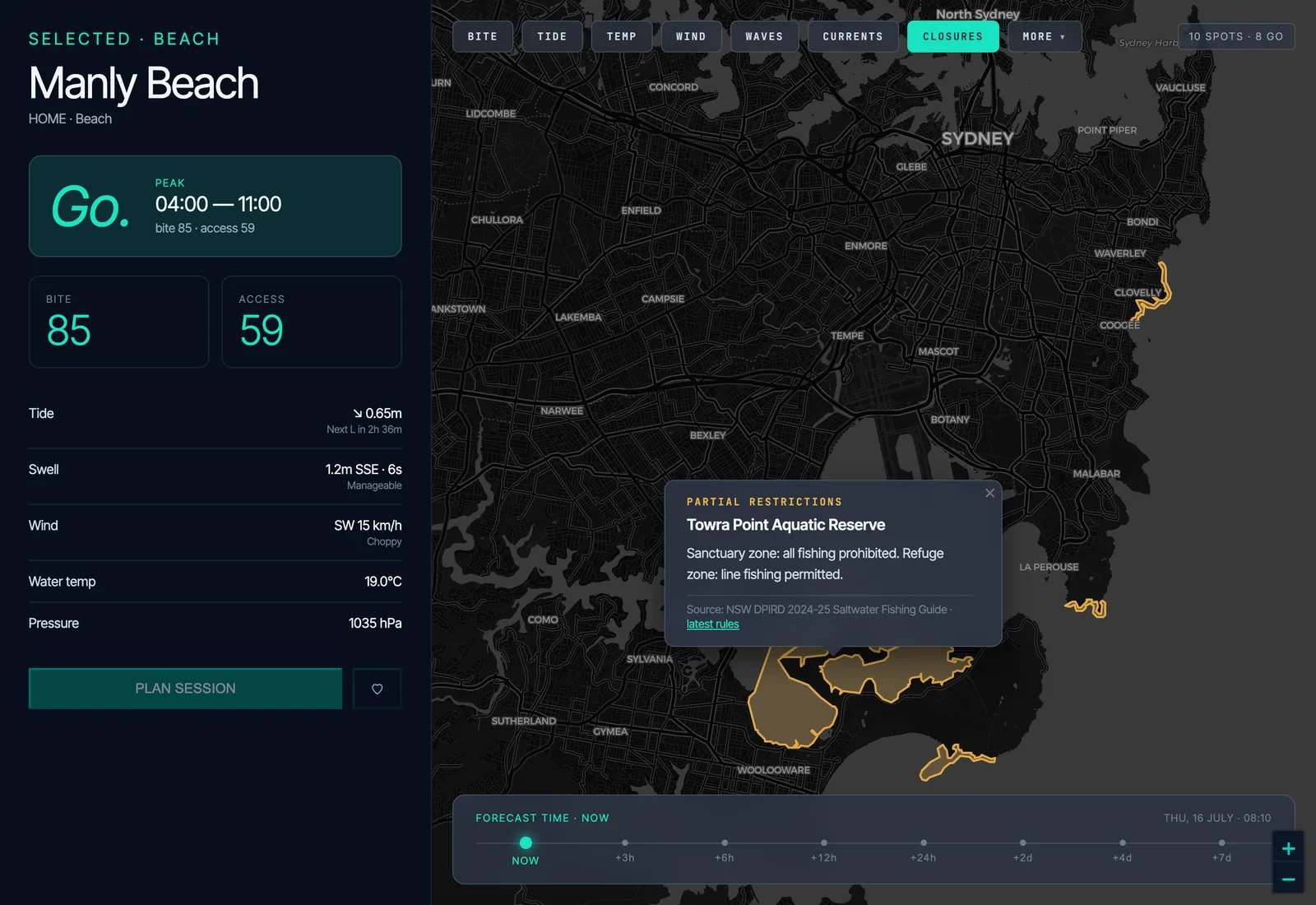
The Fishare map draws every Sydney rock-fishing platform with its LGA boundary, lifejacket-law status and angel-ring location. Save the platforms you fish, see the boundary before you cast, get a 3-hour bite-window alert next time the conditions match your saved water.
Open FishareEvery regulatory and statistical claim in this guide traces to one of the sources below. The Rock Fishing Safety Act 2016 declared-area list is reviewed by the NSW Government and the Office of Local Government on opt-in. The Kiama declaration is in moratorium as of May 2026 and not yet enforceable. Always check on-site signage at the platform before you fish.
Last verified: 2026-05-19. The declared-LGA list is current as of May 2026 and includes Kiama Municipal Council (declared March 2026, moratorium in progress). Lifejacket-law specifics mirrored from the NSW Government rock-fishing safety page, the Act on AustLII and the NSW DPIRD 2024-25 Saltwater Fishing Guide page 29.