Squid jigging is the most reliable inshore fishery Sydney has. A 12-month season, no boat needed, productive water within walking distance of every harbour suburb. This guide is the full picture — calamari and arrow squid identification, jig size and colour by depth and water clarity, the rise-and-fall retrieve that consistently produces, the under-bridge-light bite window that nobody fishes hard enough, and how to clean a squid in under a minute. Plus the spots — wharves, ledges, kelp lines, and bridges that hold squid every week of the year.
12-minute read · Verified May 2026 · Sydney Harbour + Northern Beaches + Botany Bay
THE TWO SPECIES — SOUTHERN CALAMARI VS ARROW SQUID
Sydney waters hold two squid species and you target each one differently. Both are present year-round, both eat the same prey items, but the locations, depths, and seasons skew different ways. Identifying which species is biting tells you what to change.
Southern calamari (Sepioteuthis australis)
The premium eating squid. Fat, oval-shaped mantle, wide stabilising fin that runs the entire length of the body. Caught most often around weed, kelp, and structure in 2–8 m of water. Light brown to amber colour when caught, transitions to pink and pale-cream as it stresses. Average mantle length around Sydney is 18–25 cm. Trophy fish run 35–40 cm mantle. Active across the day with peak periods at dawn, dusk, and after dark under structure or lights. Holds in tight territory — find one, you usually find more.
Arrow squid (Nototodarus gouldi)
Faster, leaner, more pelagic. Long pointed mantle with the fin only at the rear third. Caught most often in 10–30 m of water over rubble, sand, and reef edges. Reddish-brown when caught, transitions to white. Average mantle 20–28 cm. Trophy 40 cm plus. Active mostly at night and dawn. Schools move — find them and they are gone an hour later. Pursue, do not anchor.
Which one are you catching?
Look at the fins. If the side fin runs the length of the body, you have a calamari. If the fin is only at the back third, you have an arrow squid. Calamari are the more popular target — fatter mantle, sweeter flesh, easier to clean. Arrow squid are excellent fresh bait for kingfish, mahi, and any pelagic.
MONTH BY MONTH — WHEN EACH SPECIES PEAKS
Calamari are year-round in Sydney with two soft peaks. The autumn bite (March–May) consistently produces the heaviest catch rates as juvenile squid grow through legal size and aggregate around the harbour kelp lines. The spring bite (September–November) is the trophy bite — older fish that survived winter return to spawn on the inshore weed beds.
Arrow squid peak November to February, dropping off through autumn. They follow bait schools and water temperature. The harbour mouth and the deeper sections of the lower harbour fish best in mid-summer. Northern Beaches inshore (15–25 m) holds them through January.
Winter (June–August) calamari fishing is slower but the trophy fish bite under the bridge lights at night. Less competition. Fewer boats. The biggest squid of the year come out of those winter night sessions for anglers who put in the time.
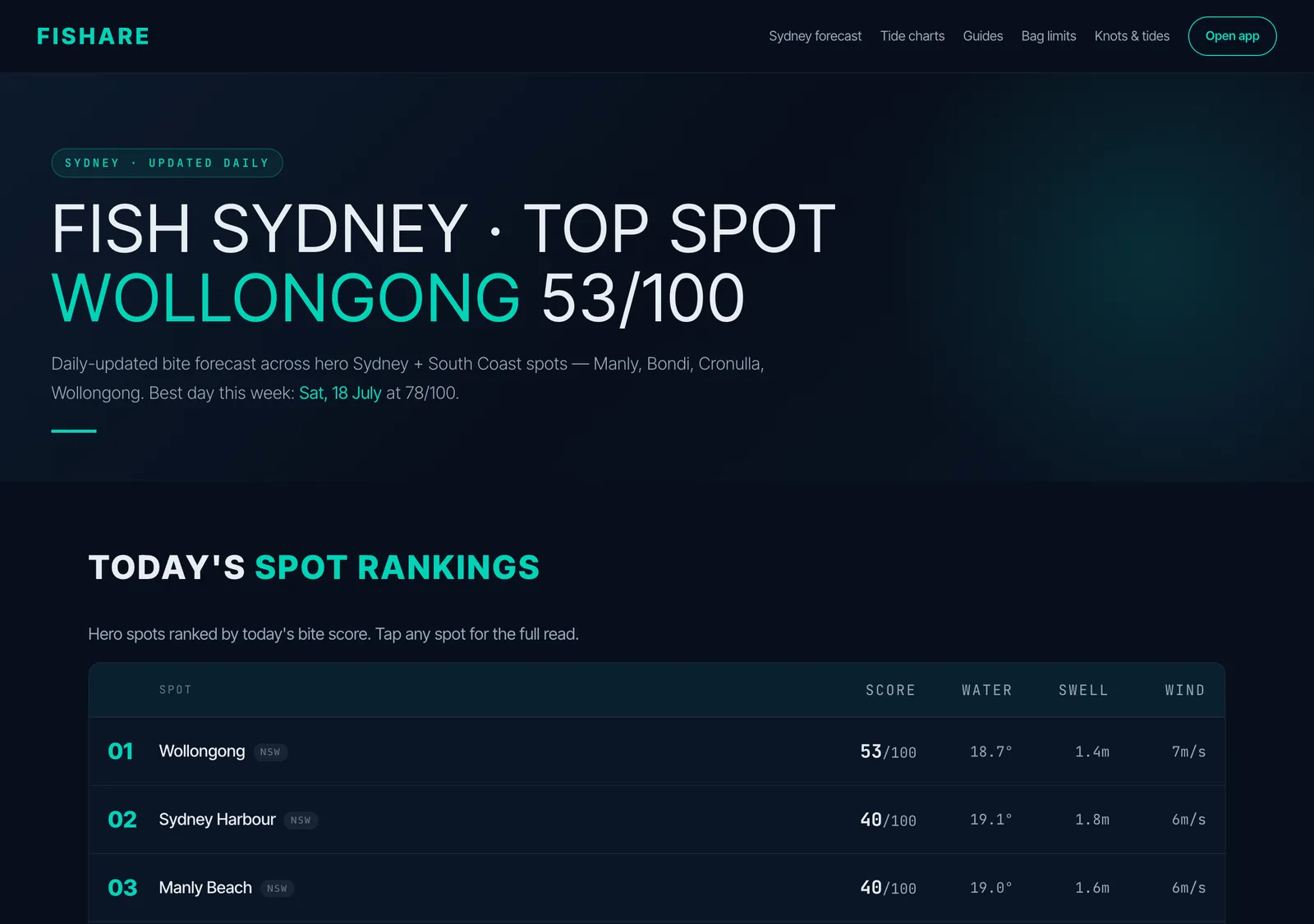
The Sydney forecast's per-spot view — the page behind the Manly, Sydney and Cronulla forecast links in this guide.
JIG SELECTION — SIZE, WEIGHT, COLOUR, UV
Squid jigs are sized in inches by Japanese convention. 2.5, 3.0, 3.5, and 4.0 are the sizes you carry for Sydney work. Each size has a corresponding sink rate measured in seconds-per-metre. Match the size to the depth and the current. Wrong size, wrong sink rate, wrong number of squid.
Jig size
Best depth
Sink rate
Sydney use case
2.5 (light)
1–4 m
~3 sec/m
Shallow kelp lines and wash zones. Manly Cove, Watsons Bay weed beds.
3.0 (standard)
3–8 m
~2.5 sec/m
Default for harbour wharves, mooring fields, ledge edges. Most-used size.
The colour question gets over-complicated. Three colour families cover every Sydney situation. Pink (bright pink, cherry pink, hot pink) is the all-purpose option — it works in clear water at dawn, in stained water at midday, in clean water under bridge lights at night. Orange (bright orange, gold-orange) is the dawn and dusk specialist for clear harbour water. Glow / UV (white, lime, blue-glow) is the night and deep-water option, especially under artificial light where it lights up like a beacon.
The trick most anglers miss is rotating jigs every 15 minutes if not getting hits. Squid investigate a jig once. If they reject it, throwing the same jig for an hour wastes time. Change colour, change size, change action, then move spots if nothing changes.
UV — when it actually matters
UV-charged jigs need light to "charge" before working in the dark. Flash them with a torch or LED for 30 seconds before each drop. Under bridge lights or pier lights the UV picks up enough ambient light without manual charging. In open water at night without artificial light, UV does nothing — use a regular glow jig charged before each cast.
THE RISE AND FALL RETRIEVE — EVERY VARIANT EXPLAINED
The default — slow rise, controlled fall
Cast the jig. Let it sink to the depth the squid are holding (count seconds, match to the jig sink rate). Once at depth, the retrieve is a series of upward lifts followed by controlled drops. Lift the rod tip 60–90 cm in a smooth motion taking about 1 second. Pause for 2–3 seconds while the jig falls back through the strike zone. Wind in 2–3 turns of slack. Repeat. The strikes come on the fall, not the rise. Watch the line — a "tick" or a sudden line-going-light is the squid grabbing the jig.
The twitch — for active fish
When you see squid following or when you spot one in clear shallow water that has not committed, the twitch retrieve provokes a strike. Two sharp wrist flicks of the rod tip in succession, then pause for 2 seconds, then repeat. The jig darts erratically and triggers a reactive grab. Active in clear water at dawn, dusk, and around lights.
The deep slow-roll — for cold-water winter fish
In June–August water at 14–16°C, squid are sluggish. The standard rise-and-fall is too aggressive. Slow-roll the jig along the bottom — cast, sink, then just slow-wind with occasional gentle rod-tip lifts. Strikes feel soft, easy to miss. Set the hook on any unusual weight or tick.
The pendulum — for hovering jigs
Off a stationary wharf or jetty in current, work the jig as a pendulum — let the current carry the jig in an arc while you slowly raise and lower the rod tip. The jig swings sideways with the flow and the squid intercept on the lateral move. Works best from the harbour wharves with tidal flow under the structure.
THE BRIDGE-LIGHT BITE — THE MOST UNDERFISHED WINDOW IN SYDNEY
Sydney Harbour has multiple bridges and wharves with overhead lighting that throws a pool of artificial light onto the water at night. Spit Bridge, Iron Cove Bridge, Glebe Island Bridge, Pyrmont Bridge, the Cahill Expressway approaches — every one of them produces calamari on summer nights and winter cold spells alike. The mechanism is straightforward — the lights attract baitfish (yellowtail, garfish, slimy mackerel), and the squid follow the bait into the lit zone.
The technique under lights is different from daytime jigging. Cast to the EDGE of the light pool, not the centre. Squid stage in the dark zone and ambush bait that swims into the lit edge. Drop your jig 5–8 m from the boundary of the light into the shadow. Slow-roll it back toward the lit zone, with the rise-and-fall action. The strike usually comes within two metres of the light boundary.
Best window: 2 hours after sunset to about 2 am. Lit-bridge sessions on cloudy nights with no moon outfish bright moon nights by a factor of two — moonlight dilutes the contrast between the lit zone and the surrounding water, the squid disperse. Cloud cover concentrates them.
Wharf access and rules
Many Sydney wharves are private or under fishing restrictions. The Harbour Bridge walking path is closed to fishing. Some ferry wharves prohibit fishing during operating hours. Cahill Expressway sections are off-limits. Check signage before setting up. The Northern Beaches Council and the City of Sydney both maintain fishing-permitted lists — search "Sydney council fishing permitted areas".
The kelp line along the Delwood Beach reef edge holds calamari year-round. Fish the eastern edge at first light or last light. The Manly Wharf area on a falling tide produces from the wharf itself or kayak access. North Steyne and Shelly Beach add rocky-headland options for the deeper water 4.0-size jig.
The kelp line off Camp Cove and the wharf at Watsons Bay produce calamari week-in week-out. Camp Cove south end at high tide. Watsons Bay wharf on a clean falling tide. The deeper water out toward Pinchgut Island holds bigger fish but requires a kayak or small boat.
Best timeDawn, last hour of falling tide
Jig2.5 size shallow, 3.0 size off the wharf
CLONTARF + EDWARDS BEACH
MIDDLE HARBOUR · SHALLOW SAND + KELP · LAND-BASED
The shallow sand-and-kelp transition at Clontarf is one of the most consistent calamari spots in Sydney. The Spit Bridge end of Clontarf Beach on a rising tide produces from waist-deep water — wade the kelp line and cast outward. Edwards Beach (the next bay east) is less crowded and fishes the same way.
MIDDLE HARBOUR · UNDER-LIGHT BITE · LAND-BASED FROM BRIDGE PATH
The Spit Bridge has overhead lighting on both sides of the carriageway. Land-based access from the eastern walkway puts you over 3–5 m of water. The biggest calamari of the year come from this spot in winter months at midnight. The pylons hold structure, the lights pull bait, the squid follow.
Best time2 hours after sunset to 2 am, cloudy nights
Jig3.0 size · pink or UV-glow charged
CRONULLA AND BURRANEER BAY
SOUTH SYDNEY · PORT HACKING ENTRANCE · LAND-BASED + BOAT
The Port Hacking entrance at Bundeena produces both calamari and arrow squid. The wharves at Cronulla and the kelp lines at Burraneer Bay produce calamari year-round. Pitt Park Reserve at Bundeena gives land-based access to the deeper water where arrow squid arrive in summer.
SOUTH SYDNEY · TOWRA POINT WEED + NORTHERN HARBOUR · BOAT
The weed beds south of Towra Point and along the Kurnell side hold calamari through autumn. Boat or kayak access. Drift over the weed and cast 3.0 jigs in pink at dawn or dusk. The Sans Souci wharf area also produces from the bank at night.
Best timeMarch–May dawn drift
Jig3.0 size · pink
NORTH HEAD AND SOUTH HEAD
HARBOUR ENTRANCE · DEEPER OPEN WATER · BOAT ONLY
The kelp on the inner faces of both Heads holds calamari in cleaner water — fewer fish but bigger averages. Arrow squid arrive at the heads in November and stay through February. Drift the 12–25 m water with 3.5 or 4.0 jigs. Aquatic reserve boundaries apply — see aquatic reserves guide.
Best timeSummer arrow squid Nov–Feb, calamari year-round
Jig3.5 or 4.0 size · UV-glow at depth
ROD, LINE, LEADER, AND THE DROPPER-JIG QUESTION
Rod
A dedicated egi (Japanese term for squid jigging) rod runs 8 to 8.5 feet, fast taper, 1–3 kg or 2–4 kg line class. The fast tip is what makes the rise-and-fall action work — soft rods cannot impart the twitch crisp enough. Egi rods are designed specifically for the lift-pause cadence. If buying just one, a 8 ft 1–3 kg works for everything from 2.5 to 3.5 size jigs.
A 7 ft light spinning rod (rated to 4 kg with a fast tip) works as a starter. Surf or beach rods are too heavy for the technique — the tip is too slow and the jigs do not work right.
Line
10–15 lb braid is the standard. Braid is essential — squid jigging is a feel game, and braid transmits the soft tick of a squid grabbing the jig in a way mono cannot. Bright-coloured braid (yellow, pink) helps you watch the line for indicator hits during the fall.
Leader
2 m of 12–20 lb fluorocarbon attached to the braid with an FG knot. The leader keeps the jig connected to fluorocarbon (less visible to squid in clear water) and provides abrasion resistance against the kelp and pylons.
The dropper-jig question
Some anglers run two jigs — a 3.0 size at the leader end and a 2.5 dropper 60 cm above. Doubles your strike zone. But it doubles the tangle rate too, and a single hooked-up squid on either jig means the other one is dragged through the strike zone and reduces follow-up chances. Recommend single jigs for beginners. Dropper-rig adds 30% to catch rates for experienced anglers in productive water.
HOW TO CLEAN A SQUID IN UNDER A MINUTE
Squid cleaning intimidates beginners and is the main reason home cooks avoid them. The technique is fast once you have done five.
Pull the head and tentacles out. Reach inside the mantle, find where the head attaches at the back, and pull steadily. The head, tentacles, ink sac, and most of the guts come out as one piece. About 4 seconds.
Remove the plastic-like quill. A long transparent strip ("the pen") sits along the inside of the mantle. Slide it out with two fingers. About 2 seconds.
Rinse the mantle. Squeeze under running water. Strip the purple skin off the outside with a thumb. The mantle goes white and clean. About 15 seconds.
Save the tentacles. Cut the head off below the eyes. The tentacles are excellent eating — leave them whole or chop them into strips. About 10 seconds.
Total time: under a minute once practised. The mantle goes whole into a freezer bag for grilling, or strips for calamari rings. The tentacles go separately. The head, eyes, beak, and guts are bait or compost.
USING FRESH-CAUGHT SQUID AS KINGFISH BAIT
Fresh-caught squid is the single best kingfish bait in Sydney Harbour. The mantle is firm, holds on a 5/0 hook, and stays in front of cruising kingfish for 20 minutes of soak time. Yellowtail kingfish eat squid as a primary food source on the harbour reef systems and around the heads.
Rig: a 6/0 wide-gap hook through the mantle from inside-out about 5 cm from the cut end. Add a stinger 5/0 hook 5 cm further down through the tail. The tail of the mantle waves in the current and triggers the strike. Fish this rig under a balloon (drifting kingfish from a boat) or weighted to the bottom (mulloway and snapper from a wharf).
If you have a kingfish session planned, jig squid 90 minutes before — fresh bait is unbeatable. See the Sydney kingfish guide for the full rig and target spots.
Specific tactical insights from working Sydney anglers and guides, sourced from the Doc Lures podcast.
Frequently asked questions.
The questions readers and members ask most often about this guide.
When is the best month to catch squid in Sydney?
Southern calamari are catchable in Sydney every month, with peak runs through January-March and again in winter. Arrow squid show on the offshore grounds through autumn. The North Harbour Aquatic Reserve closes its specific squid-jig zone seasonally — always check current rules before fishing.
What size squid jig should I use in Sydney Harbour?
Sizes 2.5 to 3.0 cover most situations — 2.5 for the shallower weed beds (Manly, Middle Harbour) and 3.0 for the deeper edges and night sessions. Heavier 3.5 jigs are useful when fishing the deeper bridge-light structure or strong tide flow.
Where can I catch squid in Sydney Harbour?
The most productive zones are the ribbon-weed flats of Manly Cove and Spring Cove, the kelp edges of Watsons Bay and Camp Cove, the bridge lights of the Spit and Roseville Bridge at night, and the wharves of Mosman and Cremorne. Avoid the closed zones of the North Harbour Aquatic Reserve.
Can I use squid as live bait for kingfish?
Yes — fresh-caught southern calamari is one of the best live baits for Sydney kingfish. Bridle a small (10-15cm hood) squid through the head with a 7/0 circle hook and either drift it on a balloon or send it down on a downrigger. Jig the squid 60-90 minutes before you want to use it so the bait is fresh.
What is the difference between southern calamari and arrow squid?
Southern calamari (Sepioteuthis australis) have a broad, oval hood and large lateral fins running most of the length of the body — they hold in shallow weed beds and structure. Arrow squid (Nototodarus gouldi) have a narrow, torpedo-shaped hood and short tail fins — they school in deeper offshore water (40m+) and are mostly an autumn catch on jigs trolled or jigged at depth.
Do I need a fishing licence to jig squid in NSW?
Yes — squid jigging is recreational saltwater fishing and requires a current NSW Recreational Fishing Fee receipt unless you qualify for an exemption. Bag limits apply (NSW: 20 squid per person per day, combined species).
Olli-Mikael Vaittinen has fished his whole life. Fifteen years of fly fishing, guiding seasons on Norway's Lakselva — his favourite Atlantic salmon river — and a blue marlin landed in Vava'u, Tonga. Founder of Fishare — the app that puts the data behind the decisions every angler makes on the water.
Fishare scores the next 7 days at every Sydney spot using live tide, swell, wind, pressure and SST data. Save your home wharf or kelp line and get pinged when the next dusk window opens. Free forever for everyone who joins now.