Offshore intelligence · Why we built it this way · 2026
HONEST HEATMAPS — WHY OUR OFFSHORE MAPS SHOW LESS COLOUR
Open a few offshore habitat maps side by side and you'll notice something: some are lit up like a Christmas tree — everywhere, every day. Ours isn't, and that's deliberate. Here is the difference between a map that always looks good and a map that tells you the truth.
5-minute read · Updated June 2026 · Absolute vs relative habitat scoring
Some maps are always bright
A habitat-suitability map scores each patch of ocean for a species and paints it on a colour ramp — dark for poor water, bright yellow for prime. The promise is simple: bright means go. So it is worth asking what "bright" actually means on the map you are reading, because not every product means the same thing by it.
The trick: "relative to view"
Some HSI products normalise relative to your current view. Their legend often says it outright — "(relative)". In practice, the map stretches whatever the best water on your screen happens to be all the way up to bright yellow — even when that water is, in absolute terms, poor.
Pan somewhere genuinely barren and the map still finds its "best" patch and lights it up. Zoom into a dead stretch of ocean and it glows anyway. The colour is not telling you the water is good — it is telling you it is the least-bad thing on your screen right now. The map always looks full and confident, because it is graded on a curve that resets every time you move.
Why that's a problem on the water
Fuel, an early alarm and a long tow back to the ramp are real costs. A map that is always bright manufactures confidence you have not earned — it tells you to run wide on a day the water simply is not there. The one job an offshore map has is to separate the days and zones worth committing to from the ones that are not. A scale that can never show "not today" cannot do that job.
Our scale is absolute
Fishare's habitat score is absolute and thermally gated. Yellow means the water is genuinely, measurably prime for that species — not just the brightest thing in frame. Dim means dim. And we go a step further: we deliberately suppress the marginal, unproductive water so it fades out of the way, instead of washing the whole map in low-grade colour. What is left is the water that actually matters, standing on its own.
The one-line version
A relative map stretches the best water on your screen up to bright — always. An absolute map shows you how good the water really is — even when the honest answer is "not here, not today." We chose absolute.
A worked example — yellowfin in winter
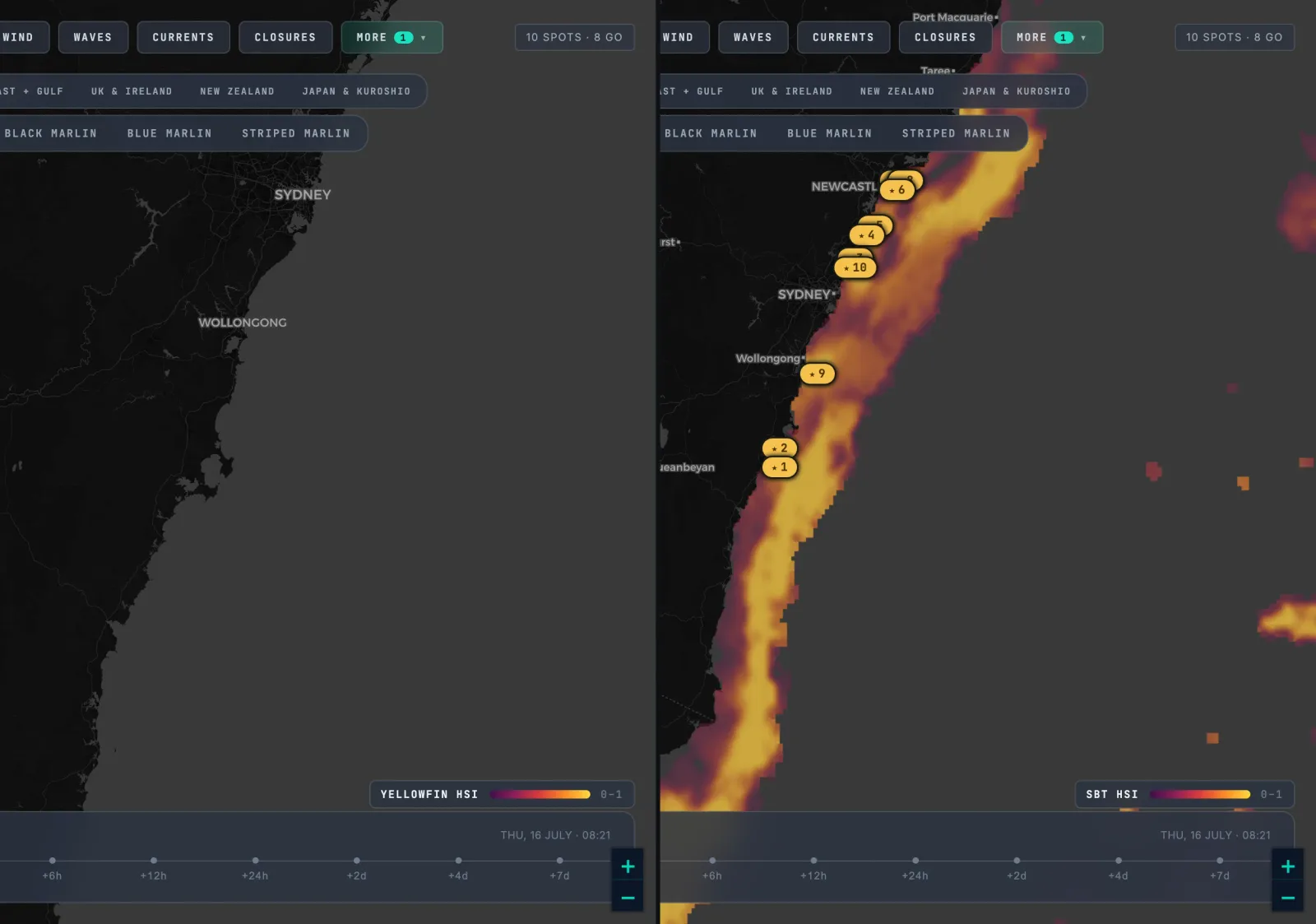
Yellowfin are a warm-water fish. In the middle of a Sydney winter, the shelf off the harbour is genuinely marginal for them — the warm water they want has pulled north. On Fishare, the yellowfin layer off Sydney in June honestly reads dim: a few faint specks, because that is the real story. A relative-scaled map, framed on the same cold water, paints it bright yellow anyway — it is just the best of a bad lot in view.
Now switch to a species that is in season — southern bluefin, in that same winter water — and Fishare's map lights up into a bright shelf-break ribbon, because the water really is prime. That is the whole point: our colour tracks the actual quality of the water, not wherever you happen to be looking.
Same water, same morning, two species: yellowfin reads dim while southern bluefin lights up the shelf break. The scale is absolute — dim means dim.
When ours lights up, it means something
Theatre is easy — paint everything bright and every trip looks promising. We would rather the map cost us a little drama and keep its credibility. When a Fishare hotspot glows, it is because the temperature, the front, the eddy edge and the structure genuinely line up for your species on that day — not because the algorithm had to colour something. A quieter map you can trust beats a loud one you cannot.
What Fishare puts on the map
Fishare pulls sea-surface temperature, the SST-gradient (fronts), currents and eddies, bathymetry and a species-by-species habitat heatmap onto one map — scored on an honest, absolute scale, with a 14-day slider so you can watch the water set up before you commit a launch day. Offshore habitat covers Australia's east coast, the US East Coast & Gulf, and Atlantic bluefin for the UK and Ireland.
See it on the live map
It is all live in Fishare — SST, the gradient layer and the habitat heatmap by species, free to browse, no account needed. Pick your species, find the edge, and back yourself when the map actually lights up.
Olli-Mikael Vaittinen has fished his whole life. Fifteen years of fly fishing, guiding seasons on Norway's Lakselva — his favourite Atlantic salmon river — and a blue marlin landed in Vava'u, Tonga. Founder of Fishare — the app that puts the data behind the decisions every angler makes on the water.
Fishare puts SST, the gradient layer, currents, bathymetry and a species-by-species habitat heatmap on one map, with a 14-day slider so you can watch a front set up before you run. Free to view, no account needed to browse.
The data layers described in this guide are built from public oceanographic products. Sea-surface temperature and chlorophyll come from satellite remote-sensing programmes; bathymetry from global compilations; waves, currents and marine SST from the Open-Meteo marine API. Species thermal preferences and the "fish the front" principle are well established in fisheries oceanography; local calibration improves as catches are logged.
Last verified: 2026-06-18. SST, gradient and habitat layers are model and remote-sensing products and carry inherent uncertainty. A habitat-suitability map shows where conditions are favourable, not where fish are present — treat a hotspot as the best place to start looking, and calibrate it against your own catch log.