
The basics, fast
Yellowfin tuna (Thunnus albacares) are the most widespread and most-targeted of Australia's pelagic tunas. Off NSW they're a cool-water-edge fish — they show when the East Australian Current pulls warmer water down the shelf and concentrates bait along temperature breaks, eddies and current lines.
- Range: Found right around mainland Australia, but the NSW east coast (Sydney → Eden) carries the most consistent autumn-winter run, with smaller pockets north into QLD and west into VIC/SA in summer.
- Size: Schoolies of 8–25kg are common; 40–60kg fish appear most autumns; 80kg+ "barrels" turn up in deep water past the shelf, mostly between Bermagui and Eden.
- Diet: Pilchards, slimy mackerel, garfish, squid, anchovies, sauries — anything biomass-rich that the current corrals into a feedable column.
- Lifespan: 6–8 years typical, fast growth — a 25kg fish is around 2-3 years old. Large fish are mature spawners; release oversize barrels if you can.
When yellowfin show on the east coast
The honest version: every year is different. The two reliable signals are water temperature and current edge proximity — not calendar month.
| Season | Where | Typical size | Notes |
|---|---|---|---|
| Late summer (Feb-Mar) | Sydney → Wollongong shelf | 15–35kg | EAC pushes south; warm-water schoolies show on the 12-fathom line. |
| Autumn (Apr-May) | Sydney → Bermagui | 20–50kg | Peak month. Cooler water + bait concentration = best ratio of effort to fish. |
| Winter (Jun-Aug) | Bermagui → Eden | 40–80kg+ | Deep-water barrel run. Cold-water surface bite difficult; troll deep or jig. |
| Spring (Sep-Oct) | Sporadic, NSW-wide | 8–25kg | Smaller, less reliable; transition months. Watch for early run signs. |
| Summer (Nov-Jan) | NSW shelf, QLD shelf | 15–35kg | Often outshone by mahi mahi and marlin, but yellowfin are there. |
The NSW autumn-winter run gets the press because the fish stack up on a relatively narrow band of cool water as the EAC pushes warmer surface water south. That concentration plus the proximity to home ports (you can get from Sydney Heads to fishable water in 60–90 minutes) is what makes it the country's most accessible yellowfin fishery.
Reading the water — what actually matters
Yellowfin don't live anywhere; they live on the edge. Find the edge, find the fish.
Sea surface temperature (SST)
The single most useful number. Yellowfin sit happily in 18–24°C, but the real signal is the break — the gradient where two water masses meet. Bait gets concentrated at temperature fronts, and yellowfin patrol those edges. A 1°C change over 5km is interesting; a 2°C change over 2km is a hot edge. Look for the break, not the absolute temperature.
Currents and eddies
Warm-core eddies spinning off the EAC are bait magnets. The downstream side of a warm-core eddy — where the warm water shears against the cold inshore current — is classic yellowfin water. If you have access to a satellite-derived current map (Bluelink, Open-Meteo marine, or Fishare's offshore mode), look for tight contour spacing and shear lines.
Bait sign
Birds working the surface, slick patches, smashed bait, jumping garfish, pilchards balling at the prop — these are the day's lottery tickets. Yellowfin are sight feeders that respond to commotion. If you find genuine bait, slow down and work it. Five hours trolling empty water beats two hours over real bait every time, but only as a last resort.
Moon and tide
Less critical offshore than inshore, but still worth tracking. Solunar major periods (moon overhead/underfoot) line up with feeding spikes for many pelagics. Avoid full-moon nights right before — they night-feed easily and dawn bites are softer.
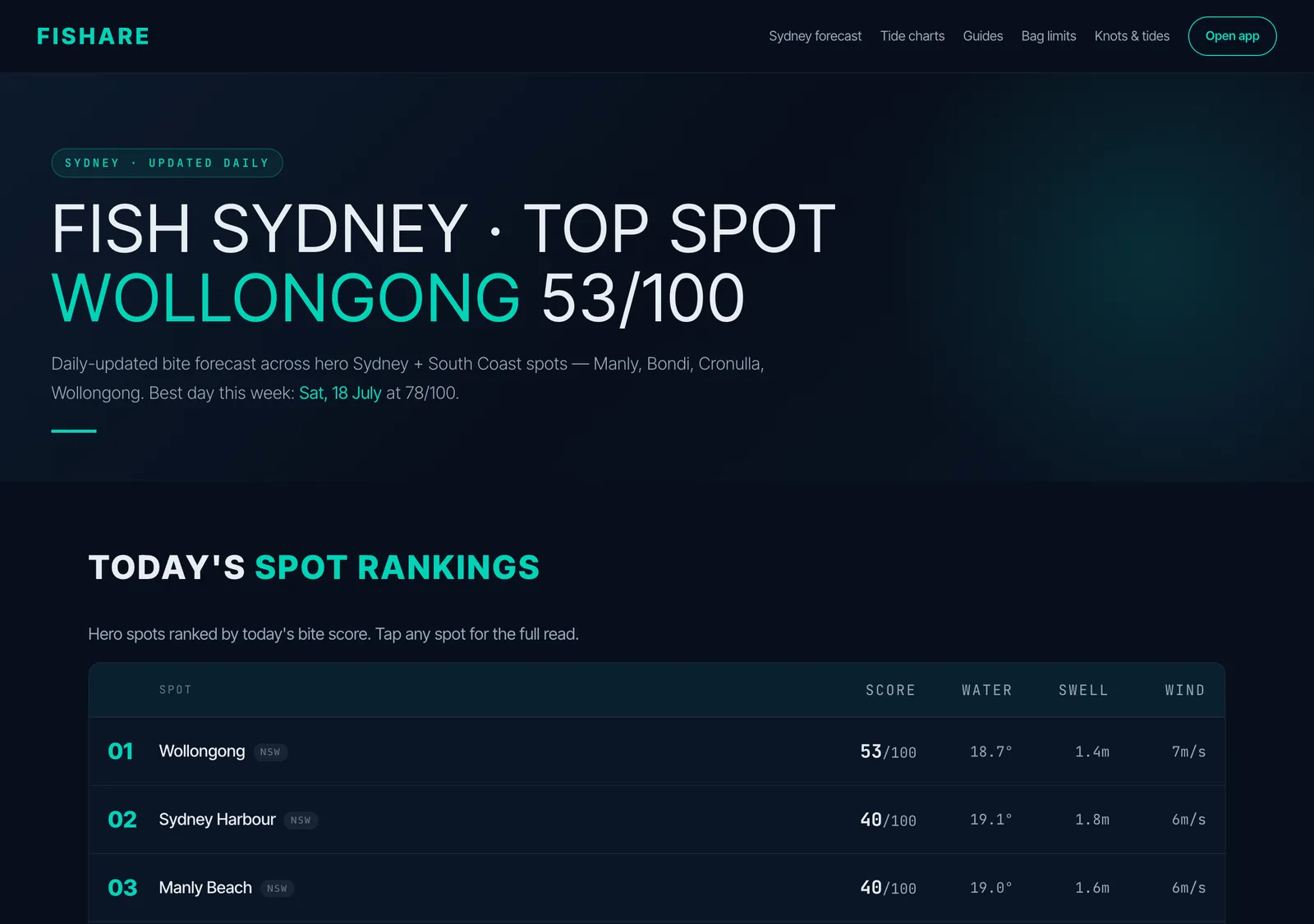
Conditions for the next 7 days at 8 hero NSW spots — water temp, swell, peak windows, and a daily bite score — are auto-updated on the Sydney fishing forecast. No login required.
Where to look — NSW from north to south
Sydney (Sydney Heads → Botany)
The 12-fathom line east of South Head, the "browns" off Maroubra, the wider shelf out to "the canyons" at 100+ fathoms. Sydney offshore charters routinely produce schoolies in March-April and bigger fish in May. From a private boat: 25-35nm runs in fishable conditions only.
Wollongong & Port Kembla
The Five Islands, "the pinnacles" off Bass Point, the wider shelf. Less crowded than Sydney but similar water; the autumn run usually shows here a week or two after Sydney.
Jervis Bay & Ulladulla
The "12-mile" reef south of Jervis. Strong April-May fishery in good years; quiet in others. Smaller average size than the Bermagui-Eden grounds but more accessible.
Bermagui & Eden
The "Brick Wall", the "Cont' Shelf" off Bermagui, the offshore canyon systems south to Eden. This is where the barrel hunters fish — June to August, 80-200+ kg fish, usually targeted by skirted trolling at speed or live-baiting at depth. Long runs, big seas, big rewards.
Gear — what actually works
Yellowfin gear divides cleanly by target size. Schoolies are sport-fishing tackle; barrels are stand-up gamefishing.
Schoolies (10–35kg) — sport rig
- Rod: 24kg jig stick or 15-24kg overhead, 5'6"–6'2", parabolic action
- Reel: Stella 18000–30000 / Saltiga 15000+, or Tiagra 30W / Talica 25 II for overhead
- Line: 30–50lb braid, 80–100m of 50–80lb mono topshot
- Leader: 80–100lb fluorocarbon, 1.5–2m
- Hooks: 5/0–8/0 ringed circles for live/dead bait, 7/0 inline trebles on hard lures
Barrels (50kg+) — stand-up
- Rod: 37kg-50kg gamefishing stand-up, short butt, parabolic but braced
- Reel: Tiagra 50W or Talica 50 with bent-butt setup
- Line: 80–130lb mono mainline, monofilament for stretch
- Leader: 200–300lb fluorocarbon, 3m single-strand wire if there's a chance of mackerel mixed in
- Hooks: 9/0–11/0 J-hooks for skirts, 12/0 ringed circles for deep live-baits
Tactics — five ways to put one in the boat
1. Trolling skirts
The default. Run a 4–6 lure spread at 7–9 knots: a couple of small skirted "tunas" (Pakula Sprockets, Black Bart Mini Breakfasts) close, a medium pusher in the rigger, a deep-running diver on the long corner. Cover ground until you find bait or hook up, then circle the area.
2. Cube trail
Anchor or drift on a known mark with a slick of pilchard cubes drifting back. Yellowfin work up the trail; present a hooked cube on a long fluorocarbon trace with no weight. Slow, deadly when the fish are localised. Best in 80–120m off Sydney.
3. Live-baiting
Slimy mackerel, yellowtail, mackerel — pin one through the nose on a circle, drop it back unweighted into the trail, or drop it deep with a downrigger or weighted balloon. Live bait outfishes dead bait when the fish are picky.
4. Spin/casting
When you find busting fish on the surface, stop the boat and cast small stickbaits (FCL Labo CSP 165, Shimano Orca 220) or sinking metals (Daiwa Saltiga 60g) through the school. Skin-tight drag, no shock. Works exceptionally well on schoolies; rarely on barrels.
5. Jigging
Knife jigs and slow-pitch jigs in 80–200m. Bigger fish often hold below the school. Top of the school = schoolies, 50m down = the better fish. Underused in NSW; outstanding when the surface bite shuts off.
How to read a day on the water
A practical sequence for finding fish, not just hours of trolling hoping.
- Before you leave: Check yesterday's SST chart, current direction, and swell. Pick a temperature break or eddy edge as your primary target. Have a backup if the wind kills your first plan.
- First hour: Run to the closest piece of structure or temperature break. Look for birds, slicks, bait sign on the sounder. Don't troll empty water hoping; look first.
- Mid-morning: If you've found bait or marks, work them. Cube trail if anchored, troll concentric circles if mobile. If you've found nothing, move 2-3nm along the same temperature contour.
- Midday slack: Bites soften. Use the time to relocate, eat, or jig deep over good structure.
- Late afternoon: Best surface bite of the day, often. Be on your best mark with fresh baits or rotated lures by 14:00.
- Sunset: Back at the dock by dark, fish iced down, water washed off — yellowfin meat spoils fast in warm boats.
Fishare's offshore mode scores conditions specifically for pelagic species — pulling in SST, current speed and direction, swell, and solunar timing. It's not magic, but it's a faster read of the day than scrolling six different sites.
Regulations and ethics
Always check current NSW DPI yellowfin tuna rules before keeping a fish — bag and size limits change. As of 2026 the recreational bag limit in NSW is two yellowfin tuna per person per day with no minimum size, but verify on the NSW DPI website before your trip.
If you're targeting barrels: most experienced gamefishermen now release the very largest fish (80kg+) because they're the breeders that drive the next year's spawning. Photograph, measure, and let it go — that fish gives the fishery another decade. Smaller schoolies eat better anyway.
Common mistakes
- Trolling without intel. The fish are on edges. Driving in straight lines through dead water for six hours catches nothing but fuel cost. Look for bait first; troll second.
- Heavy leader when not needed. 200lb leader on a 25kg yellowfin will halve your bites in clear water. Match leader to fish size, not to fear.
- Slow drag. Yellowfin run hard and far. Set drag to 30% of breaking strain at strike, not 20%. They can take 200m on the first run; let them.
- No bleeding/icing plan. Yellowfin meat starts breaking down within minutes of capture if not bled and put in slurry. Bring an ice slurry, bleed at the boat, ice immediately. The difference between average and excellent yellowfin sashimi is on-water handling.
- Going on bad days. 25-knot south-easterly seas off Sydney are dangerous and fishless. Fish on the right days; check the 7-day forecast before committing fuel and time.
The honest truth about offshore tuna
Yellowfin fishing isn't easy or cheap. You'll have multi-trip blanks. You'll burn fuel running to water that didn't hold up. You'll cop a 25-knot southerly that turns up at 2pm. The ratio of effort to fish is the worst of anything Australian recreational anglers commonly chase.
What makes it worth it: the take is unforgettable, the fight rewards experience, and the fish on the dock is the best protein in Australia's sea. If you're patient, prepared to read conditions properly, and willing to wait for the right day — the NSW autumn-winter run is one of the most accessible big-pelagic fisheries in the world.