Sydney is a dusky-flathead town. The system runs from Botany Bay through the Cooks River, the Port Hacking estuary, Sydney Harbour, the Lane Cove and Parramatta arms, all the way north into Pittwater and the Hawkesbury. Eight productive systems within an hour's drive, each holding the same fish behaving the same way. This guide is everything that matters — where dusky flathead actually hold, what they eat in winter versus summer, the tide window that consistently produces, the lure colours that work in clear water versus dirty, and the verbatim NSW DPIRD bag and size numbers you must know before keeping one.
14-minute read · Verified May 2026 · NSW DPIRD 2024-25 rule set · Sydney + Greater Sydney systems
THE SPECIES — WHY DUSKY FLATHEAD IS THE SYDNEY ESTUARY FISH
There are four flathead species you can catch around Sydney. The dusky (Platycephalus fuscus) is the one that matters for Sydney flathead anglers. It is the largest, the most aggressive, and the one that holds in water you can reach from a kayak, a small tinny, or a bank. Adults grow to over 1.2 m and 8 kg, but the average Sydney flathead keeper is 45–60 cm.
The sand flathead (Platycephalus bassensis) is an offshore species — deeper sand bottoms, prawn drifts, and bay-mouth gravel beds. Smaller on average (35–45 cm), pale brown with light spots, and rarely the target species inshore. The tiger flathead (Neoplatycephalus richardsoni) lives in 30–80 m of water on the continental shelf, and the bluespot or yank flathead (Platycephalus caeruleopunctatus) holds on the deep reef edges off the Heads. The yank gets confused with the dusky around the Heads — same general shape, but the bright blue spots on the tail give it away.
For the purposes of this guide, "flathead" means dusky. They are an ambush predator. They lie flat on sand, mud, or weed-rim edges, eyes pointed up, mouth pointed at the surface. They wait. When a prawn, gar, or small mullet swims overhead, they explode upward and engulf it. The whole strike takes a fifth of a second. They go back down. They wait again.
Two facts shape every tactic in this guide. First, they are ambush feeders — you fish where they hide, not where they hunt. Second, they are visual feeders — they look up, so lures that pass overhead are the trigger. Heavy weights that hop along the bottom do work, but a soft plastic passed two metres off the bottom on a slow retrieve gets twice as many hits, every time.
MONTH BY MONTH — WHEN THEY PEAK AND WHY
Dusky flathead are present year-round in Sydney estuaries. Most adults stay within the same system for their entire lives. What changes is their willingness to feed and their location within the estuary. The cycle follows water temperature first, prey availability second.
Jan – Feb
Peak · Spawning
Water 22–24°C. Big breeders push to the estuary mouths to spawn. Trophy fish on shallow flats at dawn. Release breeders over 70 cm — they are female and carry the next generation.
Mar – Apr
Strong · Post-spawn feed
Water 20–22°C. Post-spawn fish ravenous after egg release. Heaviest week-to-week catch rates of the year. Average keeper run 50–70 cm.
May – Jun
Steady · Holding deeper
Water dropping 18–20°C. Fish move 1–2 m deeper, sit on dropoffs and the lee side of weed beds. Slow but reliable on bait.
Jul – Aug
Slow · Bottom of the cycle
Water 15–17°C. Hardest months. Bigger fish hold near deep channels and barely move. Use baits over lures here — fresh prawn or strip mullet on a paternoster rig.
Sep – Oct
Warming · First push
Water back to 18–20°C. Fish push onto shallow flats to feed again. Mid-morning bite stronger than dawn — sand and weed warm faster than open water.
Nov – Dec
Building · Pre-spawn
Water 20–23°C. Pre-spawn aggression. Big females eat hard. Best month for trophy fish on the flats at first light.
The peak fishing months in Sydney for dusky flathead are March, April, and November–December. February is the trophy month but you give back the breeders. July–August can still produce, but the work-to-reward ratio drops hard.
WHERE THEY HOLD — EIGHT SYDNEY SYSTEMS
Below are the productive Sydney systems, ranked roughly by consistent catch rates. Each has its own personality. Pittwater is the trophy water. Botany is the most accessible. The Hacking is the cleanest. Pick by where you live, not by reputation — a 20-minute drive to a system you know is worth more than a 90-minute drive to one you do not.
BOTANY BAY
SOUTH SYDNEY · ACCESSIBLE FROM 8 BOAT RAMPS · DEEP CHANNELS PLUS SHALLOW FLATS
Sydney's largest estuary system. The Georges River and Cooks River both feed it. Fish hold on the southern flats off Towra Point, on the sand drops along the Kurnell side, and on the weed-rim edges of Quibray Bay. The Bare Island side fishes well in the cooler months when fish push to the cleaner ocean-influenced water.
Best monthsMar–May, Sep–Dec
Average size45–60 cm
Trophy class70–90 cm on the Towra flats Nov–Feb
AccessSans Souci ramp, Foreshore Park ramp, Yarra Bay ramp
HazardsPort traffic and seaplane corridors — Towra Point Aquatic Reserve has closed zones, see aquatic reserves guide
SYDNEY HARBOUR — MIDDLE AND NORTH
FROM SPIT BRIDGE NORTH · MIDDLE HARBOUR + NORTH HARBOUR + CLONTARF SAND
The shallow sand flats inside Middle Harbour are an underrated fishery. Fish hold on the sand off Clontarf, the weed line at Chinamans Beach, and the dropoffs at Edwards Beach. The drift down the Spit Bridge channel on a falling tide produces consistently. North Harbour gets less pressure than the southern bays and holds bigger average fish.
Best monthsYear-round, peak Mar–May
Average size42–55 cm
Trophy class70 cm plus around Manly Cove and the Lighthouse Reef edges
HazardsNorth Harbour Aquatic Reserve — see reserves guide for boundary detail
PORT HACKING
SOUTH OF SYDNEY · CLEANEST WATER OF THE METRO ESTUARIES
The Hacking is small but consistent. Fish hold on the southern shore of Burraneer Bay, on the Gymea Bay flats, and on the sand drops at Maianbar. Water clarity is the best of any Sydney estuary — sight-fishing on the Maianbar flats at low tide is genuinely possible on the calmest days. Pressure is moderate, locals know it well.
Pittwater holds the largest average flathead of the metro estuaries. Fish hold on the weed banks at Currawong, the sand off Mackerel Beach, and the channel edges along the western shore. Salt River and McCarrs Creek both produce in the upper bays. This is also where 80–100 cm fish get pulled from every year — release them, they are breeders.
Best monthsNov–Feb for trophies, Mar–May for keepers
Average size50–65 cm
Trophy class80–100 cm — release these
AccessBayview ramp, Church Point ramp, Palm Beach ferry wharf
HAWKESBURY RIVER
NORTH OF SYDNEY · MASSIVE SYSTEM · BROKEN BAY SECTION
The lower Hawkesbury inside Broken Bay is enormous. Sandy flats off Patonga, the Brooklyn channel edges, and the western Cowan Creek arms all produce. Fish run larger than Sydney Harbour averages — 50–70 cm is normal, with breeders to 1 m. This system is where the term "flathead drift" was invented — drop a plastic, wind it slow, drift with the tide.
The Georges feeds Botany Bay but fishes as its own system. Fish hold on the Salt Pan Creek mouth, the Como Bridge channel edges, and the sand drops at Picnic Point. Pressure is heavy on weekends. The trick is to fish midweek dawn — a Wednesday at first light on Salt Pan produces consistently year-round.
Best monthsMar–May, Sep–Dec
Average size42–55 cm
AccessComo ramp, Picnic Point ramp
COOKS RIVER
INNER WEST · URBAN ESTUARY · CONSISTENTLY PRODUCTIVE
An overlooked urban fishery. The lower Cooks from Tempe to the airport ferry channel holds resident fish on the sand off Kyeemagh and the weed edges at Tempe Reserve. Water clarity is poor but the fish do not care. Slow-rolled vibes outfish soft plastics here by a factor of two — the fish find them by vibration in dirty water.
Best monthsYear-round
Average size40–52 cm
AccessTempe Reserve ramp, Kyeemagh ramp
NARRABEEN LAGOON
NORTHERN BEACHES · TIDAL LAGOON SYSTEM
Narrabeen is closed off from the ocean for most of the year, opens during storm surges. The resident flathead are smaller on average but consistent. Fish hold on the western shore weed beds and the lagoon entrance sand bar when it is open. A canoe or kayak unlocks the system — boat ramp access is limited.
Best monthsWhen entrance is open, Apr–Jun and Nov–Dec
Average size38–48 cm
AccessForeshore at Bilarong Reserve, Berry Reserve, kayak only at the entrance
THE TIDE WINDOW THAT CONSISTENTLY PRODUCES SYDNEY FLATHEAD
Two hours into a rising tide. That is the answer for Sydney flathead. Across every Sydney estuary, across every season, across both bait and lure presentations, the first two hours of incoming water consistently produces the highest hit rate per cast. The science is straightforward — the rising tide pushes prawns, juvenile mullet, and crab off the mud and sand flats and out into the deeper channels and dropoffs. Sydney flathead stack at the edges of those flats to ambush the bait as it gets swept off.
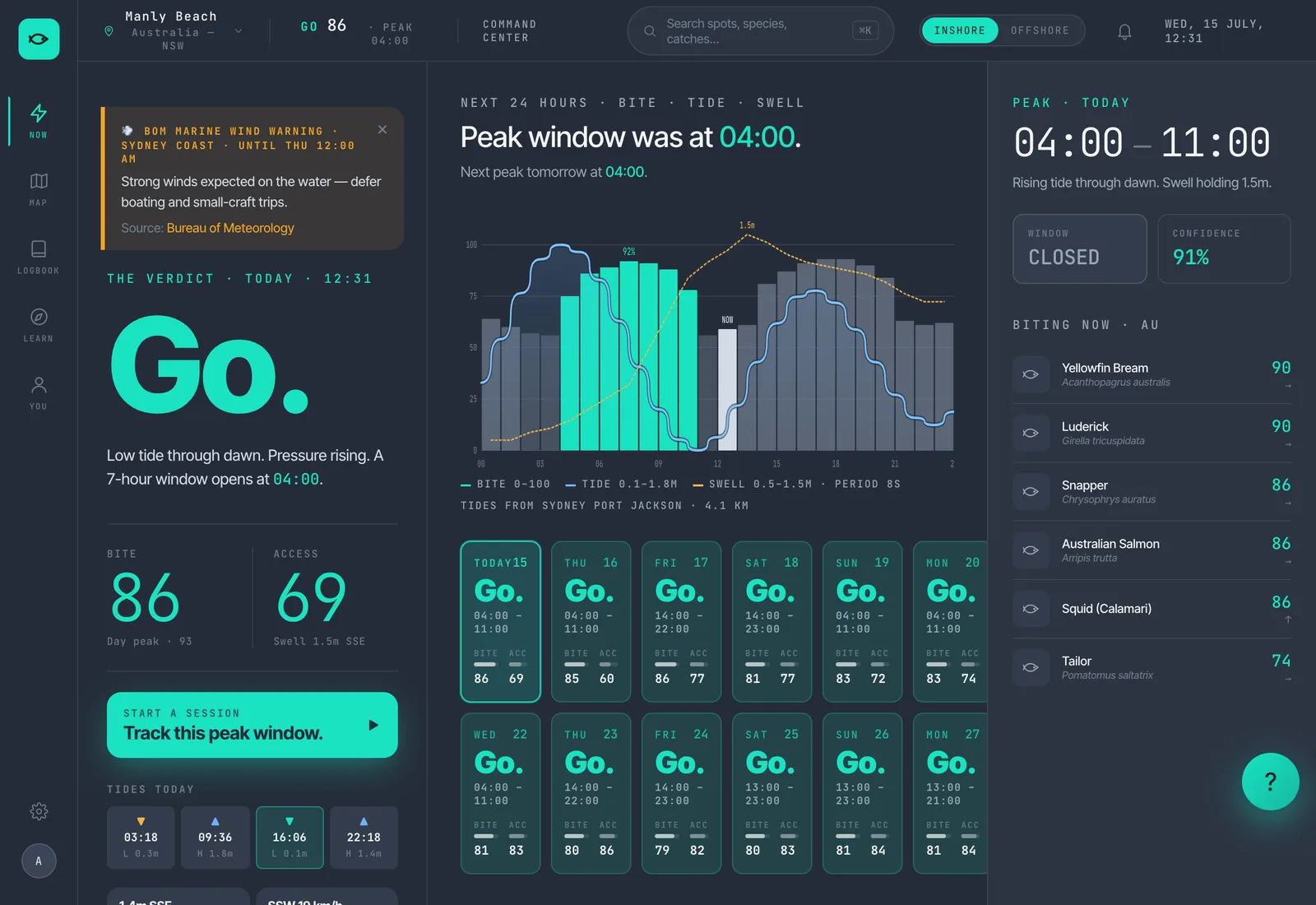
The peak window highlighted on the bite curve — the run of tide the section calls the highest-percentage flathead bite.
The second-best window is the last hour of a falling tide on the same flats. Bait gets concentrated as the water drops, and flathead push up into shallow water to feed before the tide turns. This is the trophy window — the biggest fish move shallowest at the end of a falling tide, especially on the bigger spring tides.
Slack tide is the worst time to flathead-fish. No water movement means no bait movement, which means flathead stay buried and inactive. If you only have a slack-tide window, fish the deepest channel you can find and use bait. Lures are wasted on still water.
The cross-reference: tide × moon × light
A rising tide that hits dawn or dusk is the gold standard for Sydney flathead. The full and new moon spring tides produce the biggest tidal ranges and the strongest water movement. Stack all three — rising tide, dawn or dusk, full or new moon — and you are fishing the highest-percentage window the system offers. The Sydney tides and swell guide covers the moon × tide × season interaction in detail. The how to read a tide chart page explains the chart-reading basics.
LURES, BAIT, AND RIGS THAT WORK IN SYDNEY WATER
Soft plastics — the all-purpose answer
A 4-inch curl-tail or paddle-tail soft plastic on a 1/8 oz to 3/8 oz jighead is the default Sydney flathead rig. Match the colour to the water clarity. Clear water — Pittwater, Hacking, North Harbour — go natural: pumpkinseed, motor oil, brown-bait. Dirty water — Botany, Cooks, Georges — go bright: pink, chartreuse, white. The jighead weight follows the depth and the current. Shallow flats (1–2 m) on a slack-to-medium tide: 1/8 oz. Channel edges (3–5 m) on a running tide: 1/4 to 3/8 oz.
Two brands consistently outperform in Sydney water: Squidgies (the curl tail in pumpkinseed and bloodworm colours) and Z-Man (the StreakZ in motor oil and the GrubZ in pink for dirty water). The Z-Man material is buoyant — it sits the plastic off the bottom on the pause, which is what flathead key on visually.
Vibes and blades — the dirty-water answer
For the Cooks River and lower Georges in stained water, a 50 mm to 65 mm soft vibe outfishes a plastic two-to-one. The vibration carries through the murk and triggers a strike where the visual presentation is invisible. The Jackall Mask Vibe and the Berkley Pro Shad Shape vibes both work. Slow-roll across the bottom, pause every 5 metres, let it drop to the floor and lift again.
Bait — when lures are not working
Live prawns on a paternoster rig fished on the bottom of a channel edge are the highest-percentage cold-water presentation. Strip mullet baits (5 cm by 2 cm strips, hook through the skin end) work for the bigger fish. Fresh chicken thigh meat is the budget option and outfishes frozen prawns by a margin in dirty water. Rig: a 2/0 long-shank or wide-gap hook, a small running ball sinker above a swivel, 50 cm of 8 kg fluorocarbon leader.
Topwater — the surprise option
Flathead will hit a topwater on warm days when the water is calm. A 65–80 mm popper or a small walking stickbait worked across a shallow sand flat at dawn produces explosive surface strikes. This is not the most reliable presentation but the takes are spectacular and the surrounding ecosystem (mullet schools, prawn skips) is the key indicator that flathead are active up high.
THE RETRIEVE FOR SYDNEY FLATHEAD — SLOW-ROLLING, HOPPING, DEAD-STICKING
The most common mistake Sydney anglers make with flathead is retrieving too fast. Sydney flathead are ambush feeders. They commit to a strike from a stationary position. If the lure is moving fast and erratically, they cannot intercept cleanly and they pass on the strike.
The slow-roll is the default. Cast the soft plastic. Let it sink to the bottom — count it down (one count per metre of water depth in calm conditions, more in current). Lift the rod tip gently, two seconds, then wind in the slack. Pause. Wind in slowly, just fast enough that you feel the plastic kick. Two slow turns, pause for a count of three, wind two more turns. Most strikes come on the pause or on the first turn after the pause.
The hop is for deeper water and structure. Cast, sink, sharp lift of 30–50 cm with the rod tip, let the plastic drop on a controlled slack line, repeat. The strike usually comes on the drop — feel for the line going light or the tip ticking sideways. Set the hook immediately. Flathead do not hold a soft plastic for long.
The dead-stick is the technique that nobody talks about. Cast the plastic to the edge of a weed bed or the lip of a dropoff. Let it sink to the bottom. Do nothing for 30 seconds. Then twitch the rod tip once, hard. The flathead that has been watching the lure since it landed will commit on that twitch nine times out of ten. This works best in clear water on the shallower flats at first light.
NSW DPIRD BAG AND SIZE LIMITS — READ BEFORE YOU KEEP ONE
These rules come from the NSW DPIRD recreational saltwater fishing rules, current at May 2026. They apply to all NSW waters including the Sydney estuaries listed above. Always verify against the current DPIRD page before keeping fish — limits change and seasonal closures apply.
NSW DPIRD · Dusky flathead
Minimum legal size: 36 cm total length. Maximum size: 70 cm total length — any flathead over 70 cm must be released. Bag limit: 5 in possession, of which only 1 can be 60–70 cm. No closed season.
The 70 cm cap is the rule most often broken in Sydney. The biggest flathead in any system are mature breeding females. They lay millions of eggs each spawn. Keeping a 70-plus-cm fish removes a generation of replenishment. The 60–70 cm slot limit (only one per bag) is there for the same reason — to push anglers toward the smaller, faster-replicating mid-range fish.
The trophy rule
Photograph, measure, release. A 90 cm flathead released on a March morning at Patonga will spawn at least three more times before she dies of natural causes. That is millions of eggs. The numbers compound across a season. Sydney has a healthy flathead fishery because anglers, on the whole, release the breeders. Keep this culture.
For other species, see the Sydney aquatic reserves guide and the dusky flathead species page. Each species page on Fishare carries the verbatim DPIRD bag and size data, sourced directly from the 2024-25 Saltwater Fishing Guide PDF.
FIVE MISTAKES THAT LOSE SYDNEY FLATHEAD
1. Retrieving too fast
Already covered above but worth saying twice. Slow your retrieve down. If you feel the plastic kicking aggressively, slow down more. The strike comes on the pause, not the burn.
2. Setting the hook too late
Flathead inhale a plastic and hold it for two seconds at most before spitting if they feel the hook or the resistance. Set the hook the instant you feel weight on the line or the tip going sideways. A delayed strike loses ninety percent of fish.
3. Wrong jighead weight for the conditions
Too heavy and the plastic crashes to the bottom and the flathead never sees it. Too light and the plastic drifts off the bottom on the current and looks unnatural. The right weight gets the plastic to the bottom in 3–5 seconds, then keeps it within 50 cm of the bottom on a slow retrieve. Re-tie if the conditions change.
4. Fishing the wrong tide phase
If your only available window is slack water or the last hour of a rising tide as it goes full, accept that you are fishing the worst window and adjust expectations. Pick bait over lures. Pick deeper channels over flats. Move every 15 minutes if you are not getting bites.
5. Wrong leader for the water
10 kg fluorocarbon leader is the Sydney default. In dirty water (Cooks, Georges) you can drop to 8 kg. In clear water (Pittwater, Hacking) on a bright day with a 70-plus-cm fish target, drop to 6 kg and accept the risk. The bigger the leader, the lower the strike rate. Match leader to clarity, not paranoia.
Olli-Mikael Vaittinen has fished his whole life. Fifteen years of fly fishing, guiding seasons on Norway's Lakselva — his favourite Atlantic salmon river — and a blue marlin landed in Vava'u, Tonga. Founder of Fishare — the app that puts the data behind the decisions every angler makes on the water.
CHECK TODAY'S FLATHEAD BITE BEFORE YOU LEAVE THE HOUSE
Fishare scores the next 7 days at every Sydney estuary using live tide, swell, wind, pressure and SST data. Save your home estuary and get pinged when the next 2-hour rising-tide window opens. Free forever for everyone who joins now.