A kayak is the cheat code for Sydney estuary fishing. It puts you on water a boat cannot reach without spooking the fish — the mangrove edges, the back bays, the shallow flats where bream tail in 30 cm of water at dawn. It launches off any beach, ramp, or grassy foreshore for free. And five of the best estuary systems in Australia sit within 60 minutes of the CBD.
This is a spot guide, not a gear guide. Five estuaries, the free launch points, the species each one delivers, and the kayak-specific safety bits that get glossed over in the magazines.
10-minute read · Verified May 2026 · Sydney estuary systems · Free launch points throughout
Sydney has roughly 230 km of estuary shoreline once you add up the Harbour, Port Hacking, Pittwater, the Georges, and the Cowan / Hawkesbury system. A meaningful share of that shoreline is mangrove edge, secondary channel, oyster lease, and shallow flat that a 5 m tinny cannot fish without spooking the entire bay. The kayak unlocks all of it.
The kayak is also silent. Bream and flathead in 50 cm of water hear a propeller from 30 m away and disappear. They hear a paddle dipping cleanly into the water from about three. That difference is most of the catch rate on shallow flats.
Free launch points sit on almost every Sydney foreshore — grassy parks, gravel beaches, and any boat ramp that lets you slide off the side. No queue, no ramp fee, no trailer parking permit. And Pittwater plus the Hawkesbury plus Port Hacking together give you fishable water in every wind direction, every season, within an hour of the CBD.
FIVE ESTUARY SYSTEMS, WHAT TO TARGET
Below are the five Sydney estuary systems ranked roughly by accessibility and consistency for a kayak angler. Each has its own personality — Pittwater is the trophy water, the Hawkesbury is the wilderness, the Georges is the mangrove maze, Port Hacking is the cleanest, and the Harbour upper reaches are the after-work hit. Pick by where you live, then learn one system properly before bouncing.
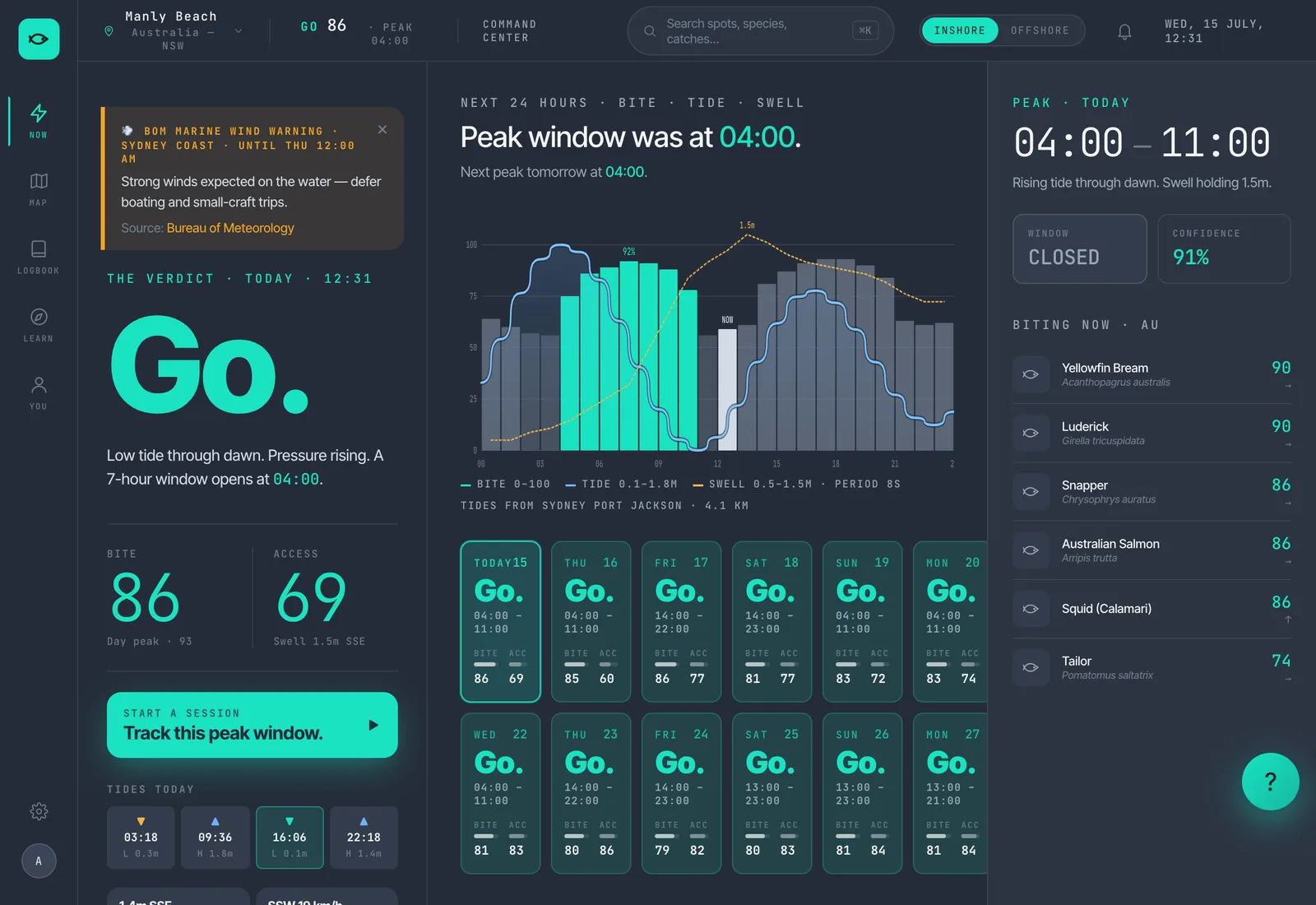
A GO morning on the command center — light wind, rising tide — the calm window the guide's spot links point kayak anglers toward.
SYDNEY HARBOUR — PARRAMATTA RIVER UPPER REACHES
INNER WEST · MANGROVE EDGES · AFTER-WORK ACCESSIBLE
The upper Parramatta from Drummoyne to Meadowbank is the most underrated kayak fishery in the metro area. Mangrove walls, shallow flats, oyster racks, and the deeper holes around Iron Cove all hold fish. Resident kingfish sit on the deeper structure year-round. The mangrove edges produce bream and flathead consistently.
LaunchPutney Park or Cabarita Park — free parking, no ramp fee, grassy launch straight onto the water
TargetBream, flathead, leatherjacket; resident kingfish in the deeper holes around Iron Cove
Why kayakThe mangrove edges from Drummoyne up to Meadowbank can't be worked from a boat without spooking everything
SafetyFerry wake, occasional commercial traffic — stay close to the banks, cross channels at right angles
Heads upSydney Harbour fish carry dioxin contamination west of the Harbour Bridge — catch-and-release only in this stretch
SOUTHERN SYDNEY · CLEANEST WATER · BACK BAYS AND CHANNELS
Port Hacking is small, clean, and the closest thing Sydney has to north-coast water clarity. The back of Burraneer, the South West Arm channels, and the Yowie Bay flats all hold fish year-round. Sight-fishing for bream and whiting is genuinely possible on the calmer days.
LaunchBurraneer Bay foreshore, Yowie Bay, Bonnie Vale — all free, all accessible by car
TargetBream, flathead, whiting, occasional kingfish in the deeper holes
Why kayakThe back of Burraneer and the South West Arm channels open up — boat traffic stays in the main basin
SafetyOpen water near Jibbon Beach — wind picks up fast on a southerly change, stay west of the Maianbar sand
Pittwater holds the biggest average flathead in the metro area, year-round kingfish in the deeper water, and a serious squid fishery on the weed banks. The flats from Mackerel Beach to Currawong are paddleable on a calm morning. Salt Pan Creek and the mangrove pockets on the western shore produce bream.
LaunchMona Vale public ramp, Bayview boat shed area, Church Point — all accessible, Mona Vale and Church Point free
TargetKingfish in the deeper water, flathead on the flats, jewfish at night, squid year-round on the weed banks
Why kayakDrift the sand stretches from Mackerel Beach to Currawong, plus the mangrove pockets around Salt Pan
SafetyThis is genuine offshore water near Barrenjoey — wind, tide, and ferry wake all in play. Stay south of Mackerel Beach until you have ten sessions under the belt.
SOUTHERN SYDNEY · MANGROVE MAZE · MASSIVE BACK-BAY AREA
The Georges from Kyle Bay up to East Hills is the biggest mangrove and shallow-flat area in Sydney. Bream and flathead are the bread and butter. Mulloway hold in the deeper holes around Como Bridge — the night bite there is one of Sydney's worst-kept secrets. Salt Pan Creek mouth is a productive flathead drift on a falling tide.
LaunchComo Pleasure Grounds, Oatley Park foreshore, Kogarah Bay — all free, all with car parking nearby
TargetBream and flathead on the flats; mulloway at night in the deeper holes around Como Bridge
Why kayakHuge area of mangrove and shallow flats from Kyle Bay up to East Hills that a tinny can't work without spooking
SafetyBull sharks present in summer, particularly upstream of Como — don't dangle hands in the water at dusk, and rinse fish blood off the kayak deck before paddling on
Cowan Creek and the lower Hawkesbury combined give you the biggest, quietest, most productive water within an hour of the city. Smiths Creek, Coal and Candle, and America Bay are the side arms — most of them are kayak-only water because the swing moorings block the main basin to bigger boats.
LaunchAkuna Bay (free public launch beside the marina), Bobbin Head (small parking fee on the picnic side), Brooklyn public ramp
TargetBream, flathead, jewfish, occasional kingie at the river mouth on the bigger tides
Why kayakCowan Creek's side arms (Smiths Creek, Coal and Candle, America Bay) are kayak-only water — moorings block the main basin to anything bigger
SafetyTidal current is strong on the bigger spring tides — pick a smaller-tide day for the first paddle and stay inside the side arms until you know the system
KAYAK-SPECIFIC SAFETY — THE BIT THAT GETS GLOSSED OVER
The Sydney estuary system kills two or three anglers a year. Most of those are rock fishers — the Sydney rock fishing safety guide covers that ground. Kayak fatalities are rarer but they happen, and the pattern is consistent — cold water immersion, no PFD, no float plan, no way to call for help.
PFD on, not strapped to the deck. Mandatory in NSW waters and life-saving in practice. A PFD bungeed behind the seat does nothing once you're already in the water. Wear it.
VHF or PLB on bigger water. A waterproof phone in a chest pouch is acceptable on the inner Harbour or the upper Georges. It is not enough on Pittwater, Broken Bay, or the lower Hawkesbury. A handheld VHF or a PLB pays for itself the first time a southerly catches you 2 km from shore.
Tell someone where you're going and when you'll be back. Marine Rescue NSW logs trips for free via the MarineRescue app — give them your launch point, your route, and your ETA. They follow up if you don't close the log.
Dress for the swim, not the paddle. Sydney winter water sits at 17–18°C. A capsize in a t-shirt in July is a hypothermia problem inside 30 minutes. Wear a long-sleeve quick-dry top and quick-dry pants minimum, a thin neoprene top in winter.
Wear bright colours. The NSW Rock Fishing Safety Act doesn't apply to kayakers, but the visibility principle does. A high-vis shirt or a yellow PFD makes the difference between a 10-minute and a 90-minute search.
The float plan
Three lines in a text message to a mate before you push off — launch point, intended route, ETA back at the car. Send a second text when you're packed up. If the second text doesn't arrive on time, the mate calls Marine Rescue. This costs nothing and is the single highest-leverage safety habit a kayak angler can build.
GEAR THAT'S WORTH THE KAYAK PREMIUM
This is not a buyer's guide. The bigger purchase decisions (sit-on-top versus sit-in, pedal versus paddle, 3 m versus 4 m) come down to your home water and your budget. But four upgrades pay for themselves on the first dozen sessions.
Anchor trolley (~$60). Lets you anchor from the bow or stern in current, which means you can hold position on a productive flat without arms or paddle. Single biggest quality-of-life upgrade a kayak angler can buy.
Rod holders — two minimum, three is better. Flush-mount or clamp-on both work. Keep one rigged with a soft plastic, one with a bait rig, one with a metal for surprise kingfish.
Fish finder. A basic Garmin Striker 4 at around $150 is enough for finding the channel edges and depth changes that kayaks excel at fishing. You don't need side-imaging or chartplotting — depth and bottom hardness are 90% of what matters.
Sun protection. Kayak sessions run 5+ hours of direct UV plus reflected glare off the water. Long-sleeve UPF top, buff or neck gaiter, polarised glasses, and a brimmed hat. Sunscreen alone doesn't cut it.
What you don't need yet: forward-facing sonar, a live-bait tank, a GoPro mount, or a second fish finder. None of those moves the catch rate in a Sydney estuary by a meaningful margin in your first year.
TWO SPECIES THE KAYAK UNLOCKS SPECIFICALLY
Bream on shallow flats
The back bays of Sydney Harbour, the upper Pittwater flats, and the Georges River shallows all hold bream that tail up in 30–50 cm of water at first light. They are sight-fishable and they are uncatchable from a boat — the engine noise, the wake, the silhouette all put them down before the cast lands. From a kayak you drift in quietly, spot the tail, cast a soft plastic five metres ahead, and let the bream swim onto the lure. The Fishare Sydney flathead guide covers the same retrieve mechanic for shallow-flat flathead.
Jewfish at night in shallow water
Como Bridge, the Spit Bridge, the Hawkesbury railway bridge pylons. All three hold jewfish that move into the shallower pylon shadows at night, especially on the quarter moon. From a kayak you drift past silently with a live yellowtail or a mullet strip under a small float, your bait skimming three metres down past the pylon. The silence is the unlock — even an electric outboard pushes too much pressure wave to keep the fish committed.
FAQ
Where can I launch a kayak in Sydney for free?
Most foreshore parks and beaches accept kayak launches at no cost — Putney Park, Cabarita Park, Mona Vale public ramp, Church Point, Burraneer Bay foreshore, Como Pleasure Grounds, and the Brooklyn public ramp are the most reliable. Boat ramps charge a fee for trailers but kayaks usually slide off the side at no cost. Always check the local council signage before parking — some carparks have time limits.
Do I need a fishing licence to fish from a kayak in NSW?
Yes. NSW requires a recreational fishing fee for anyone fishing in saltwater or freshwater, including from a kayak. The fee runs about $14 for 3 days, $35 for one year, or $85 for three years. See the Australian fishing licence guide for the verbatim rules and where to buy it.
What's the best kayak for Sydney estuary fishing?
A sit-on-top kayak between 3.5 m and 4.2 m is the Sydney sweet spot. Long enough to track well across open water like Pittwater, short enough to manoeuvre in the mangrove side arms of the Georges. Pedal-drive kayaks (Hobie, Native, Old Town) free your hands for fishing but cost twice as much as a paddle equivalent. For a first kayak, a second-hand paddle sit-on-top in the $400-700 range gets you fishing — upgrade once you know what you actually want.
Is it safe to kayak fish in Sydney Harbour?
Yes, with the standard precautions — PFD on, stay close to the banks, cross shipping channels at right angles, and avoid the main ferry routes during peak hours. The biggest risk in the Harbour is wake from commercial vessels, not the water itself. Stick to the upper Parramatta, Middle Harbour, or North Harbour for your first sessions and you'll never see a serious wake.
Can I keep fish I catch from a kayak in Sydney Harbour?
Only east of the Harbour Bridge. NSW DPIRD declares the Parramatta River and Sydney Harbour west of the Bridge a no-take zone for all species because of historic dioxin contamination in the sediment. East of the Bridge you can keep fish under standard NSW bag and size limits, though most kayak anglers fishing the upper reaches release everything by default.
What time of day is best for kayak fishing in Sydney?
First light through to about 9 a.m. is the highest-percentage window across every Sydney estuary. The water is calmest, the wind is lightest, the fish are most active on the flats, and the boat pressure is lowest. The last hour before dusk is the second-best window. The middle of the day is the worst — wind, glare, boat wake, and reduced fish activity all stack against you. See the first fishing session in Sydney guide for the full pre-session checklist.
Olli-Mikael Vaittinen has fished his whole life. Fifteen years of fly fishing, guiding seasons on Norway's Lakselva — his favourite Atlantic salmon river — and a blue marlin landed in Vava'u, Tonga. Founder of Fishare — the app that puts the data behind the decisions every angler makes on the water.
CHECK TODAY'S KAYAK WINDOW BEFORE YOU LOAD THE CAR
Fishare scores the next 7 days at every Sydney estuary using live wind, tide, swell, pressure and SST data. Save your home estuary and get pinged when the next calm-morning, light-wind, rising-tide window opens. Free forever for everyone who joins now.