Most fishing clubs run monthly competitions the same way they have for twenty years: entry forms by email, weights phoned in on the day, one volunteer who spends their Sunday evening building a leaderboard in Excel, and a final-results post on Facebook that someone will argue about in the comments by Monday morning.
It works, mostly. But it creates friction that caps participation, puts a disproportionate burden on one or two organisers, and leaves the door open for the disputes that erode trust in any club over time.
This guide covers the practical mechanics of running a fishing competition — scoring formats, catch verification, managing entries, handling disputes — and then shows what's available for clubs that want to automate the parts that don't need a human.
The four decisions every comp organiser makes
Before you open a registration form or set a date, four structural decisions shape everything else:
1. Scoring format
There's no universally right answer. The best format depends on whether you want to reward a single great fish, a consistent catch over the day, or breadth across species.
| Format | How it works | Best for |
|---|---|---|
| Longest single fish | One measurement per entrant, biggest wins | Simple comps, clear leaderboard, no measurement disputes |
| Heaviest single fish | Weight on a scale, biggest wins | Boat comps where weigh-stations are accessible |
| Sum of top-N lengths | Add the 3 or 5 best fish per entrant | Rewards consistency; reduces luck-of-one-fish variance |
| Species slam points | Points per species category: bonus for slam completion | Multi-species or estuary comps; rewards versatility |
| Season point ladder | Points awarded per round, accumulated over the year | Annual club championship; keeps members engaged month-to-month |
Mix-and-match is common: monthly rounds use "sum of top-3 lengths," the annual ladder accumulates points from each monthly result, and a winter slam gives bonus points for a four-species bag.
2. Species eligibility and size limits
Define this in writing before the comp opens, not when a dispute arises. Reference NSW DPIRD, QLD DAF, or WA Fisheries bag and size limits for your target species and include them in the rules document. Any fish below legal minimum size is disqualified automatically. Clubs that set species minimums above the legal limit (e.g. 40cm minimum for bream when the legal minimum is 25cm) should state this explicitly.
If your comp includes catch-and-release, establish whether you're measuring length (on a mat, tip of jaw to tail) or using a standard measuring tape photo. Inconsistent measurement method is the most common source of post-comp disputes.
3. Catch verification
This is where most clubs leave money on the table — or create arguments that outlast the comp.
The standard is a photo with a measuring device in frame, taken at the time of catch. The problems that arise:
- Pre-staged entries — catch logged the week before, submitted during the comp window. Without a timestamp check, this is unverifiable.
- Measurement disputes — fish measured tail-not-pinched, tape not flush, hand covering the reading. Hard to adjudicate from a photo taken at arm's length on a rocking boat.
- Location disputes — comp is restricted to a defined waterway; entrant claims to have fished there, no one can verify.
The most reliable low-tech verification for club comps: announce a code word at the start of the comp window (or require a specific timestamp pose), and require it to appear in the catch photo. Anyone with a pre-staged entry can't retroactively add it. This is the same principle competition anglers use in the US and UK circuits for closed-access events.
4. Entry and result collection
A shared Google Sheet or Messenger thread works up to about 15 entries. Above that, the organiser's Sunday evening becomes a real cost, and the risk of a transcription error affecting the leaderboard grows with every entry.
The options available to Australian clubs:
- Google Forms + Sheet + manual leaderboard — free, familiar, volunteer-dependent
- Fishing comp spreadsheet templates — reduces setup time per comp; still requires manual data entry and leaderboard updates
- Purpose-built competition apps — automate entry, leaderboard, and season ladder. Relevant if your club runs more than 4 comps per year or wants a season points ladder across rounds.
Season ladders — the glue that keeps members active between comps
Individual comps spike engagement around the comp date. Season ladders extend that engagement across twelve months. The mechanism: each comp round earns points for the season table based on finishing position. Members who miss a round stay invested in the season because they can still recover in subsequent rounds.
Setting up a season ladder manually is feasible for a one-off year. Maintaining it across 10-12 monthly rounds while ensuring results from each round feed correctly into the cumulative season table is where the volunteer cost becomes significant enough that clubs either stop doing it or assign a dedicated treasurer-equivalent role to manage it.
A rule that sustains member engagement year-round: allow members to drop their two lowest-scoring rounds from the season total. This means someone who misses a comp in December because of family commitments isn't disadvantaged in the February standings. Clubs that implement this see higher attendance in the second half of the season.
What disputes actually look like — and how to prevent them
Most fishing comp disputes fit three patterns:
The measurement dispute. "Their fish was clearly 48 not 51." Prevention: standardise the measurement photo requirement — fish flat on a mat, jaw at zero, tail extended (not pinched), tape in frame. If the photo doesn't meet the standard, the entry is invalid. Publish this in writing before the comp.
The timing dispute. "They submitted a fish they caught at 6pm but the comp ended at 5pm." Prevention: require entries to be submitted within 30 minutes of catch, not batched at end of day. Or use a system that timestamps each entry server-side at submission.
The location dispute. "They weren't fishing in the allowed area." Prevention: if location matters, require GPS coordinates in the submission. If your comp covers a broad area and location isn't a differentiating factor, don't add it to the rules — it creates an enforcement obligation you can't meet.
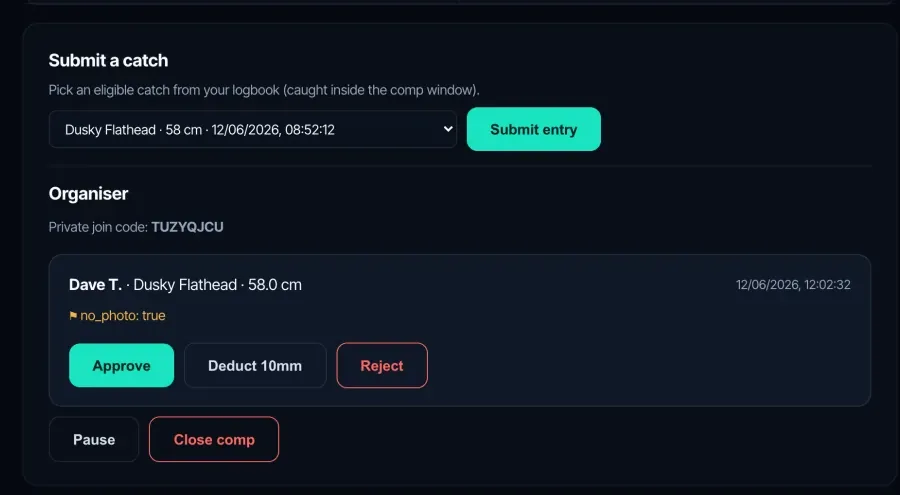
Running club competitions on Fishare
Fishare Competitions is available free for any Australian club to run. It was built to solve the specific problems above:
- Code-word verification — a word announced at comp start, required in the catch photo. Pre-staged entries can't retroactively include it. No expensive hardware required.
- Live leaderboard — updates in real time as entries are approved. Members can check standings from their phone during the comp, not just after the organiser builds the spreadsheet.
- Scoring formats — longest single fish, sum of top-N lengths, or species slam points. Set per comp.
- Season point ladders — configure once, aggregate automatically across monthly rounds. No manual carry-forward needed.
- Members-only comps — restrict entry to club members. Open public comps are also supported for events where you want outside participation.
- Location privacy — catch coordinates are never shown on any comp surface. This was non-negotiable for club members who consider their spots confidential.
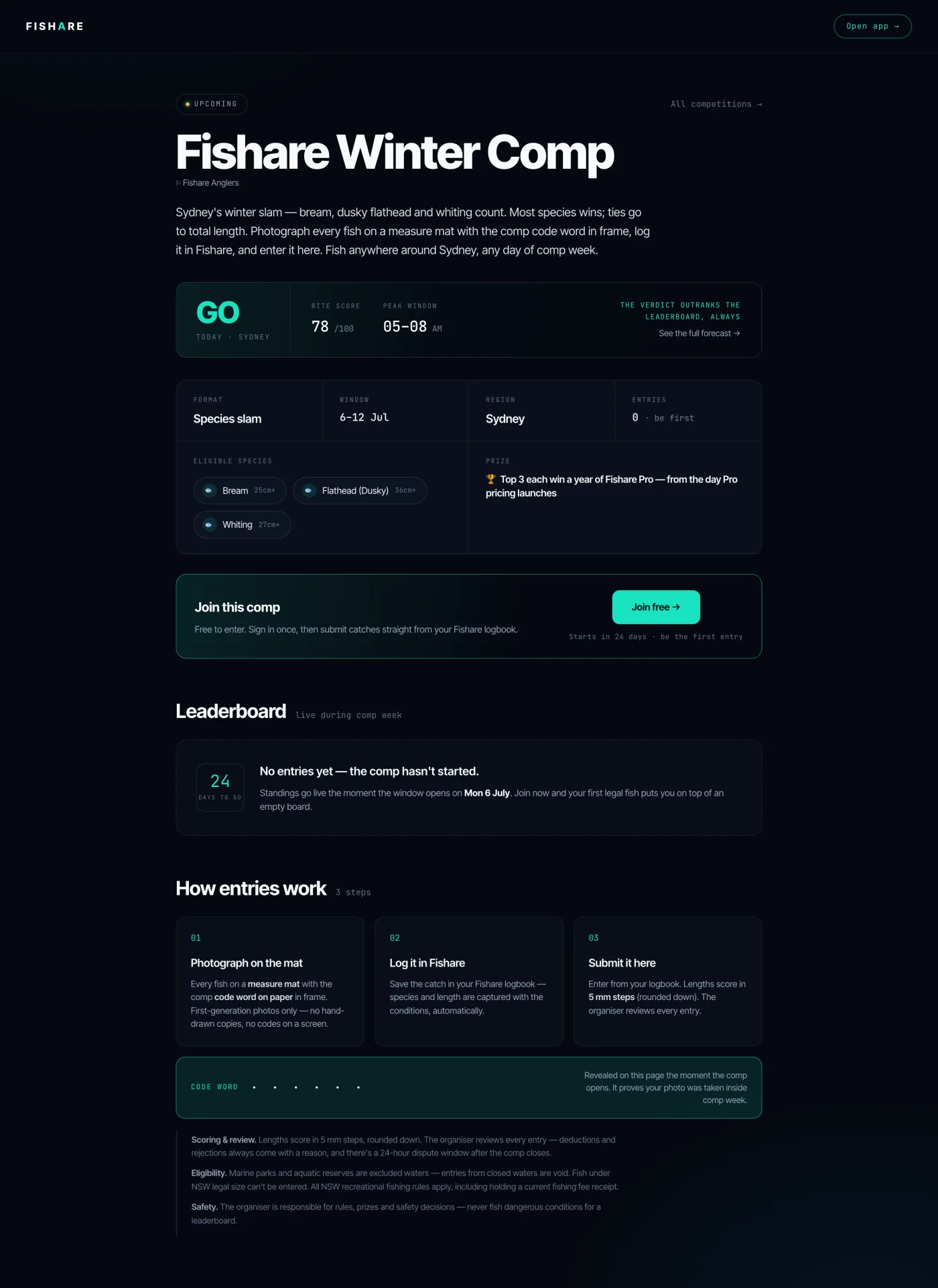
Setting up a comp takes under 10 minutes: name, time window, eligible species, scoring format, code word. Entry is from the catch log — photograph the fish, add the code word to the photo, submit. The leaderboard updates immediately.
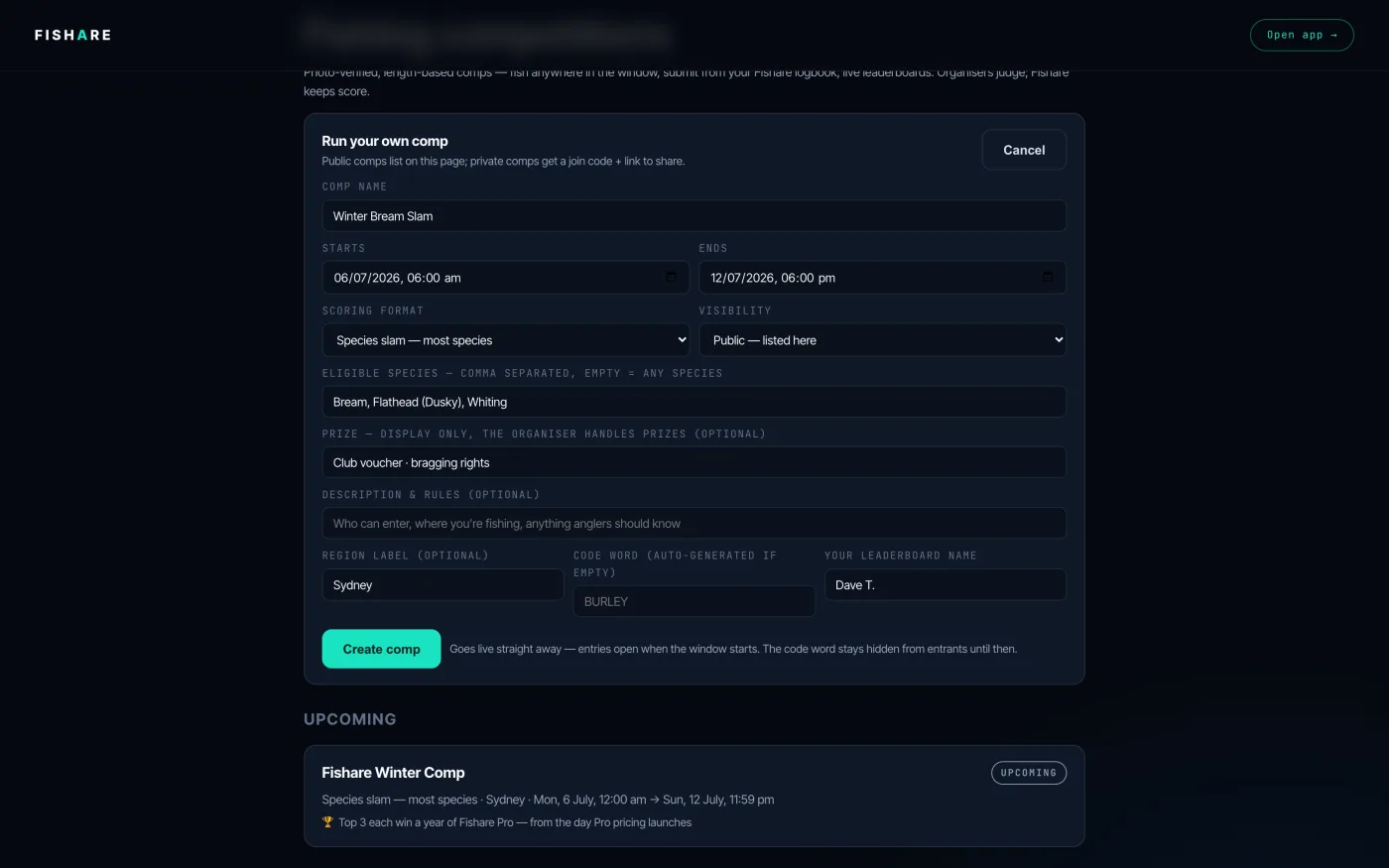
Club accounts are free — forever: unlimited members, competitions and admins, with every feature included. There are no tiers and nothing to upgrade to. The club organiser guide & FAQ walks through the whole setup.
Practical checklist for setting up your first comp
- Choose your scoring format and write it down before you announce the comp.
- Reference the current state bag and size limits for your eligible species. Link to the source document, not a summary.
- Set your measurement photo standard: mat, jaw at zero, tape in frame. Make it a rule, not a suggestion.
- Choose your verification method — code word is the lowest-friction option for most clubs.
- Define the entry window clearly: start time, end time, and submission deadline. Sunday midnight is usually fine; the same day as catch-end causes late scrambles.
- Nominate who resolves disputes and what "final" means — one named person or a committee of three.
- Announce the comp minimum 7 days in advance. Shorter lead time reduces participation.
The most common mistake clubs make with new comp management tools is trying to automate too much in the first round. Set up one comp with a simple scoring format, run it, and let members give feedback on the submission flow before you add the season ladder in round two.
Useful resources
- NSW DPIRD bag and size limits
- QLD DAF recreational fishing rules
- WA Department of Primary Industries and Regional Development — Fisheries
- NSW saltwater bag and size limits reference (Fishare)
- Fishare Competitions — feature overview
Set up your club competition
Live leaderboards, code-word verification, season ladders. Free to run. Works in any browser — no app download needed.
Go to Competitions Founding club offer