The basics, fast
Yellowfin bream (Acanthopagrus australis) are NSW's most-fished species — abundant from Cape York to Mallacoota, present in every estuary, harbour, headland and ocean beach along the coast. They're stubborn, suspicious, structure-oriented, and reward technique over gear.
- Range: Cape York to eastern Victoria. Strongest populations in NSW estuaries from the Hunter to the South Coast. They're at home in salt and brackish water, less so in pure freshwater.
- Size: Most caught fish are 22–30cm. Anything over 35cm is a quality fish. 40cm+ ("forty-up bream") is genuinely worth a photo. The state record is just under 50cm.
- Diet: Crustaceans, prawns, worms, crabs, small baitfish, oysters, mussels, cunjevoi. Wide-spectrum opportunists.
- Habitat: Structure — oyster racks, bridge pylons, mangrove roots, deep snags, rock walls, weedbeds, sand flats with broken bottom. They orient to edges.
- Lifespan: 20+ years for big estuary fish. The 40cm fish you release lives another 5+ years.
When bream bite — the seasonal calendar
Bream are a year-round species, but the year breaks into four distinct phases. Match technique to phase and the fishing transforms.
| Phase | Months | Where | Best technique |
|---|---|---|---|
| Pre-spawn | Mar–Apr | Mid estuaries, drains | Plastics on light jigheads, hard bodies on edges |
| Spawn run | May–Jul | Estuary mouths, ocean beaches, rocks | Beach worms, fresh prawn, soft plastics in the wash |
| Winter recovery | Aug–Sep | Deep estuary holes | Slow plastics, soft vibe baits, fresh nipper |
| Spring–summer | Oct–Feb | Flats, mangroves, oyster racks | Surface lures dawn/dusk, plastics on shallow flats |
Two windows produce the most quality bream: autumn pre-spawn when fish feed up before moving to spawning grounds, and summer surface fishing on glassy mornings over flats and around mangroves. The surface bite in particular is one of the most addictive sessions in NSW fishing — a 35cm bream eating a Sugapen on top is unforgettable.
Where bream actually live
The "where" is more important than the "what." Bream live on edges. Find an edge.
Oyster racks and leases
Sydney's working oyster leases (Hawkesbury, Brisbane Water, Port Stephens) are bream factories. The fish patrol the rack lines hunting for crabs and worms knocked off by the current. Cast plastics or hard bodies right against the racks — within a foot — and twitch them out. Heavier leader (8–10lb fluoro) survives the rack scrape; lighter leader breaks off.
Bridge pylons and rock walls
Almost every NSW estuary bridge holds bream year-round. The pylon edges are ambush points; fish sit in the shadow on a moving tide and intercept anything pushed past. Cast upstream, let the lure drift down past the pylon. The take is often on the drift, not the retrieve.
Mangrove edges
The first 30 minutes of run-out tide along a mangrove edge produces consistently. Fish hunt for mud crabs, prawns, and small baitfish that get pushed off the flats. Skip plastics under low branches with a side-arm cast; surface lures work as the light fades.
Sand flats with broken bottom
Look for sand flats with patchy weedbeds, rubble, or broken oyster shell. Big bream cruise these in the heat of summer mornings. Stalk on foot if you can; the take is visual, fish will eat a surface lure inches from your feet.
Beach gutters and rock washes
The June–July spawn run brings bream out of the estuaries onto the open ocean. Fish the same beach gutters and rock washes you'd target for tailor or salmon. Beach worms, peeled prawn, fresh squid. The fish are big and feeding hard — this is when 40cm bream are caught off the rocks.
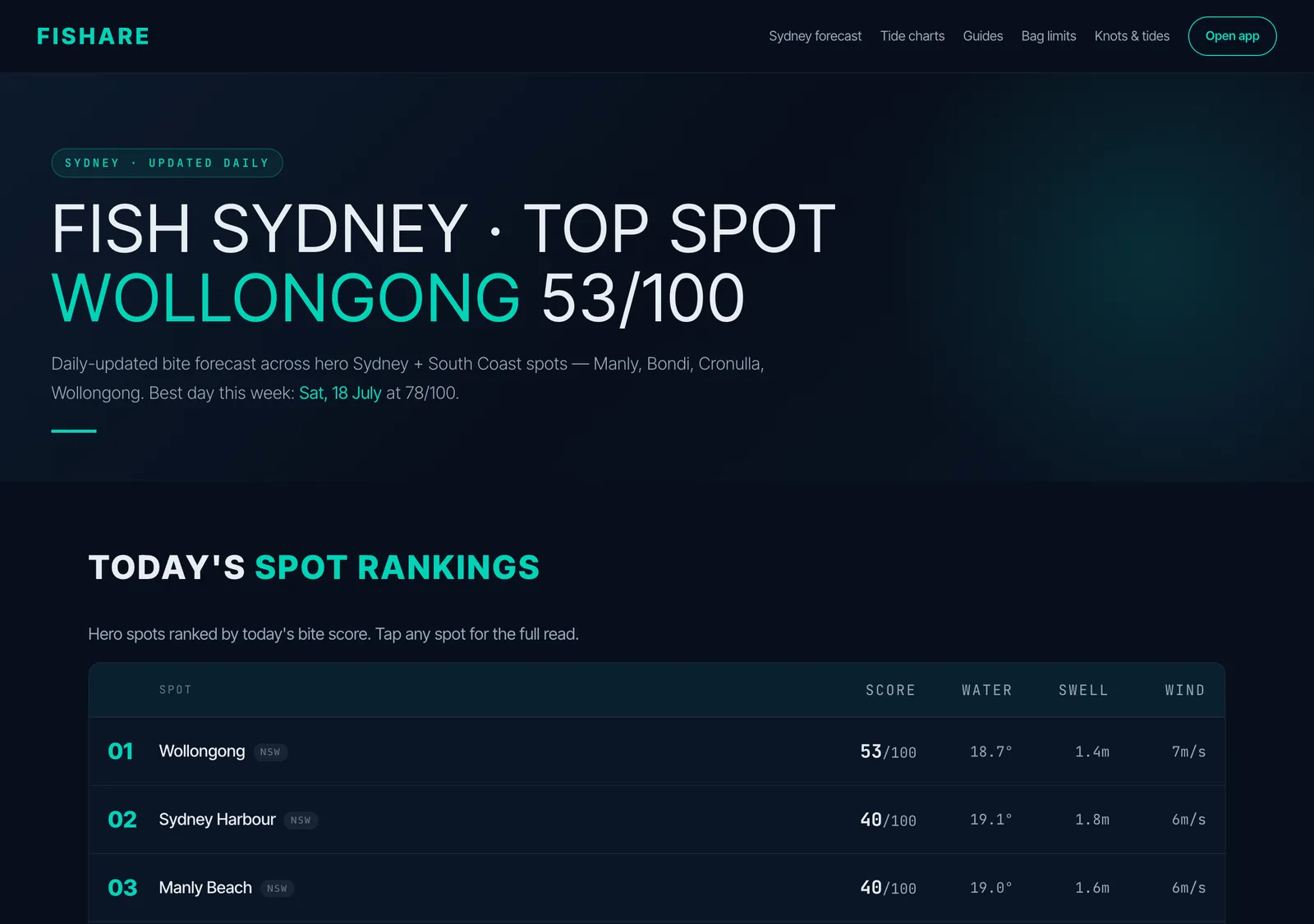
The current Sydney 7-day forecast has the day-by-day tide phases and peak windows for every hero spot at /forecast/sydney/. Bream are most predictable in the first 90 minutes of run-out and the last 60 minutes of run-up.
Reading the day — what actually matters
Tide phase
The single biggest variable. Bream feed best on moving water — the more flow, the more bait gets pushed past their ambush points. Spring tides outfish neaps, run-out outfishes run-up for most estuary work, and the change of tide is when many big fish move shallow.
Water clarity
Bream see well. Clear water means line-shy fish, lighter leader (2–4lb), more natural lure colours. Dirty water from rain runoff means heavier leader (6–8lb), brighter lures, more vibration.
Water temperature
Optimum 18–24°C. Below 16°C the bite slows but never stops; above 26°C they get lethargic and go deep through the heat of the day, only feeding dawn/dusk.
Barometric pressure
Stable or slowly rising pressure outfishes a rapid drop. The exception: the 12 hours before a strong southerly change. Bream feed up before a front, then shut down through the change itself.
Gear by technique
Three rod-and-reel setups cover 90% of NSW bream fishing. Match technique to water — don't try to make a 4kg outfit work for spinning surface lures on flats.
Light spinning (general estuary)
- Rod: 7' 1–3kg or 7'2" 2–4kg fast taper
- Reel: 1000–2500 size, smooth drag (Stradic FL, Stella, Daiwa Certate)
- Line: 4–6lb braid (Sufix 832, Daiwa J-Braid)
- Leader: 4–6lb fluorocarbon, 1.5m
- Use for: Plastics, light hard bodies, lightly weighted baits
Surface / flick stick (flats and surface lures)
- Rod: 6'8" or 7' 1–3kg, sensitive tip
- Reel: 1000–2000 size
- Line: 4lb braid (low diameter for casting tiny lures)
- Leader: 3–4lb fluorocarbon, 0.8–1m
- Use for: Stickbaits (Bassday Sugapen 70mm, Cranka Frog), poppers, small surface walkers
Heavier estuary (oyster racks, snags, beach)
- Rod: 7'2" 3–5kg or 7'6" 4–6kg
- Reel: 2500–3000 size
- Line: 8–10lb braid
- Leader: 8–12lb fluorocarbon, 1.5m
- Use for: Pulling fish out of oyster racks or heavy snags before they bury you, beach worming
Lures and baits — what actually works
Soft plastics — the workhorse
For estuary bream, plastics outfish everything else. The standards:
- Berkley Gulp Shrimp 2" in Banana Prawn, Peppered Prawn, Glow — a fish-magnet, slightly cheating, but devastatingly effective
- Z-Man GrubZ 2.5" in Motor Oil, Pearl, New Penny — softer plastic, more natural fall
- Squidgy Pro Wriggler 70mm in Bloodworm, Black Gold, Wasabi — better for slightly bigger water
Rig on 1/16oz to 1/12oz jigheads (size 1/0 hook) — let it sink, let it sit, soft twitches. The take is almost always on the drop. Slow down. If you're moving the lure too much, you're working too hard.
Hard bodies — high-percentage edges
For working bridge pylons, oyster racks and rock walls:
- Megabass Vision OneTen Junior 95mm — premium, expensive, catches more fish
- Daiwa Double Clutch 60SP — cheaper, works almost as well
- Lucky Craft Pointer 65SP — proven, suspending, twitch-pause
Cast tight to structure, twitch-twitch-pause cadence with 3–5 second pauses. The take is on the pause, not the twitch.
Surface lures — the addictive bite
For dawn flats and mangrove edges:
- Bassday Sugapen 70mm — the classic. Walk-the-dog cadence, slow.
- Cranka Frog Standard — for over weed and lily-pad edges
- OSP Bent Minnow 86mm — when the wind picks up and the Sugapen won't get bites
Bait — when nothing else works
Live nipper (yabby/Bass yabby) on a small running sinker rig is hard to beat. Beach worm for ocean fish. Fresh peeled prawn on a #2 long-shank for snag work. If the fish are pressured (Sydney Harbour, Hawkesbury) bait sometimes outfishes lures by 5:1.
Tactics — the high-percentage approaches
1. The plastic + rack drift
Drift along an oyster rack line on the run-out tide. Cast a 1/16oz Gulp Shrimp 2" tight against the racks, let it sink to the bottom, then a single soft twitch every 5 seconds. Most takes happen on the second drop after a twitch. Set the hook on weight, not on tap.
2. The bridge pylon work
Position upstream of a pylon. Cast a hard body upstream, retrieve back so it works past the pylon shadow. Pause for 3 seconds when the lure reaches the shadow line. Twitch once, pause again. Most fish hit on the pause-after-twitch.
3. The dawn flats walk
Glassy summer dawn, flats <80cm deep with broken bottom. Walk slowly, cast small surface lures (Sugapen 70) ahead of where you're walking. Walk-the-dog cadence with long pauses. Watch for boils, bow-waves, or the lure simply disappearing. Visual fishing at its best.
4. The beach gutter spawn run
June–July, ocean beaches, the bottom of run-out tide. Beach worm or fresh peeled prawn on a #1 ringed circle, light running sinker, cast 30m into the gutter. Let it sit. Bream are in pulses — quiet for 20 minutes, then several fish in 10 minutes.
5. The deep-hole winter slow-roll
August, mid estuaries, find a deep hole (>4m). Cast a 1/8oz vibe bait or 3" plastic on a 1/8oz head, let it hit bottom, slow-lift-and-drop with the boat drifting. The fish hold tight to the bottom in cold water; you have to put it on their nose.
Regulations and ethics
Always verify current NSW DPI rules before keeping fish. As of 2026 the recreational limit is 10 bream per person per day, minimum size 25cm. Most experienced anglers release everything over 30cm — the bigger fish are slow-growing breeders that drive the next generation.
Catch and release works well with bream — they survive release if hooked in the mouth and handled wet. Hooked through the gills or gut, the fish dies regardless. Use barbless hooks if possible; circle hooks if bait fishing.
Common mistakes
- Working the lure too fast. Bream are deliberate feeders. The take is almost always on a long pause. Slow down — slower than feels reasonable.
- Heavy leader in clear water. 8lb fluoro in clear estuary water spooks bream. Drop to 4lb for plastics work; the extra bites outweigh the lost fish to abrasion.
- Wrong jighead weight. Too heavy and the lure crashes through the strike zone too fast. Too light and you can't hit bottom in current. Match weight to depth: 1/16oz for under 2m, 1/12oz to 1/8oz for 2–4m, 1/6oz for deeper.
- Spooking flats fish. A loud hull slap on a glassy morning kills the bite for an hour. Walk softly. Long casts. Let your shadow fall away from the fish.
- Setting the hook on tap. Bream often mouth a lure for 1–2 seconds before committing. Wait for weight on the line, then lift smoothly. Striking too early pulls the lure out.
- Going on dead tides. Slack water = no current = no feeding. Plan trips around tide change, not your weekend.
The honest truth about bream
Bream are the species that teaches you how to fish. They're abundant enough that you'll catch them as a beginner; subtle enough that they reward decades of refinement. The 40cm fish on light plastics in a busy Sydney estuary is harder than most people's first marlin.
What separates anglers who consistently catch quality bream from anglers who occasionally land one isn't gear or location — it's presentation, patience, and tide reading. Slow down. Match leader to clarity. Fish the moving water. The bream do the rest.