Whiting are the third-most-talked-about species on Sydney's estuary boards for a reason. A 40 cm sand whiting on 6 lb fluoro out of Pittwater fights harder pound-for-pound than most reef fish you will land in twice the depth, and Sydney holds genuine 45-plus-cm fish if you know where to look. This guide covers both the species that matter here — sand whiting (Sillago ciliata) and school whiting (Sillago flindersi) — the seasonal calendar, the spots, the running-sinker rig, the bait order, and the underrated surface-popper bite on shallow flats at dawn.
12-minute read · Verified May 2026 · NSW DPIRD 2024-25 rule set · Sydney estuaries and beaches
SAND VS SCHOOL WHITING — THE DIFFERENCES THAT MATTER
Both species hit the bait the same way and both eat the same on a plate, but they live in different places and grow to different sizes. Knowing which one is in front of you tells you whether you are working the right ground, and whether the average run-of-fish is the keeper class or the size you put back.
Sand whiting
School whiting
Body shape
Longer, deeper, pronounced silver flanks
Slimmer, less depth, greyish back
Habitat
Ocean beaches, estuary sand flats, harbour back bays
Estuaries year-round, softer / muddier bottom
NSW min size
27 cm
27 cm
Average run
30–40 cm; trophy class 45+
27–30 cm; harder to find above 30
Flesh
Slightly firmer, holds together pan-frying
More delicate, almost flaky
Freezer
Better fresh — both lose quality after a week frozen
Same — eat within 3–4 days fresh
Body shape and colour
Sand whiting are longer and deeper through the shoulder, with bright silver flanks that flash when the fish rolls in shallow water. School whiting are slimmer, less depth front-to-back, and the dorsal surface is a soft greyish colour rather than the brighter silver of the sand. Hold two side by side at the cleaning table and the difference is obvious; alone, the body depth at the pectoral fin is the cleanest tell.
Habitat
Sand whiting are the species you target on ocean beach gutters, on the clean sand flats of Pittwater and Botany Bay, and in the harbour back bays where the bottom is firm and pale. School whiting live deeper inside the estuaries, holding on softer and muddier ground, and they tolerate dirtier water than the sand will. If the bottom looks like mud and the water is stained, school is the more likely fish; if the bottom looks like a beach and the water is clean, sand is the answer.
Size
NSW DPIRD sets the minimum legal size for both species at 27 cm total length. Sand whiting commonly run 30–40 cm around Sydney with trophy-class fish at 45 cm and a handful over 50 cm landed in the system every year. School whiting struggle to crack 30 cm in Sydney estuaries — they are a smaller-bodied fish to begin with, and an above-average school is a 28 cm fish.
Eating quality
Both excellent, both better fresh. Sand whiting flesh is slightly firmer and holds together better in the pan. School whiting is more delicate, almost flaky when cooked. Neither species freezes well — they go off in flavour and texture inside a week in the freezer, where bream and flathead handle freezer time without complaint. Eat what you catch within three to four days; do not stock the freezer with whiting.
THE SYDNEY SAND-WHITING SEASONAL CALENDAR
Sand whiting are a warm-water-leaning species. They peak in summer when water temperature pushes past 20°C and the flats hold prawns, beach worms, and nippers. They do not vanish in winter — they pull back into deeper estuary channels and hold on the dropoffs — but the bite rate halves and the average size drops.
Nov – Mar
Peak · Flats and beaches
Water 21–24°C. Ocean beach gutters fire. Pittwater flats hold fish on every run-out tide. Botany Bay sand banks the second-best window. Average run 30–40 cm, trophies on dawn flats.
Apr – Aug
Thin · Deeper channels
Water 16–19°C. Fish leave the beaches and stack in the deeper estuary channels — Pittwater main channel, Botany Bay drop-offs, Port Hacking 3–6 m sand. Bait beats lures here. Smaller average size.
Sep – Oct
Rebuilding · Light flats
Water back to 18–20°C. Fish push back onto the flats but the average size is small. Catch-and-release on the smaller ones, keep one or two if they make 27 cm. The trophy class returns from late October.
What the bite-score model actually picks up
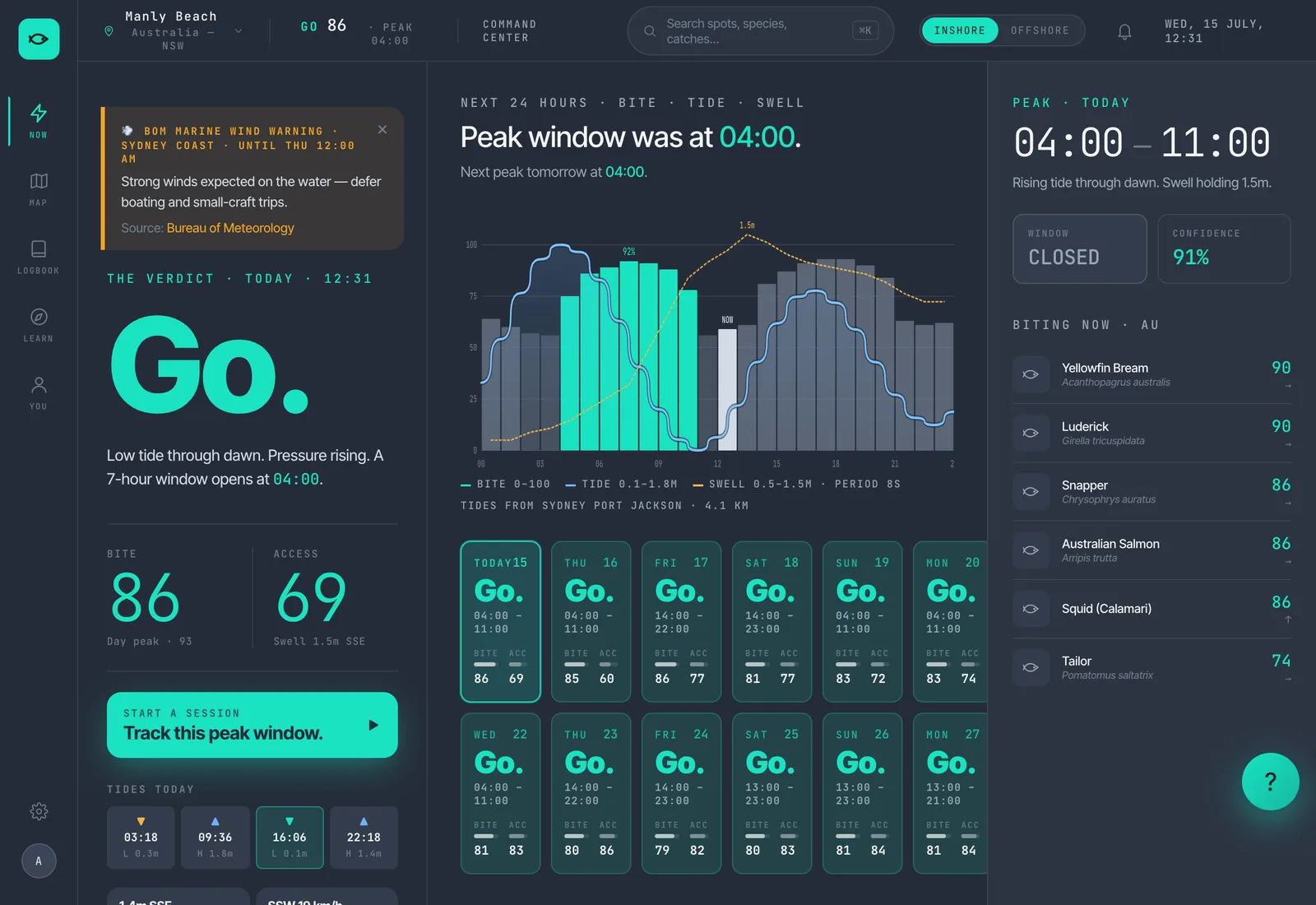
The Fishare bite-score for whiting weights wind direction higher than barometric pressure, which is the inverse of what the model does for snapper or jewfish. Whiting feed by sight on clean sand, and a 15-knot onshore wind dirties the water column over the flats — they switch off. A light northerly or a westerly that flattens the harbour and clears the column produces twice the catch rate of an east or south-easterly of the same strength, even with the same barometer and same tide. Check the wind forecast on the Sydney forecast page before you commit a session to the flats.
The bite score and the conditions behind it — for whiting the model leans hardest on wind, exactly as the text explains.
WHERE THEY HOLD IN SYDNEY
Below are the productive sand-whiting locations within an hour of the CBD, ordered roughly by consistent catch rates over the warm season. Each fishes differently — beaches are stand-and-wait, flats are drift-and-cover-ground, back bays are walk-and-cast. Pick by what suits your day and your gear.
PITTWATER FLATS
NORTHERN BEACHES · MACKEREL · CURRAWONG · LOVETT BAY
Pittwater is the trophy water for sand whiting in Sydney. I find sand whiting most reliable on the back-bay run-out around Currawong and the sandy stretches near Lovett Bay — drift a baited rig across the flats on a falling tide, two or three light sinkers along a 50 m drift, and the average bite rate is one fish per ten minutes through a peak December afternoon. Mackerel Beach fishes the same way from the kayak on a higher tide.
Best monthsNov–Mar peak, Oct and Apr shoulder
Average size32–42 cm
Trophy class45–50 cm on the back-bay sand at first light
AccessSpot forecast · Bayview ramp, Church Point ramp, Palm Beach ferry to Mackerel
BOTANY BAY SAND BANKS
SOUTH SYDNEY · TOWRA POINT MARGIN · SILVER BEACH
Two productive sub-systems. The north side around the Towra Point margin is kayak country — the foreshore inside the aquatic reserve is accessible by foot only along defined paths (check the Sydney aquatic reserves guide for closures), but a kayak drift across the sand banks just outside the reserve produces consistently. Silver Beach on the south side is stand-on-the-beach territory — small ball sinker, beach worm, cast 20 m into the first gutter.
Best monthsNov–Feb peak, Oct and Mar shoulder
Average size30–38 cm
AccessSilver Beach foreshore, Sans Souci ramp, Foreshore Park ramp
CRONULLA / BATE BAY SAND
SOUTHERN SYDNEY · OCEAN BEACH CLASSIC
Wanda, Eloura, North Cronulla — all the same fishery. A morning or afternoon session at the back of a shore gutter with beach worm on a 4/0 long-shank is the textbook Sydney sand-whiting beach run. Larger average size than the inside-estuary fish, the trade-off is wave management — the deeper second gutter usually holds the bigger fish but a 20-knot easterly closes the whole beach.
Back inside the river mouth at Bundeena and across to Maianbar, the sandy back flats fish exactly like Pittwater on a smaller scale. The water clarity is among the best of any Sydney estuary, and sight-fishing on the Maianbar flats at low tide is realistic on a flat morning. The advantage over Pittwater is the access — you can wade or kayak from the Bundeena ferry wharf and reach productive sand inside ten minutes.
Best monthsNov–Mar peak
Average size30–40 cm
AccessBundeena ferry from Cronulla, Gunnamatta Bay ramp by kayak
THE SPIT / MIDDLE HARBOUR BACK END
SYDNEY HARBOUR · CLONTARF · EDWARDS BEACH
The shallow sand off Clontarf and the back end of Middle Harbour around Edwards Beach is the dark-horse sand-whiting fishery in Sydney. Quietly productive on a high tide push, lower pressure than the estuary classics, and accessible from a kayak launched at Tunks Park or even on foot from the Clontarf shore. Fish run smaller on average than Pittwater but the consistency is what wins it a spot on this list.
Best monthsNov–Mar
Average size28–36 cm
AccessClontarf foreshore, Tunks Park ramp, Spit Bridge ramp
THE RIG THAT ACTUALLY WORKS
The running-sinker rig is the whiting rig. Decades of beach and estuary fishing have not produced a better one for this species. Build it light, build it long, and accept that you will lose the occasional rig to a stingray or a flathead by-catch.
Mainline — 6 lb braid (8 lb maximum). Anything heavier and the bite feel disappears.
Sinker — small ball sinker, running on the mainline above the swivel. Size #1 ball on the beach, size 0 or 00 on the flats. Use no sinker at all if the cast distance allows it on a shallow flat.
Swivel — size 10 or 12, the smallest you can comfortably tie.
Leader — 1 m of 6 lb fluorocarbon. Length matters; a short leader sits the bait too close to the sinker and the strike drops.
Hook — size 4 long-shank, in either chemically-sharpened red or plain bronze. Mustad 540 or Gamakatsu LS-3113B are the two I keep in the box.
Why long-shank, not circle
Whiting take the hook deep on a slow swallow — the bite mechanics are different from bream or flathead, which strike and turn. A long-shank hook sits the hook eye well clear of the gullet, and a pair of long-nose pliers slides the whole hook out cleanly without gut-hooking the fish for release. Circle hooks are the wrong tool for whiting; the bite cycle does not match how a circle is meant to set, and you end up with poorly hooked fish and dropped strikes. Stay with the straight long-shank.
Sinker philosophy
Use the lightest sinker you can cast and hold the line straight. On the flats in calm conditions, no sinker at all and a slow bait drift across the bottom outfishes a ball-sinker rig by a clear margin. On the beach the smallest ball that holds in the gutter is the answer. Heavy sinkers spook whiting — they are a shy fish in shallow water and a 3 oz star sinker thumping into a shore gutter clears the area for ten minutes.
BAIT — THE BORING TRUTH
The bait order for whiting is decided by what they actually eat in the wild, not by what is convenient. Nippers and beach worms are the top of the table for a reason — they are the natural prey item — and every step down from those is a measurable drop in bite rate.
1. Nipper / bass yabbie
The top-shelf bait. Caught fresh that morning at the launch ramp or off the flats with a yabbie pump, fished alive on a size 4 long-shank, and you will out-fish everyone else in the bay by a four-to-one ratio. Hook them through the tail segment from underneath, point exposed, and let them work naturally on the bottom. Frozen nippers work too but the bite rate halves; fresh is the rule.
2. Beach worm
For ocean beach work. Fewer anglers bother to gather them — the technique with a stocking and a piece of pilchard takes a session to learn — but a beach worm is the deadliest sand-whiting beach bait there is, full stop. Cut a 4 cm length, hook through one end and thread up the shank, leave a wriggling tail. One worm gives three to five baits.
3. Pippie (pipi)
On Sydney's ocean beaches, pippies work well and are easy to find at the swash line on any half-tide. The shells crush in your fingers, the meat goes onto the hook, and they fish well in clear water gutters. Less effective inside the estuaries because the fish do not see them as often.
4. Prawn
Works, always second choice. A fresh peeled prawn tail on a long-shank will catch whiting all day but the bite rate sits well below nippers or worms. Use prawn when nippers are not available. School prawns (smaller, whole-shelled) outperform tiger prawns for whiting — match the bait size to the natural prey.
5. Squid strip
Last resort. Whiting will eat squid but they prefer it fresh and small — a thin 3 cm strip, not a thumb-sized chunk. Useful when nothing else is available, never a first choice.
Bait care
Keep bait cool from the moment it leaves the bait jar. Nippers in a small aerated bucket of seawater stay alive for the session; worms go in a damp newspaper wrap on the ice in the esky. Change the bait every ten minutes if it goes soft — a tired bait sits dead on the bottom and whiting walk past it. Fresh, lively, and changed often is the rule.
LURES AND SOFT PLASTICS — THE DROPSHOT REVOLUTION
Lure fishing for whiting was a fringe practice ten years ago and is now a legitimate alternative on shallow flats. The breakthrough was the small worm-style plastic on a featherweight jighead, fished slow. The second breakthrough was the surface popper, which produces strikes that look like a small trout taking a dry fly.
Soft plastics — the dropshot worm
A 2-inch worm-style plastic on a 1/16 oz jighead is the rig. Slow, twitchy retrieve — two short hops along the bottom, pause, two more hops. Most strikes come on the pause. The plastic should sit on the sand between hops, not hang in the column, and the jighead weight needs to match the depth — 1/16 oz on the flats in 1 m of water, 1/8 oz if you are working a 2–3 m drop.
Colour and brand
Sleek and tan colours for clean water. The Berkley Gulp Sandworm in "Camo" and "Natural" is the consistent producer. The Z-Man GrubZ in "Cleared Sand" works the same way and the plastic is more durable through repeated bites. In stained water, switch to a brighter pink or chartreuse — visibility beats subtlety when the column is dirty.
Surface poppers — Sydney's underrated fishery
Surface lures on shallow flats at dawn are one of the most exciting whiting techniques going, and most anglers in Sydney have never tried it. A Bassday Sugapen 70F in a clear or natural colour, or a small Stiffy in the 50–65 mm size, worked across a knee-deep flat with a tip-twitch-pause-twitch cadence — and a whiting will boil at it, often miss, then come back for the second pass. The visual is what wins; pound-for-pound topwater whiting fishing rates with the best sight-fishing in Sydney.
READING THE BITE
Whiting bite differently from every other Sydney species, and most missed fish are the result of striking on the wrong moment. The bite is tap-tap-tap before they commit — a series of small probe-tugs as the fish picks at the bait, followed by a slow draw as they take it properly. Strike on the first tap and you pull the bait out of the fish's mouth.
The slow-lift method
When you feel the first tap, do nothing. Two or three seconds, hold the rod still. The fish will tap again, then start to draw the line slowly to one side. That is the moment to lift the rod tip — slow lift, not a sweep, just enough to load up the leader and feel the weight of the fish. If the rod loads, sweep the rod side-ways and the hook is set. If the bait peels off the hook, drop back, wait a moment, and most of the time the same fish will come back for the second go.
Surface lures
The surface bite is its own discipline. The fish splashes at the popper, often misses, and the temptation is to twitch immediately. Resist it. Pause for a count of one or two — the popper sits still on the water — then a tiny twitch, just enough to ripple the surface. The fish that missed the first pass commits on the still-pause and takes the lure cleanly on the second twitch. Most missed surface strikes are anglers twitching too soon.
HANDLING AND TABLE
Whiting are a fragile fish that bruises and softens fast. The handling routine matters more than the species' legal-size detail; a well-handled 28 cm whiting eats better than a poorly-handled 38 cm one, every time.
From hook to esky
Keep them cool from the moment they come out of the water. Drop straight onto an ice slurry — the same 50/50 ice and seawater mix that works for flathead — and the flesh stays firm. A whiting left in a bucket of warm seawater for half an hour is biochemically going off before you get home, and the table quality is gone.
Dispatch
If you are keeping the fish, dispatch quickly with a knife behind the head — sever the spinal cord just behind the skull plate. The same iki-jime principle applies as on flathead (the handle and dispatch flathead guide covers the full method); whiting are a smaller fish so the spike target is smaller, but the location is the same — between the eyes on the dorsal midline. A small fillet-knife tip works as well as a dedicated spike on a fish this size.
Filleting
Scale lightly with the back of a knife before filleting — the skin is genuinely good grilled, and worth saving. The Y-bones in the rib cage are minimal on a sand whiting; angle the knife above the spine, sweep down past the ribs, and you have a clean fillet in two passes. The cheek meat is too small to be worth taking on whiting — eat that as part of the head if you cook the fish whole.
Cooking
Pan-fry whole or fillets with the skin on. A hot pan, a little oil, two minutes a side for a fillet, four minutes a side for a whole fish. Salt and pepper at the table is the only seasoning that belongs on a fresh whiting — the flesh is sweet enough that anything heavier just gets in the way. A wedge of lemon, optional. A glass of cold riesling, mandatory.
NSW DPIRD BAG AND SIZE LIMITS
These rules come from the NSW DPIRD recreational saltwater fishing rules, current at May 2026. They apply to all NSW waters including the Sydney estuaries listed above. Always verify against the current DPIRD page before keeping fish — limits change and seasonal closures apply.
NSW DPIRD · Sand whiting and school whiting
Minimum legal size: 27 cm total length. Bag limit: 20 in possession, combined across whiting species. No closed season.
Twenty fish is a generous bag, and the practical answer for most sessions is to keep four to six fish for a meal that night and put the rest back. Whiting do not freeze well; over-keeping just clutters the freezer with fillets that go soft by month three. Match the keep to what you will eat in the next three or four days. For licence requirements see the fishing licence Australia guide.
FAQ
What size whiting is legal to keep in NSW?
The NSW DPIRD minimum legal size for both sand whiting and school whiting is 27 cm total length, measured from the tip of the snout to the tip of the tail. The combined whiting bag limit is 20 fish in possession. Always check the current DPIRD recreational saltwater rules before keeping fish — limits change and the cleanest source is the DPIRD species page.
What time of day is best for whiting in Sydney?
First light and the last hour of daylight are the two best windows, with first light producing the bigger average fish. The middle of the day produces too — whiting are diurnal feeders and the bite does not switch off in bright sun the way it does for jewfish or kingfish. Tide matters more than time: a falling tide on a shallow flat fishes well at any daylight hour, and a slack-water midday session is usually a thin one regardless of the date.
What's the best bait for sand whiting?
Fresh live nipper (bass yabbie) is the top bait for sand whiting in any Sydney estuary — pump them yourself at the launch ramp the morning of the session and fish them alive on a size 4 long-shank. Beach worm is the equivalent on ocean beaches. Prawn and pippie are second-tier baits that work but produce noticeably fewer bites than nippers or worms. Squid strip is last resort.
Can you catch whiting on lures?
Yes — and it is one of the underrated fisheries in Sydney. A 2-inch worm-style soft plastic on a 1/16 oz jighead, fished with a slow twitch-and-pause retrieve, will produce whiting on any shallow estuary flat. Small surface poppers (a Bassday Sugapen 70F is the Sydney standard) worked at dawn over knee-deep sand will draw explosive surface strikes from sand whiting. Use the lightest jighead the depth allows and slow the retrieve down.
How do you tell sand whiting from school whiting?
Sand whiting are longer and deeper through the shoulder, with bright silver flanks and a paler dorsal surface. School whiting are slimmer, less depth, and the dorsal surface is a softer greyish colour. Habitat is also a strong tell — sand whiting hold on clean firm sand (ocean beaches, estuary flats, harbour back bays) while school whiting hold on softer muddier ground deeper inside the estuaries. If you can compare two side by side at the cleaning table, the body depth at the pectoral fin is the cleanest single tell.
Where's the best beach for whiting near Sydney?
The Wanda–Eloura–North Cronulla stretch of Bate Bay is the classic Sydney sand-whiting beach. A morning session with beach worm in the first or second gutter consistently produces 30–40 cm fish through summer. Silver Beach inside Botany Bay is the alternative on days when ocean swell closes the open beaches. On the northern beaches the back of Mona Vale and the Narrabeen Beach gutters fish well on a calmer easterly day.
Olli-Mikael Vaittinen has fished his whole life. Fifteen years of fly fishing, guiding seasons on Norway's Lakselva — his favourite Atlantic salmon river — and a blue marlin landed in Vava'u, Tonga. Founder of Fishare — the app that puts the data behind the decisions every angler makes on the water.
CHECK TODAY'S WHITING BITE BEFORE YOU LEAVE THE HOUSE
Fishare scores the next 7 days at every Sydney flat and beach using live tide, wind, swell, pressure and SST data. Save your home estuary and get pinged when the next dawn or run-out window opens. Free forever for everyone who joins now.