Hairtail are the species Sydney anglers obsess over in July. A winter-only, deep-water, night-only fishery in the Pittwater and Cowan Creek systems — a silver ribbon of a fish with one of the most savage bites in estuary fishing and a mouth full of teeth that will sever fluorocarbon in seconds. Cult following, narrow window, hard-won fish.
12-minute read · Verified May 2026 · Pittwater · Cowan Creek · Cottage Point · Winter night fishery
Trichiurus lepturus. A long, silver, pelagic fish that looks more like a band of polished steel than a fish — eel-shaped, scaleless, with no tail fin. The body tapers to a thin filament instead of ending in a paddle. Sydney fish run from about 70 cm up to 1.2 m, typically 1–2 kg with the larger class approaching 3 kg. The mouth is the headline feature: a tight rack of inward-angled needle teeth that snip leaders, hooks, and unwary fingers with equal disregard. Every hook-up is a leader check before the next drop.
The names move with the geography. In Australia it is hairtail; in New Zealand it is frostfish, after the way it once washed up on cold beaches after winter storms; in Korea, Japan and across the East-Asian commercial fisheries it is beltfish (galchi in Korean, tachiuo in Japanese). All the same species. The Reddit Australia posts that draw fifty-plus comments every July use "hairtail" almost exclusively — that is the search term that brings anglers to this fishery.
The flesh is bright white, oily, and excellent. Sweet, soft-textured, and built for high-heat cooking. Grilled on the bone in Korean galchi-gui, slow-braised with daikon and chilli in galchi-jorim, or smoked. Restaurant menus in Korean districts of Strathfield and Eastwood show what to do with one if you have never cooked the species before.
NSW SIZE AND BAG LIMITS
Hairtail are not in NSW DPIRD's separately-listed bag and size table — they fall under the general saltwater recreational rules. As at the most recent NSW saltwater fishing guide there is no specific minimum legal length for hairtail and no species-specific daily bag; the catch counts toward the general recreational daily limit. Verify against the live NSW DPI saltwater fishing rules before keeping fish — species-specific entries are added and revised over time, and the rule in force on your session day is the one that matters.
NSW DPI · Hairtail · Verify before keeping fish
No species-specific minimum size or bag limit listed in the current NSW saltwater rules. Catch counts toward the general daily recreational limit. Always confirm against the live NSW DPI rules page before keeping fish — see the NSW regulations index or the NSW and Australian fishing licence guide.
Pragmatically, the size class of Sydney hairtail makes the question moot — fish below 70 cm are uncommon, and any kept fish is well into edible-portion size by default. The practical limit on a hairtail session is leader life and live-bait supply, not the bag.
THE SYDNEY WINTER SEASON
Sydney hairtail are a strictly winter fishery. June through August is the peak window; the bite tapers in early September; by mid-spring the fish have left the Sydney estuaries entirely. Trying to catch a Sydney hairtail in December is not a long shot, it is a misunderstanding of the calendar. The window is short, the bite is concentrated, and the anglers who put their freezers full do it in a six-week stretch around the winter solstice.
Jun
Early winter · First runs
The first cold snap of the month switches the fishery on. Estuary surface temperature dropping into the mid-teens is the rough trigger; the fish appear in the deep holes within a week of the temperature break.
Jul
Peak month · Cult window
The defining month. Cottage Point and the Pittwater deep holes hold consistent numbers and the Reddit catch-photos pile up. Cold, still, dark nights produce the heaviest sessions of the year.
Aug
Late winter · Still firing
The fishery holds through August on the same grounds. The trophy class — fish over a metre — show on calm post-front nights when the deep water settles and the lateral-line hunting works clean.
Sep – May
Off-season · Wait it out
Hairtail disappear from the Sydney estuaries through spring, summer, and autumn. The fishery is a winter-only event. Save the rigs, wire and glow sticks for next June.
Why winter, and why deep
Hairtail are cold-water pelagics that follow inshore upwellings of cooler water through winter. The Pittwater and Cowan Creek systems hold deep estuary holes — twenty to fifty metres in places — that concentrate cold water and the baitfish that follow it. The peak weekend in most years is the first cold snap after mid-June, when the surface temperature drops and the bite turns on within a few nights. The Sydney forecast tracks sea-surface temperature and moon phase for the relevant estuaries — bookmark it through the June changeover.
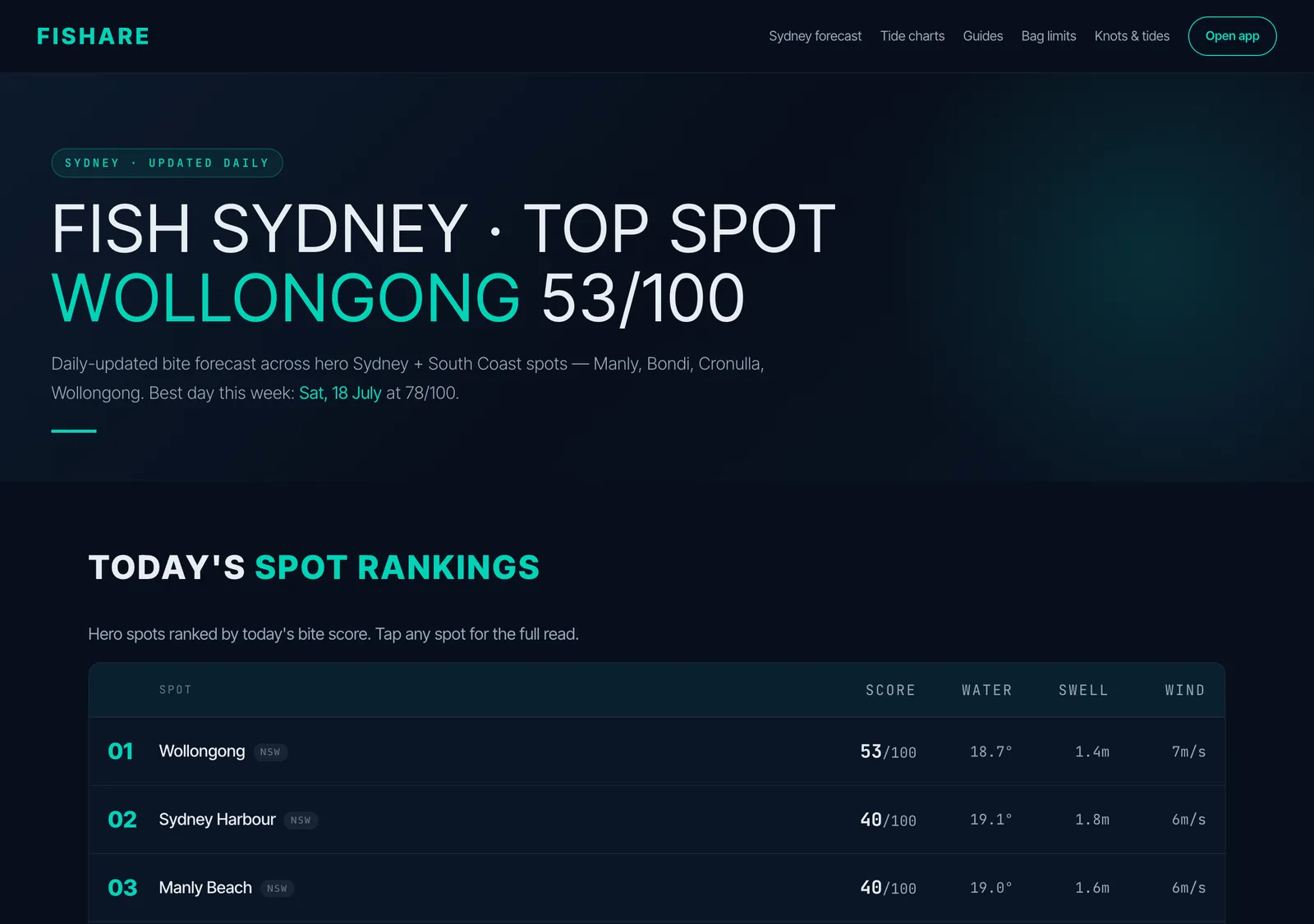
The Sydney forecast tracks water temperature per spot — the signal that flags the hairtail cold-snap switch-on.
THE LOCATIONS — PITTWATER + COWAN CREEK
Every productive Sydney hairtail anchorage is in two estuary systems: Pittwater on the northern beaches side, and Cowan Creek / Cottage Point inside Ku-ring-gai Chase National Park. Both are deep-water systems with steep-sided holes that hold cold water and baitfish through winter. All require a boat or a serious kayak — this is not a shore fishery, and the anchored vertical-jig technique cannot be replicated from land.
COTTAGE POINT DEEP HOLE · COWAN CREEK
COWAN CREEK · 25–35 M · CLASSIC HAIRTAIL ANCHORAGE
The most reliable hairtail anchorage in Sydney. The deep hole off the Cottage Point ramp drops to thirty-plus metres within a short run of the kiosk, and the bottom contour funnels baitfish into a tight band that the hairtail patrol after dark. Anchor on the edge of the deep, fish straight down with a glow-stick rig. The same handful of moorings get re-fished every winter — there is no secret hole at Cottage Point, only the same one, repeatedly, by everyone who fishes hairtail seriously.
Best monthsJun – Aug
Depth25–35 m
MethodAnchored, vertical paternoster with glow sticks, strip squid bait
Pittwater holds several productive holes along the western shore inside the bay. Off Mackerel Beach the bottom drops into the 25–40 m range; off The Basin, 20–35 m; off Coasters Retreat the same depth band. All three fish the same way — anchor on the edge of the hole where the bottom transitions from sloping to steep, drop straight down, hold still. The bite often runs in waves of fifteen to twenty minutes either side of the slack, then quiets while the fish move on.
Cowan Creek extends north from Cottage Point through a string of sheltered arms — America Bay, Refuge Bay, Smiths Creek — that all hold winter hairtail in the deeper sections. The pressure on these bays is lower than on Cottage Point because the run from the nearest ramp is longer, which makes them a useful option on the cult-fishery peak weekends when Cottage Point is anchored bumper-to-bumper. Pick the deepest hole on the contour and fish it the same way.
AccessApple Tree Bay ramp or Akuna Bay marina; longer run-in than Cottage Point
AKUNA BAY DEEPS
COWAN CREEK · 25–35 M · MARINA-ACCESS GROUND
The deep water out from the Akuna Bay marina holds hairtail in good winter years and offers the shortest run-in for boats trailered up the F3 corridor. The marina has overnight parking, fuel, and a kiosk that opens early enough to support a dusk-to-midnight session. Fish the same way as the Cottage Point hole — anchor on the contour break and run vertical paternoster rigs.
Best monthsJun – Aug
Depth25–35 m
MethodAnchored, vertical, glow-stick paternoster
AccessAkuna Bay marina ramp; parking onsite
THE RIG THAT DEFINES THE FISHERY
Every productive Sydney hairtail rig is some version of the same paternoster: a sinker at the bottom, two long-shank hooks on droppers above, glow sticks or LED beads on the leaders, and wire trace above each hook. The components are non-negotiable in different ways — the wire is the difference between landing fish and watching expensive fluorocarbon disappear into the dark.
Component
Notes
Sinker
1–4 oz pyramid or bomb at the bottom of the rig
Match to current; Cottage Point on a quiet night runs 1–2 oz, the Pittwater deeps on a running tide need 3–4 oz
Droppers
Two 30 cm droppers above the sinker, spaced ~50 cm apart
Long-shank hooks on the dropper give a wider gape and an easier hookout
Hooks
#6/0 long-shank, two per rig
Long shank keeps the hook point clear of the wire trace and gives a finger-friendly purchase for the hookout
Wire trace
30 lb single-strand or knottable wire above each hook
Non-negotiable. Hairtail teeth sever fluorocarbon in seconds; wire is the only material that survives the bite
Glow
Glow stick or LED bead on each dropper
Hairtail are visual predators in the dark — the glow draws them to the bait. Crack a fresh stick at the start of the session
Mainline
30–50 lb braid
The fish is only 2–3 kg but the rig loses sinkers and droppers to snags and bite-offs all night — braid lasts
Leader
30–40 lb mono or fluoro between braid and rig
A shock leader between the braid and the paternoster takes the abrasion at the rod tip on the lift
Tie the rig before you leave the ramp
Tying wire-trace paternoster rigs at anchor in the dark, on a cold deck, with numb fingers, is the recipe for a wasted session. Pre-tie six to eight complete rigs at home, store them on a foam rig board, and swap a fresh rig in whenever the bite-offs start to compromise the existing one. The thirty seconds it takes to clip in a new pre-tied rig is the difference between fishing and rigging while the bite is on.
BAIT — THE ONLY DEBATE
Hairtail bait choice is narrower than most species and the debate runs along the toughness axis as much as the flavour axis. The rig sits stationary at depth for thirty-plus minutes between fish; the bait that survives the leatherjackets and the small pickers without falling off catches more hairtail than the bait that lasts ten minutes and then fishes a bare hook for the next twenty.
1. Strip squid — the workhorse
A 4–5 cm rectangle cut off a fresh squid mantle, pinned through one end of the strip and left to flutter. Tough enough to take repeated pecks without falling off, scent-shedding enough to draw fish from a metre or two away, and cheap to replenish through a long session. Strip squid is the dominant bait on every Cottage Point boat for a reason — it fishes for thirty minutes without checking and lands more fish than fancier options.
2. Pilchard chunks
Whole pilchards cut into two or three pieces, hooked through the centre. Strong scent trail, soft texture, eaten by leatherjackets within fifteen minutes if there are any in the area. Best as a secondary bait on the upper hook of the paternoster while the lower hook runs strip squid. Refresh aggressively.
3. Whole pilchard or blue-bait pin-rigged
A small whole pilchard or blue-bait pinned through both eyes and once through the spine, set on the upper hook of the paternoster. The pin-rig presents a whole-fish silhouette to the larger class of hairtail — the metre-plus fish that pass on bait fragments. Lower hit rate; bigger average fish.
4. Live yakka or live garfish — for the trophy class
Catch fresh yakka or garfish on the way out of the ramp at dusk on a sabiki, hold them in an aerated bucket, and pin one through the shoulders on the upper hook of the rig. A live bait of the right size pulled past a winter hairtail draws strikes from the largest fish in the system. The cost is ninety minutes added to the session catching the live bait first — for most nights, strip squid catches enough fish that the live-bait detour is not worth the time. For a known trophy session it is the right call.
Refresh the bait every twenty minutes regardless of which option is in the water. Hairtail will swim past a softened, scent-depleted bait without committing — the bite rate on a fresh bait is two to three times higher than on a bait that has been down for an hour.
THE RETRIEVE, OR LACK THEREOF
The hairtail technique inverts every instinct trained by lure fishing. There is no retrieve. The rig goes down to the bottom; you wind up one or two turns of the reel to lift the sinker just clear of the substrate; and then you hold still. Hairtail track the glow-stick light and the scent trail. Movement spooks them — a moving bait on a hairtail rig is a hairtail bait that does not get hit.
The bite — peck, peck, load
The bite has a signature two-part shape. The first part is a series of short, sharp pecks — the hairtail mouthing the bait sideways, positioning it across the long axis of the jaw before swallowing. The second part is a heavy load on the rod tip — the bait fully in the mouth, the fish turning to swim off. Strike on the load, not the pecks. Striking on the pecks rips the bait out of the fish's mouth before the hook has anything to grip; striking on the load drives the hook into the corner of the jaw with the fish moving away.
The hook-set — lift, not snap
The strike is a steady upward lift, not a sharp snap-set. Hairtail have a thin body and a delicate jaw membrane; a hard snap-set tears the hook out of the soft tissue on the inside of the mouth. A slow firm lift of the rod tip — three to four seconds of steady pressure that loads the rod into a deep bend — sets the hook reliably and keeps it set through the slow lift to the surface.
The retrieve in one line
Drop to bottom. Wind two turns. Hold still and let the rig fish. On the pecks, do nothing. On the load, lift steady. Slow lift to the surface. Net waiting.
LANDING THEM WITHOUT LOSING A FINGER
The hairtail handling problem is straightforward and unforgiving: the mouth is full of needle teeth angled inward, the body whips like a length of cable when the fish is brought aboard, and anything resembling a normal lip-grip puts your skin directly inside tooth territory. Every Sydney hairtail angler with more than a few seasons under their belt has a scar story; the avoidable ones come down to two or three handling habits.
Three rules for the deck
Never lip-grip a hairtail. The teeth are angled inward and a thumb inside the jaw is a thumb that gets sliced when the fish twitches. Use a wet towel folded over the body just behind the head, or a Boga grip on the gill plate where the teeth cannot reach.
Cut the leader, not the fish. If the fish is going home for the table, cut the wire trace at the hook eye and pull the hook later with pliers when the fish is cold and still in the slurry. Saves bait time, saves skin, saves an in-the-dark hook-out with a live fish whipping on the deck.
Bleed immediately. A cut behind the gills the moment the fish is unhooked, dropped into a slurry bucket of seawater and ice. Hairtail flesh is fragile and warm-handled fish develop soft patches in the fillet within a couple of hours.
The handle-and-dispatch principle is the same as for any species kept for the table — clean dispatch, immediate bleed, straight onto ice. The flathead handle-and-dispatch guide covers the routine in detail; scale the same routine down for hairtail (smaller body, wire-trace handling, no thumb in the mouth).
FILLETING AND COOKING
Filleting a hairtail is unlike any other Sydney species because the body is round in cross-section rather than oval, and tapers to the filament tail rather than ending in a paddle. Approach it the same way as a snake — run the knife along the spine on one side, lift the fillet, flip and repeat on the other side. The fillets come off long and ribbon-shaped; portion them into 10 cm sections for cooking.
Skin on for grilling, off for braising
Korean galchi-gui is the textbook hairtail preparation — fillet sections salted and grilled with the skin on, served over rice. The skin crisps into the kind of texture that defines the dish. For braising in the Korean galchi-jorim style — fish stewed in soy, gochugaru, ginger and daikon — pull the skin off first; the slow cook softens skin that has not crisped, and the result is a textural distraction in the bowl. Both dishes are excellent, both are easy, and both are what hairtail are for.
The Y-bones
The hairtail has small Y-bones running down the centre of the fillet. They are visible against the white flesh on a good light. Two options: pull them with fish-bone pliers before cooking, which takes about ninety seconds per fillet; or eat around them at the table, which is the standard approach in the Korean preparations where the bones are part of the dish. Either works.
Do not freeze long
Hairtail flesh is oily and oxidises quickly in the freezer. Six weeks is the practical ceiling on freezer-stored hairtail; beyond that the freezer-burn destroys the flavour and the fillets are only good for braising at best. The right move is to fish on a Friday night and eat on Saturday or Sunday — fresh hairtail is one of the best fish in the Sydney winter, frozen hairtail is a chore.
THE SESSION STRUCTURE
A productive hairtail session is a long sit in cold dark water. The shape of it matters — anchor early, fish through the peak window, leave warm. Plan for five to six hours on the water and pack accordingly.
Anchor 30 minutes before dusk
The first useful hour is the late-dusk transition when the column starts to darken and the fish begin moving up off the bottom. Anchoring thirty minutes before dusk gives the boat time to settle, the rigs time to drop, the glow sticks time to crack, and the bait time to release scent into the column before the bite window opens. Anchoring after dark wastes the first hour of fishable water.
Bite window — 8pm to midnight
The textbook Sydney hairtail bite peaks between 8pm and midnight, with occasional sessions running productively until 2am. Cold, still nights extend the window; windy nights with wave action against the boat shorten it. The peak hour in most sessions is roughly two hours after dark, when the fish have committed to the deep holes for the night and the lateral-line hunting is in full effect.
Berley sparingly
A slow trickle of crushed pilchard and tuna oil through a small berley pot, just enough to lay a scent trail down-current of the boat. Heavy berley feeds the leatherjackets and the smaller pickers, which consume the rigs without contributing to the hairtail catch. The goal is a thin, persistent scent trail that pulls hairtail in without satiating them — the small berley pot, refreshed every hour, does this better than a big berley bomb.
Dress for genuine cold
Pittwater on a July night is colder than the daytime numbers suggest. Surface temperature in the low teens, wind chill on the open water, and five hours of sitting still in the dark. Winter parka, thermal base layer, beanie, gloves, neck buff. A thermos of coffee or tea. The angler who is warm fishes the full window; the angler who is cold leaves at 10pm and misses the peak.
FAQ
When are hairtail in season in Sydney?
Sydney hairtail are a winter-only fishery. The window runs from June through August, with July as the peak month. The fishery switches on with the first significant cold snap after mid-June, when estuary surface temperatures drop into the mid-teens and the cold-water upwelling pulls the fish into the deep estuary holes in Pittwater and Cowan Creek. By mid-September the bite is over for the year. Trying to catch a hairtail in Sydney outside the winter window is a misread of the calendar.
Where do you catch hairtail in Pittwater?
The productive Pittwater hairtail anchorages sit in the deep holes along the western shore of the bay — off Mackerel Beach in 25–40 m, off The Basin in 20–35 m, and off Coasters Retreat in the same depth band. All three are boat-only grounds; you anchor on the edge of the deep hole where the bottom contour transitions from sloping to steep, and fish straight down with a glow-stick paternoster rig. Bayview, Church Point and Palm Beach offer the closest ramp access.
What bait works best for hairtail?
Strip squid is the workhorse bait — a 4–5 cm rectangle cut off a fresh squid mantle, tough enough to take repeated pecks without falling off and effective enough to fish on the same hook for thirty minutes between refreshes. Pilchard chunks work but get pecked off fast by leatherjackets. Small whole pilchards or blue-bait pin-rigged on the upper hook produce the larger class of fish. Live yakka or live garfish target the trophy class but add ninety minutes to a winter session to catch the live bait first.
Do you need wire trace for hairtail?
Yes, and the answer is not debatable. Hairtail have a tight rack of inward-angled needle teeth that will sever fluorocarbon or monofilament leader in seconds. The standard rig runs 30 lb single-strand or knottable wire above each hook on the paternoster droppers. Without wire trace you lose the rig on every hook-up; with wire trace you land fish and recover hooks. This is the single non-negotiable component of the rig.
Are hairtail good to eat?
Excellent. The flesh is bright white, oily, sweet-textured and built for high-heat cooking. The benchmark preparations are Korean — galchi-gui (salt-grilled with the skin on, served over rice) and galchi-jorim (slow-braised with soy, gochugaru, ginger and daikon). Skin on for grilling, skin off for braising. Small Y-bones run down the centre of the fillet — pull them with bone pliers or eat around them. Avoid long freezer storage; the oil oxidises within about six weeks and the flesh loses its quality.
What is the minimum size for hairtail in NSW?
Hairtail are not currently listed with a species-specific minimum legal length in the NSW DPI saltwater recreational rules — the species falls under the general daily catch limit rather than a dedicated entry. Verify against the live NSW DPI saltwater fishing guide before keeping fish, as species-specific entries are revised over time. See the NSW regulations index for the current rule set. In practical terms the size question rarely matters — Sydney hairtail run from about 70 cm up to 1.2 m, well above any sensible kept-fish minimum.
Olli-Mikael Vaittinen has fished his whole life. Fifteen years of fly fishing, guiding seasons on Norway's Lakselva — his favourite Atlantic salmon river — and a blue marlin landed in Vava'u, Tonga. Founder of Fishare — the app that puts the data behind the decisions every angler makes on the water.
SAVE YOUR HAIRTAIL SPOTS. GET PINGED WHEN THE COLD SNAP HITS.
Fishare scores Pittwater and Cowan Creek by the day, tracking sea-surface temperature, moon phase and barometer through the winter changeover. Save your home anchorages and get notified when the water drops below the hairtail switch-on temperature — the night the fishery opens for the year. Free forever for everyone who joins now.