The problem with Australian fishing regulations
Ask an angler planning a Coral Sea trip from NSW what the QLD snapper bag limit is and watch them reach for their phone. Not because the information is obscure, but because it is scattered across eight different government websites with eight different formatting conventions, eight different update cycles, and — occasionally — eight different definitions of what counts as a "bag".
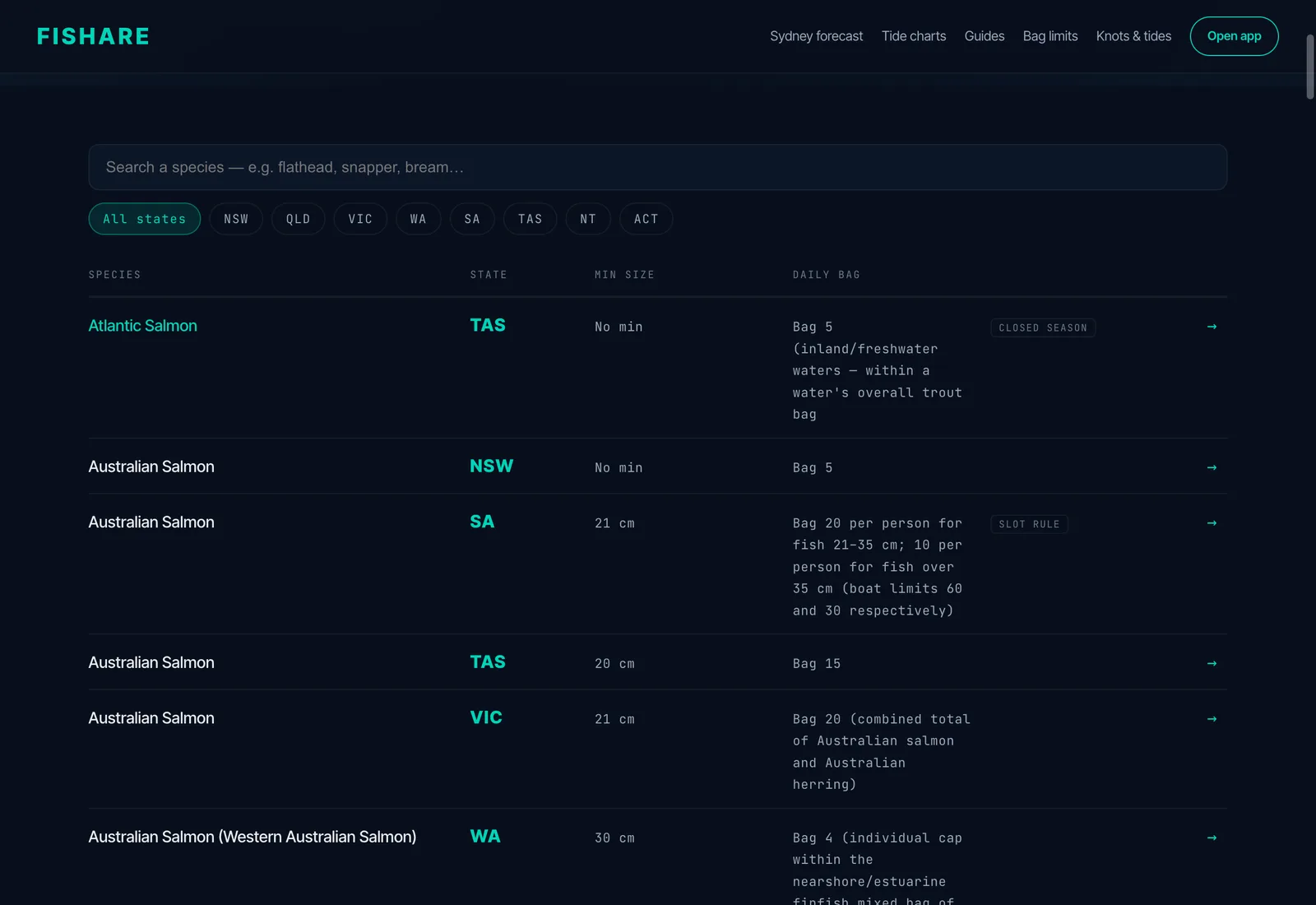
The Fishare Australian Fishing Rules Atlas consolidates all of it. Bag limits, minimum legal sizes, slot rules, and possession limits for 105 species across NSW, QLD, VIC, WA, SA, TAS, NT and ACT — in one searchable table, verified against each fisheries agency's published schedule.
The Atlas is live
The full searchable table is at fishare.app/regulations/australia/. Type a species name or state to filter. 105 species-by-state entries, updated June 2026.
Why regulations differ between states
Each Australian state manages its fishery independently under the national cooperative framework. Stock assessments, pressure levels, and recovery targets vary by coast — a species that is sustainably abundant in SA can be under pressure in NSW, so each agency sets its own rules. The result is genuine biological differentiation, not bureaucratic redundancy.
For travelling anglers the practical implication is that the bag limit in your home state is not the bag limit at your destination. The difference is not always in the obvious direction. A species with a 10-fish limit at home might carry a 5-fish limit interstate, or vice versa.
State-by-state at a glance
The eight jurisdictions, their governing agency, and whether a recreational fishing licence is required in saltwater:
No licence for tidal (saltwater) fishing. Licence required for stocked impoundments. QLD regulations →
Recreational fishing licence required (freshwater + saltwater). VIC regulations →
Licence required for inland waters. No licence for most marine fishing. TAS regulations →
Licence required for all freshwater fishing. Predominantly freshwater jurisdiction. ACT regulations →
Key species where regulations vary most by state
These are the species where interstate variation is significant enough to catch travellers out. Numbers below are from the full Atlas — always verify against the source agency before a trip.
| Species | NSW | QLD | VIC | WA |
|---|---|---|---|---|
| Snapper (Pagrus auratus) | 10 bag · 30 cm min | 30 bag · 30 cm min | 10 bag · 27 cm min | 8 bag · 41 cm min |
| Flathead (dusky) | 10 bag · 36 cm min | 20 bag · 30 cm min | 10 bag · 30 cm min | 10 bag · 40 cm min |
| Mulloway (Argyrosomus japonicus) | 2 bag · 70 cm min | 5 bag · 75 cm min | 1 bag · 70 cm min | 2 bag · 50 cm min |
| Tailor (bluefish) | 20 bag · 30 cm min | 20 bag · 30 cm min | 20 bag · 30 cm min | 16 bag · 30 cm min |
| Barramundi | No min size (estuary) · 5 bag | 58–120 cm slot · 5 bag | Not applicable | 55 cm min · 5 bag |
Source: Fishare Australian Fishing Rules Atlas, verified June 2026 against NSW DPIRD, QLD DAF, VFA, and WA Fisheries published schedules. Always verify current rules with the relevant state agency before fishing.
Minimum size limits — why the number matters
Minimum legal sizes are not arbitrary. They are set to the length at which a species first reaches sexual maturity — the biological threshold at which a fish has had at least one opportunity to reproduce before it can be legally taken. Catching fish below the minimum size removes individuals before they have contributed to the next generation, which compounds pressure on the stock.
Measuring correctly matters too. Most Australian agencies measure total length (TL) — tip of snout to end of tail, tail lobes compressed. A small number of species use fork length (FL) — tip of snout to the fork of the tail — typically tuna and some pelagics. The Atlas notes which measure applies to each species.
Bag limits vs possession limits
These are not the same thing. The bag limit is the maximum number of a species you may take in a single day's fishing. The possession limit is the maximum you may have in your possession at any time — in a car, at camp, in a freezer. Most states set possession limits at 1 to 2 times the daily bag limit, but this varies by species and jurisdiction.
The Atlas includes possession limits where they differ from the daily bag. The states where this catches anglers most often are VIC (where some species have a 24-hour combined-area rule) and QLD (where possession limits apply differently for charter vs. recreational).
How the Atlas is verified
Each entry in the Atlas was verified against the primary source — the relevant state or territory fisheries agency's published recreational fishing guide or gazette notice — and is tagged with the date of last verification. The Atlas uses a monthly staleness monitor to flag entries due for re-verification, and a CI-tracked freshness gate to prevent stale entries from being served without a warning.
Where agency publications are ambiguous (which happens with species that cross multiple fishery management categories), the Atlas uses the more restrictive interpretation and notes the ambiguity. Corrections and updates are submitted via the Fishare app.
Look up any species before you cast
The full Atlas covers 105 species across all 8 Australian states and territories — searchable by species name or state.
Open the Atlas